Table of contents (9 sections)
Why Pandas Became the World’s Favorite Animal Character
Key Fact: The giant panda has become one of the most commercially valuable animated characters in history — the star of a $1.8 billion DreamWorks film franchise, the face of the most successful Olympic mascot ever created, and a ubiquitous presence in advertising, video games, and social media. This transformation — from obscure mountain bear to global screen icon — reflects both the panda’s unique visual appeal and the deliberate efforts of filmmakers, designers, and marketers who recognized that a black-and-white bear could carry nearly any narrative.
Key Takeaways
-
Kung Fu Panda redefined the panda narrative — from passive and cute to capable, dynamic, and heroic, generating $1.8 billion across four films.
-
Bing Dwen Dwen became the most commercially successful Olympic mascot ever — $300 million in merchandise sales in a single month.
-
The panda’s visual design — high contrast, neotenous features, round contours — makes it uniquely adaptable to any medium, any style, any story across cultures.
Early Panda Characters (1960s–1990s)
Before Kung Fu Panda made Po a household name, the panda had already appeared in countless minor roles across global media — in advertising, children’s television, and of course as mascots for sporting events and brands.
The earliest panda character to achieve wide recognition was Pan Pan, the official mascot of the 1990 Asian Games in Beijing. Pan Pan was designed as a standing panda, arms raised in a welcoming gesture, wearing a medal around his neck. His expression was simple: a broad smile, round eyes, a friendly wave.
Pan Pan was not artistically ambitious — his design was functional, intended to be reproduced cheaply across thousands of products. But that functionality was itself a kind of genius. Pan Pan could appear on a 20-metre stadium banner or a 2-centimetre pin and remain instantly recognizable. The black patches read at any scale. The round body fit any surface. Pan Pan was nature’s perfect logo, and the 1990 Asian Games was the first time anyone used him that way.
Pan Pan’s influence on subsequent panda characters is difficult to overstate. He established the basic design vocabulary — standing posture, round belly, friendly expression — that nearly every later panda mascot would adapt.
After Pan Pan, panda mascots proliferated:
- Jing Jing (2008 Beijing Olympics) — one of the five Fuwa mascots, wearing a lotus crown
- Bing Dwen Dwen (2022 Beijing Winter Olympics) — the ice-shell panda
- Panda Mascots at every international panda zoo — each with its own branded character
- Corporate mascots — Chinese companies adopted pandas as brand symbols
Before Pan Pan, pandas appeared in children’s programming but rarely as lead characters. A notable early television appearance was in the Japanese anime Panda Kopanda (1972) by Studio Ghibli’s Isao Takahata and Hayao Miyazaki — a charming short film about a little girl who finds a baby panda. The film predates Kung Fu Panda by 36 years but already demonstrates the panda’s natural fit for animation.
The Kung Fu Panda Revolution
When Kung Fu Panda premiered on June 6, 2008, it did something no previous panda media had attempted: it made a panda an action hero.
The premise was deliberately absurd. Po is a panda who works in his father’s noodle shop, dreams of kung fu stardom, and is spectacularly unsuited for it. He is overweight. He is clumsy. He falls down stairs. When he is chosen as the Dragon Warrior, everyone — including Po — assumes it is a mistake.
The opening sequence is a dream. Po imagines himself as a kung fu master, fighting five legendary warriors atop a mountain of mist. The animation is fluid, dramatic, fully convincing. Then he wakes up — sprawled on his bed, a noodle stuck to his forehead. The comedy is not just in the contrast. It is in the recognition: we have all been Po. We have all dreamed of greatness while lying in bed, covered in noodle juice.
The film’s success — $631.7 million worldwide against a $130 million budget — astonished the industry. It spawned three sequels (2011, 2016, 2024), multiple television series, video games, and a theme park attraction. The franchise has grossed over $1.8 billion globally.
Why Po Worked: A Cultural Analysis
Po’s success as a character reveals something fundamental about how panda characters function in narrative.
1. The underdog narrative. Po’s combination of incompetence and determination makes him the ultimate underdog. Audiences root for him because his failures are relatable. The panda’s natural roundness and slowness become assets in this narrative: Po looks like a loser. That makes his victory more satisfying.
2. Physical comedy. The panda body — round, soft, black-and-white — is inherently funny in motion. Animators at DreamWorks created a physics system specifically for Po’s belly — it jiggles, bounces, and wobbles with independent momentum. No other animal character offers such built-in comedic physics.
3. Cross-cultural bridge. The films are saturated in Chinese visual culture — the architecture of the Jade Palace draws from the Forbidden City and Wudang Mountains; the calligraphy in the end credits is authentic; the martial arts styles reference actual kung fu schools. But the emotional story — a misfit finding his place — is universal. The panda, being uniquely Chinese yet universally appealing, becomes the perfect vessel for this cultural exchange.
4. Voice and personality. Jack Black’s vocal performance — exuberant, heartfelt, effortlessly funny — gave Po a personality that transcended the animation. Black’s own public persona (the funny fat guy with unexpected emotional depth) mapped perfectly onto Po’s character arc.
China’s Response to Kung Fu Panda
The reception of Kung Fu Panda in China was a case study in cultural politics and economic nationalism.
On one hand, the film was embraced. It became the first animated film to gross over 100 million yuan in China. Chinese audiences praised the visual authenticity and the respectful treatment of Chinese culture. The Ministry of Culture released a statement noting that the film “demonstrates the global appeal of Chinese cultural elements.”
On the other hand, there was unease. A Hollywood studio had made a film about a Chinese icon — and done it better than any Chinese studio had managed. The panda, China’s national animal, had been given a voice by an American comedian and a story by American writers.
The response was a wave of Chinese-produced panda animation:
- The Adventures of Panda Warrior (2012) — poorly received, widely ignored
- GG Bond series — a panda superhero franchise that found moderate success with Chinese children
- Panda Story (2015) — documentary-style animation
- Panda Plan (2024) — Jackie Chan vehicle featuring a real panda
None of these achieved the global reach of Kung Fu Panda. The gap between Hollywood’s panda and China’s panda told a larger story about the asymmetry of global cultural production.
Bing Dwen Dwen: The Mascot That Ate the Olympics
Six years after the third Kung Fu Panda film, a new panda character captured the global imagination under very different circumstances.
Bing Dwen Dwen was the official mascot of the 2022 Beijing Winter Olympics. Selected from 5,800 design submissions from 35 countries, the winning design by Cao Xue featured a panda inside a transparent ice shell resembling an astronaut’s helmet. The shell was decorated with a halo of ice crystals. On the panda’s palm was a heart shape, symbolizing welcome.
The design was polarizing when first revealed. ‘A panda in a spacesuit?’ critics asked. Pandas are warm mountain animals — an ice shell seemed conceptually wrong. But the design’s defenders argued that the ice shell was exactly the point: it carried the winter theme while preserving the panda’s universal appeal. The panda inside the shell was not a contradiction. It was a resolution: warm heart, cool exterior, ready for winter adventure.
When the Olympics began in February 2022, Bing Dwen Dwen exploded in popularity. The phenomenon was driven by:
-
Social media virality. Videos of Bing Dwen Dwen falling over, dancing with athletes, and tumbling across ice rinks spread across Douyin (Chinese TikTok) and Weibo. The mascot’s slightly clumsy movements — genuine performer slips, not choreographed — made it feel alive and lovable.
-
Scarcity. Lunar New Year had closed most Chinese factories. Only 5,000 units per day were produced initially. Demand vastly exceeded supply. People queued for hours.
-
The pandemic context. The 2022 Winter Olympics were held under strict COVID-19 protocols. Spectators were limited, international visitors scarce. Bing Dwen Dwen became a tangible symbol of joy in an otherwise restricted celebration.
By the end of February 2022, Bing Dwen Dwen merchandise sales had reached an estimated $300 million — making it the most commercially successful Olympic mascot in history. The record was previously held by Sochi 2014’s trio of mascots at approximately $80 million.
Why Pandas Work as Characters: The Visual Psychology
The panda’s dominance as a character — across animation, mascot design, and brand identity — is not accidental. It is rooted in specific visual and psychological factors that make pandas uniquely suited for character design.
The Five Factors
| Factor | Explanation | Character Design Impact |
|---|---|---|
| High-contrast coloration | Black patches on white fur | Reads clearly at any scale, on any screen, in any lighting |
| Baby schema (neoteny) | Large eyes, round face, small nose-to-face ratio | Triggers caregiving instincts across cultures |
| Round body contours | No sharp angles, soft silhouettes | Perceived as harmless, approachable, friendly |
| Non-threatening expression | No visible teeth, no predatory gaze | Zero intimidation — audiences relax immediately |
| Cultural neutrality | No aggressive symbolism (unlike eagle, lion, dragon) | Works in any cultural context without negative baggage |
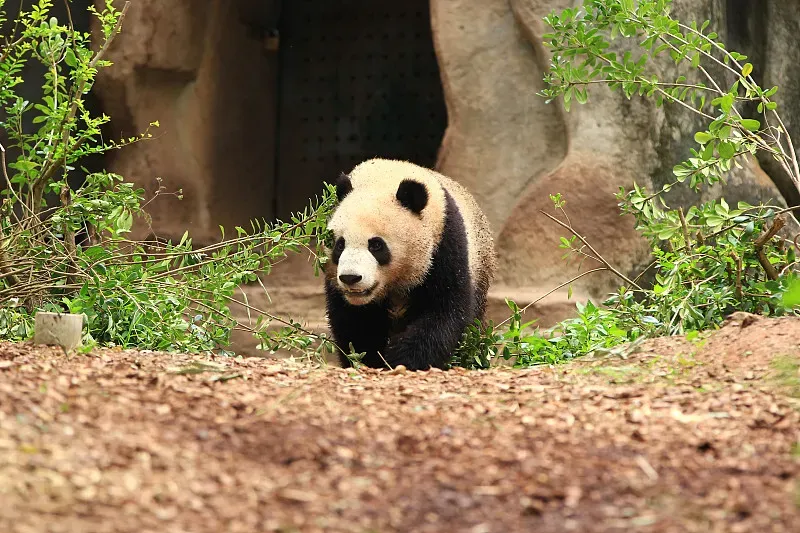
The animator’s rule of thumb: if a character does not read in silhouette, it does not work. The panda, alone among animals, reads in silhouette at three pixels. Two black ears, two black eye patches — the essential information is captured in half a dozen pixels. This is why panda emoji, panda logos, panda mascots work perfectly at any scale, from stadium banners to smartwatch faces.
Comparison with Other Iconic Animal Characters
| Animal | Visual Clarity | Cross-Cultural Appeal | Emotional Range | Character Adaptability |
|---|---|---|---|---|
| Panda | ★★★★★ | ★★★★★ | ★★★★ | ★★★★★ |
| Cat | ★★★ | ★★★★★ | ★★★★★ | ★★★★ |
| Dog | ★★★ | ★★★★★ | ★★★★★ | ★★★★ |
| Tiger | ★★★★ | ★★★ | ★★★ | ★★★ |
| Lion | ★★★★ | ★★★ | ★★★ | ★★★ |
| Elephant | ★★★ | ★★★★ | ★★★ | ★★★ |
The panda leads in visual clarity and cross-cultural adaptability — the two factors that matter most for character-driven media that must travel across borders and platforms.
The Future of Panda IP
The panda’s character potential is far from exhausted. Several emerging trends point to the next generation of panda-based media and branding.
AI-generated panda characters. As generative AI becomes capable of producing consistent animated characters, the panda’s simple design makes it an ideal subject for AI-driven animation. Personalized panda characters — customized by users and rendered in real time — could become the next wave of digital companion.
Virtual panda idols. Chinese tech companies are developing virtual panda influencers for social media — digital pandas that live on platforms like Douyin, Bilibili, and Weibo, posting content, interacting with fans, and generating revenue through merchandise and brand partnerships. The first generation of these virtual panda idols launched in 2023–2024.
Gaming. Despite the success of Kung Fu Panda video game adaptations, pandas remain underrepresented in the gaming industry. A major open-world panda game — a conservation-themed adventure set in the mountains of Sichuan — has been discussed but never produced.
Metaverse and digital twins. The concept of a “Pandaverse” — a virtual space where users interact with digital pandas, explore habitats, and participate in conservation — has been proposed by Chinese technology firms. These digital twins of real pandas (modeled on actual individuals like Hua Hua and Meng Lan) could create new revenue streams for conservation funding.
Frequently Asked Questions
Is there a panda film before Kung Fu Panda?
Panda Kopanda (1972), directed by Isao Takahata with character design by Hayao Miyazaki, is the most significant pre-Kung Fu Panda panda film. It tells the story of a little girl who befriends a baby panda and its giant father. The film is charming, visually beautiful, and available in the West as a DVD extra on the My Neighbor Totoro release.
Why are panda mascots so common at international events?
Panda mascots are common because they are low-risk: they offend no cultural or religious sensibilities, they are universally recognized as Chinese, and they appeal across age and gender demographics. For Chinese mega-events, a panda mascot is the diplomatic safest choice.
How did Kung Fu Panda influence Chinese animation?
Kung Fu Panda demonstrated to Chinese studios that there was a global market for Chinese-themed animated content — but also that Hollywood was better equipped to serve it. The film prompted investment in Chinese animation infrastructure, but as of 2026, no Chinese-produced animated film has achieved comparable global reach with a panda protagonist.
What is the most viewed panda video online?
The most viewed panda video on the internet is the “Baby Panda Bites Keeper’s Leg” clip from the Chengdu Research Base, which has accumulated over 200 million views across platforms. The video’s success — a baby panda playfully biting a keeper’s bright green pants — demonstrates the panda’s unmatched capacity for non-verbal comedy.
Could a panda character work as a villain?
Unlikely. The panda’s visual characteristics — round, soft, neotenous — are fundamentally incompatible with villainy. Audiences instinctively trust pandas. A villainous panda would face an uphill battle against the animal’s built-in sympathy advantage.
Your Turn
The panda on screen has traveled a remarkable arc in 50 years — from Pan Pan’s simple wave to Po’s Dragon Warrior destiny to Bing Dwen Dwen’s Olympic glory. Each iteration revealed something new about what pandas could mean to us: a friend, a hero, a national pride, a global joy.
The next panda character has not been designed yet. It might be an AI companion. A gaming protagonist. A virtual idol in the metaverse. Whatever form it takes, it will build on the template established by the pandas that came before: black and white, round and soft, carrying our stories on its shoulders.

Dr. Mei Zhang
Spatial Ecology & Conservation Editor
Spatial ecologist using GIS, remote sensing, and satellite imagery to study panda population dynamics, habitat connectivity, and conservation effectiveness at landscape scales.
View full profile →Tags in this article
Questions readers often ask
How did Kung Fu Panda change perceptions of pandas?
Before Kung Fu Panda (2008), pandas were primarily associated with gentleness, passivity, and cuteness. The film introduced a new narrative: Po, despite his clumsiness, becomes a kung fu master through perseverance and self-belief. This redefined the panda as capable, dynamic, and heroic — not just cute but competent. The film franchise has grossed over $1.8 billion globally and reshaped how millions of people imagine pandas.
Why was Bing Dwen Dwen so commercially successful?
Bing Dwen Dwen, the 2022 Beijing Winter Olympics mascot, succeeded through a combination of thoughtful design (a panda encased in a transparent ice shell resembling a spacesuit), intense demand amplified by social media, and limited supply that created scarcity. The mascot generated an estimated $300 million in merchandise sales — potentially the most commercially successful Olympic mascot in history.
Why do pandas work so well as animated characters?
Pandas possess a rare combination of visual traits that make them ideal for animation: high-contrast black-and-white coloration that reads clearly at any scale, round and soft body shapes, neotenous facial features that trigger human caregiving instincts (baby schema), and a naturally non-threatening expression. In character design terms, the panda is nature's perfect cartoon.
Was Kung Fu Panda successful in China?
Yes — unusually for a Hollywood film set in China, Kung Fu Panda was embraced domestically. It became the first animated film to gross over 100 million yuan in China. The success was attributed to the creative team's investment in Chinese cultural authenticity: they studied Chinese architecture, calligraphy, martial arts, and landscape painting. The film was seen as respectful, not exploitative.
What was Pan Pan?
Pan Pan was the official mascot of the 1990 Asian Games in Beijing — a standing panda with arms raised in welcome, wearing a medal. Pan Pan was the first panda mascot to achieve mass-market commercial penetration across China, appearing on T-shirts, keychains, mugs, and pins. He established the template for Chinese mega-event mascots and created the first generation of panda collectibles.
What is the future of panda IP?
The future of panda IP includes: AI-generated panda characters for personalized digital interaction, virtual panda idols (like the emerging 'Pandaverse' concept in Chinese tech), expanded video game presence, and metaverse-based panda experiences. The panda's visual simplicity makes it ideal for low-resolution rendering and stylized adaptation across digital platforms.