Table of contents (9 sections)
Pan Pan’s Dynasty: The Hero Father Behind 25% of All Captive Pandas
Key Fact: When Pan Pan died at age 31 in December 2016, he left behind a genetic legacy unmatched by any individual of any endangered species in captivity: over 130 living descendants, representing approximately 25% of the entire global captive giant panda population. His progeny included generations of breeding females and males who, in turn, produced the cubs that transformed panda conservation from a struggle into a success. But Pan Pan’s extraordinary fertility also created the captive breeding program’s most complex challenge: how to manage a population where one male’s genes are everywhere, threatening the very genetic diversity his offspring were meant to preserve.
Key Takeaways
-
Pan Pan was the most reproductively successful panda in history — 32 direct offspring, 130+ descendants, and a genetic legacy that touches one-quarter of all captive pandas.
-
He was also the 1990 Asian Games mascot — the real Pan Pan behind the cartoon panda that first established the panda-as-brand template explored in our article on panda Olympic mascots.
-
His genetic dominance is both a triumph and a trap — he saved the breeding program from early failure, but his genes now threaten to create the inbreeding problem his offspring were meant to solve.
The cub was found in the spring of 1985, alone in the forest of Baoxing County, Sichuan — the same mountain region where Armand David had collected the first Western panda specimen more than a century earlier. The cub was emaciated, barely alive, too young to survive without its mother. Rangers from the Fengtongzhai Nature Reserve carried it to safety.
They named him Pan Pan — “hope.”
At the time, the captive panda breeding program was in crisis. Through the 1970s and early 1980s, captive pandas bred rarely, conceived infrequently, and produced cubs that seldom survived. The entire global captive population hovered around 100 individuals, maintained more by periodic wild captures than by successful captive reproduction. If pandas were to survive as a captive population, someone needed to breed — successfully, repeatedly, with multiple females, producing cubs that lived.
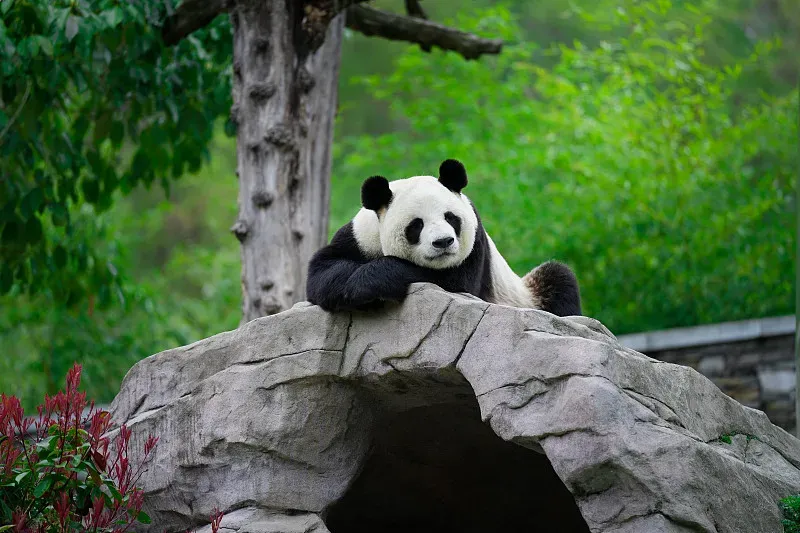
Pan Pan became that someone. He was not the largest panda, nor the most aggressive, nor the most dominant. But he possessed a quality rarer than size or aggression: consistent fertility. Over his 20-year breeding career, Pan Pan sired 32 surviving cubs with multiple females. His offspring, in turn, bred successfully. His grandchildren bred successfully. By the time of his death, his living descendants numbered over 130 — a quarter of the captive population.
The Family Tree That Ate the Studbook
Pan Pan’s descendants read like a who’s-who of modern panda conservation:
Hua Mei (studbook #488, born 1999): Pan Pan’s daughter, born at the San Diego Zoo — the first surviving giant panda cub born in the United States. Her birth in 1999 was front-page news worldwide and marked the first major success of American panda breeding. She returned to China in 2004 and became a prolific breeder herself.
Mei Xiang (studbook #473): Pan Pan’s granddaughter through his daughter Xue Xue, born in 1998 at the Wolong Center. She was paired with Tian Tian and sent to the Smithsonian National Zoo in 2000, where she produced five surviving cubs — including Tai Shan, Bao Bao, Bei Bei, and Xiao Qi Ji — over 20 years, becoming one of the most celebrated panda mothers in history.
The Everland lineage: Through multiple generations, Pan Pan’s genes flow into the Korean panda program — Fu Bao’s father, Le Bao, carries Pan Pan’s DNA through his ancestry. The “K-Panda” phenomenon described in our article on K-Panda Fever at Everland is, genetically speaking, a Pan Pan phenomenon.
The Chengdu Research Base population: A significant proportion of the pandas at Chengdu — the world’s largest captive panda population — trace their lineage to Pan Pan through at least one parent. Walk through the enclosures at Chengdu and you are, statistically, walking through Pan Pan’s extended family.
The Genetic Paradox
Pan Pan’s fertility solved the breeding program’s most urgent problem — but created a subtler, longer-term one.
In population genetics, the ideal captive population is one where every individual has a different genetic background, maximizing the diversity available for future generations. Pan Pan, by contributing so overwhelmingly to the population, has made genetic diversity harder to maintain. When two randomly selected captive pandas both carry Pan Pan’s genes, breeding them together concentrates Pan Pan’s DNA rather than diversifying it.
The International Studbook system has spent the years since Pan Pan’s death working to dilute his genetic dominance. The strategy has been to identify pandas with minimal or no Pan Pan ancestry — individuals from the few captive bloodlines that Pan Pan never bred with — and prioritize them for breeding. These “non-Pan Pan” pandas, rare as they are, carry genetic variants that Pan Pan’s descendants lack. Breeding them with Pan Pan-line pandas introduces genetic novelty while preserving the valuable traits Pan Pan’s line carries.
The strategy is working, but slowly. Pan Pan’s mean kinship — his genetic “commonness” — has been declining. In another two to three panda generations (15-20 years), his dominance may be diluted to a level that no longer constrains breeding recommendations. Until then, every breeding recommendation must navigate the Pan Pan problem.
Did You Know? The real Pan Pan was the inspiration for, and namesake of, the 1990 Beijing Asian Games mascot — the first panda mascot in Chinese sporting history. But the mascot bore no resemblance to the actual animal. Pan Pan was a large, somewhat solemn male, not the grinning cartoon panda that decorated posters and merchandise. He lived at the Chengdu Research Base during the games, unaware that a cartoon version of himself was, at that moment, becoming the most recognized panda image in China.
Pan Pan’s Descendant Expansion
| Generation | Number | Examples | Role in Captive Population |
|---|---|---|---|
| Direct offspring | 32 | Hua Mei (sb488), Xue Xue, all born 1988-2005 | Founders of major bloodlines; established the captive breeding program |
| Grandchildren | ~60 | Mei Xiang (sb473), Tian Tian (sb483), many Chengdu breeding stock | Core reproductive population of the 2000s-2010s |
| Great-grandchildren | ~40 | Tai Shan (sb649), Bao Bao (sb913), Bei Bei (sb1036) | International loan pandas; diplomatic ambassadors |
| Fourth generation | ~20 | Fu Bao (sb1075), Rui Bao, Hui Bao, Xiao Qi Ji | Current breeding generation; increasingly diverse genetics |
| Total living descendants | ~130+ | Spread across China, Korea, Japan, Europe | ~25% of global captive population |
The concentration of Pan Pan’s genes is slowly being diluted through deliberate studbook management. Non-Pan Pan bloodlines — pandas descended from other wild founders — are being prioritized for breeding to reduce his genetic dominance. In another 2-3 panda generations (15-20 years), his mean kinship is expected to decline to a level that no longer constrains breeding recommendations.
The Death of a Patriarch
Pan Pan died on December 28, 2016, at age 31 — the oldest male panda ever recorded at the time. The cause was cancer, detected late and untreatable at his advanced age. His body was preserved for scientific study — the tissues and organs of a genetically extraordinary animal, contributing to research even in death.
The public mourning was genuine and widespread. Chinese media ran obituaries that read like remembrances of a statesman. Fans who had never seen Pan Pan in person — he was not a public-facing celebrity like Hua Hua or Fu Bao — learned his story through the coverage: the orphaned cub who became the father of a species.
His genetic legacy, immortalized in the studbook, continues to shape panda conservation. Every time a captive panda cub is born, the studbook manager traces its lineage — and more often than not, the trail leads back to #001, to Pan Pan, to the cub in the Baoxing forest who became a dynasty.
Did You Know?
Pan Pan was originally thought to be a female. His wild rescuer, a local farmer in Baoxing County, described him as “a small panda with no obvious male characteristics.” It took weeks at Chengdu Breeding Center before keepers confirmed he was male — a distinction that would prove consequential for the entire species.
Pan Pan’s wild-caught status gives him a mean kinship advantage. Wild founders like Pan Pan carry genetic diversity that captive-born pandas cannot replicate. His descendants are deliberately paired with pandas from other wild founders (Si Xue, Tang Tang, Lin Nan) to maximize heterozygosity and minimize inbreeding in the captive population.
Entity Hub
| Entity | Role | Significance |
|---|---|---|
| Pan Pan (sb001) | Individual | Most genetically prolific panda in history; 130+ descendants; 25% of captive population |
| Hua Mei (sb488) | Individual | Pan Pan’s daughter; first surviving US-born cub; founded the San Diego breeding line |
| Mei Xiang (sb473) | Individual | Pan Pan’s granddaughter; 4 cubs at Smithsonian; returned to China 2023 |
| Chengdu Research Base | Facility | Pan Pan’s home; where most of his descendants live |
| Studbook #001 | Concept | Pan Pan’s studbook designation; the patriarch of the modern captive population |
| Mean kinship | Concept | Genetic management metric used to track and manage Pan Pan’s dominance |
Frequently Asked Questions
How does Pan Pan compare to other prolific animal sires?
Pan Pan’s genetic impact — 25% of the captive population — is comparable to the most genetically dominant individuals in other managed endangered species populations. In the California condor recovery program, a single male (AC-9) accounts for a similar proportion of the population. However, Pan Pan achieved his numbers through natural fertility, not through the intensive artificial reproductive techniques used in some avian breeding programs.
Were Pan Pan’s cubs born through natural mating or artificial insemination?
Both. Pan Pan successfully mated naturally with several females, demonstrating the species’ capacity for natural reproduction that had been questioned in the early captive breeding era. He also contributed to artificial insemination programs, where his semen was collected and used to inseminate females at distant facilities. His reproductive versatility was part of his extraordinary breeding value.
Are there any pandas today with NO Pan Pan ancestry?
Yes, but they are increasingly rare and are the highest-priority breeding individuals in the studbook. These pandas represent alternative bloodlines — descendants of other founding sires who bred less prolifically than Pan Pan — and their genes are critically important for maintaining the long-term diversity of the captive population.
At the Chengdu Research Base, a young cub born this year opens its eyes for the first time. The studbook manager records the birth, assigns a number, traces the lineage. Mother: a Pan Pan granddaughter. Father: a non-Pan Pan bloodline, deliberately chosen to diversify. The cub is a living compromise between the genetic legacy that saved the population and the genetic diversity that will sustain it. Pan Pan’s dynasty continues — but it is slowly, deliberately, being shared.
Call to Action
Explore the studbook system that manages Pan Pan’s genetic legacy, learn about genetic management strategy for the captive population, or trace the family tree of Hua Mei, Pan Pan’s most famous daughter.
Dr. Lin Chen
Conservation Genomics Editor
Conservation geneticist specializing in giant panda genomics, molecular ecology, and evolutionary biology. Validates all genetics and genome-related content on Panda Common.
View full profile →Tags in this article
Questions readers often ask
Who was Pan Pan and why was he important?
Pan Pan (盼盼, studbook #001) was a male giant panda rescued from the wild in Baoxing County, Sichuan, in the early 1980s. He became the most reproductively successful panda in history, siring over 130 descendants who now account for approximately 25% of the global captive panda population. His offspring include generations of breeding pandas at facilities worldwide, making him the genetic patriarch of the modern captive panda population.
How many cubs did Pan Pan father?
Pan Pan fathered a confirmed 32 surviving cubs directly, who went on to produce over 100 additional descendants across multiple generations. His most famous descendants include Mei Xiang (granddaughter, Smithsonian National Zoo), Hua Mei (daughter, first surviving panda cub born in the United States), and through multiple lineages, many of the breeding pandas currently at the Chengdu Research Base and other facilities.
Is Pan Pan's genetic dominance a problem?
Yes — it is simultaneously the captive breeding program's greatest success and its most significant genetic management challenge. Pan Pan's extraordinary fertility rescued the program from its early struggles, but his genes are now so widespread that breeding two unrelated pandas is difficult without one or both carrying Pan Pan's DNA. The studbook management system actively works to dilute his genetic dominance by prioritizing pairings with pandas from non-Pan Pan bloodlines.