Table of contents (5 sections)
Rewilding Pandas: From Captivity Back to the Deep Forest
Key Fact: Since 2006, China’s panda rewilding program has been attempting something unprecedented: taking pandas born in captivity — animals that have never hunted, never foraged, never encountered a predator or a rival — and teaching them to survive in the wild. The program’s early years were marked by tragedy: the first released panda, Xiang Xiang, was found dead within a year, killed by wild pandas in a territorial dispute he was not prepared for. But the program learned from its failures. Tao Tao, released in 2012, survived, thrived, and reproduced. The rewilding program has since achieved approximately a 50% post-release survival rate — low by some standards, but remarkable for a species as behaviorally complex as the giant panda. Each successful release repays the failures, one wild panda at a time.
Key Takeaways
-
The rewilding program transforms captive pandas into wild animals through a multi-year training process that begins at birth, with mothers — not humans — as the primary teachers.
-
The panda suit protocol is the defining image of rewilding — keepers in black-and-white costumes, smeared with panda scent, ensuring that cubs learn survival skills without learning to trust humans.
-
Rewilding targets small, isolated wild populations — releasing genetically diverse captive-born pandas into wild groups threatened by inbreeding, directly addressing the fragmentation crisis explored in our article on wildlife corridors.
Deep in the forests of the Liziping Nature Reserve in Sichuan, a female panda named Tao Tao — studbook #823, born in captivity, raised by her mother in a semi-wild enclosure, released at age two — forages for bamboo. She does not know that keepers once wore panda suits to feed her. She does not know that her mother, Cao Cao, was deliberately chosen for her wild-born instincts. She does not know that she is part of an experiment — that her survival, her reproduction, her very wildness is being monitored by GPS collar and infrared camera and fecal DNA analysis.
She simply eats bamboo, in a forest her ancestors knew, as a wild panda. And that, for the rewilding program, is the definition of success.
The Early Tragedies: Xiang Xiang and the Lessons of Failure
The first panda selected for rewilding was a male named Xiang Xiang, born in 2001 at the Wolong Center. He was raised by human keepers, fed by human hands, habituated to human presence from birth. The rewilding team trained him — teaching him to forage, introducing him to a semi-wild enclosure — and in April 2006, released him into the wild.
Xiang Xiang was found dead in February 2007, less than a year after release. The cause of death was traumatic injury consistent with a fight with wild pandas — likely a territorial dispute that Xiang Xiang, raised without exposure to panda social aggression, was not prepared to handle. He had been attacked, and he had lost.
The death of Xiang Xiang was devastating to the rewilding team — but it was also clarifying. The key insight was this: a panda raised by humans learns to trust humans, but does not learn to be a panda. It does not learn the social signals, the threat displays, the dominance hierarchies that wild pandas navigate from birth. When released, it is not a wild animal returning home — it is a naive animal entering an alien society, unprepared for the violence that society can inflict.
The lesson transformed the rewilding program. Future candidates would not be raised by humans. They would be raised by their mothers — in semi-wild enclosures where human contact was minimized, where the mother taught the cub to forage, to climb, to avoid danger. The keepers would still provide food and medical care — but they would do so wearing panda suits, their human forms obscured, their human scent masked.
The Mother-Led Method: Cao Cao and the New Protocol
The panda who proved the mother-led method was Cao Cao, a wild-born female who had been brought into captivity after being injured — one of many famous wild panda rescues that supplied the captive population with critical genetic diversity. Cao Cao possessed something that captive-born pandas lacked: a complete behavioral repertoire — the instincts and skills of a wild panda, acquired during her own cubhood in the forest.
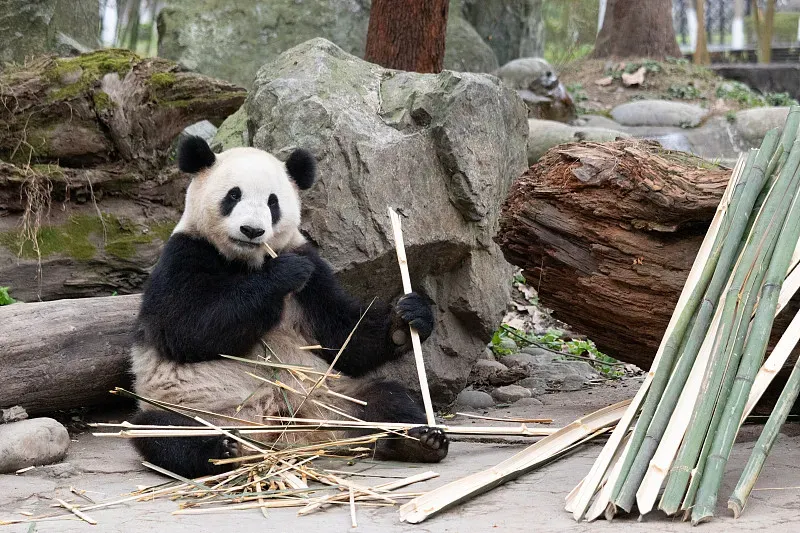
In 2010, Cao Cao gave birth to Tao Tao in a specially designed semi-wild enclosure — a large, forested area within the Wolong Reserve, fenced but otherwise natural. Human contact was restricted to keepers in panda suits delivering supplementary food. Cao Cao raised Tao Tao as she would have raised a cub in the wild: teaching him to climb, to forage, to recognize danger, to navigate the complex bamboo forest terrain.
At age two — the age at which wild panda cubs naturally separate from their mothers — Tao Tao was released. The GPS collar attached to him transmitted data for over a year. He moved. He foraged. He established a territory. He survived.
In 2017, five years after his release, fecal DNA analysis confirmed that Tao Tao had fathered a cub in the wild. He was not merely surviving — he was contributing to the wild gene pool, the ultimate measure of rewilding success. The mother-led method had worked.
Did You Know? The panda suits worn by keepers are not merely costumes — they are a carefully designed form of sensory deception. The suits are black and white to mimic panda coloration. They are smeared with panda urine and feces to mask human scent. Keepers in suits do not speak — the sound of a human voice would break the illusion. The goal is to become, as far as the cub is concerned, simply part of the forest — a large, quiet, bipedal presence that brings food and then disappears.
The Calculus of Release: Who Goes, Who Stays
Not every captive-born panda is a candidate for rewilding. The selection criteria are rigorous:
Genetic suitability. Released pandas must carry genetic variants that the target wild population lacks, directly addressing the inbreeding risk in small, isolated wild groups. The fecal DNA monitoring described in our article on panda scat DNA analysis identifies which wild populations are most in need of genetic supplementation.
Maternal competence. The cub’s mother must be behaviorally competent — ideally wild-born, or at minimum raised with minimal human contact. A mother-raised cub learns survival skills that a human-raised cub never acquires.
Health and age. Released pandas must be physically robust, free of disease, and released at approximately 2-3 years old — the natural age of maternal separation in the wild. Older pandas, habituated to captive life, are poor candidates.
Habitat suitability. The release site must have adequate bamboo, low human population density, and — critically — must be a population small enough to benefit from genetic supplementation but large enough to absorb the new arrival without social disruption.
The selection process means that of the approximately 700 captive pandas, only a small fraction — perhaps 5-10% — are suitable rewilding candidates. The rest will live out their lives in captivity, contributing to the captive population but never the wild one.
Frequently Asked Questions
Why not just release all captive pandas?
Most captive pandas would die quickly if released. They lack the foraging skills, the social competence, and the fear of humans necessary for wild survival. A panda that has spent 20 years being fed by keepers cannot suddenly learn to find its own food. Rewilding is not a dumping ground for surplus captive pandas — it is a carefully targeted program for specific individuals prepared from birth.
What percentage of released pandas survive?
The post-release survival rate has improved from 0% (Xiang Xiang) to approximately 50% in recent years, with some cohorts achieving higher rates. This is comparable to rewilding programs for other large mammals — black-footed ferrets, Arabian oryx, California condors — where 40-60% survival is considered successful. The goal is continuous improvement as training methods and release site selection are refined.
Is rewilding actually increasing wild panda numbers?
The impact is modest but significant. A single genetically diverse released panda that survives and reproduces can introduce novel gene variants into a small wild population, reducing inbreeding risk for an entire generation of cubs. For populations like the Daxiangling group (fewer than 30 pandas), a single successful release could be the difference between genetic viability and inbreeding collapse.
In the forest of Liziping, Tao Tao’s cub — born wild, raised wild, unaware that its father was born in captivity — eats bamboo. The GPS data from Tao Tao’s collar stopped transmitting years ago, but his DNA continues to appear in fecal samples collected from the forest floor. He is still there. He is still wild. The rewilding program, born from a dead panda named Xiang Xiang, lives on in a living panda named Tao Tao — and in every wild cub his wild genes will ever produce.

Dr. James Thornton
Wildlife Ecology Editor
Wildlife ecologist specializing in forest ecology, protected area effectiveness, mammal community conservation, and human-wildlife coexistence in panda habitats.
View full profile →Tags in this article
Questions readers often ask
What is panda rewilding?
Panda rewilding is the process of training captive-born pandas to survive independently in the wild and then releasing them into protected habitat. The goal is to supplement wild populations — especially small, isolated populations at risk of inbreeding — with genetically diverse, healthy pandas that can contribute to the wild gene pool. The program began in 2003 and has achieved several successful releases, though early attempts resulted in the deaths of released pandas.
Why do keepers wear panda suits during rewilding training?
To prevent the pandas from habituating to humans. A panda that associates humans with food and safety will approach human settlements after release — a dangerous behavior that often ends in the panda being recaptured or killed. The panda suits, which are smeared with panda urine and feces to mask human scent, allow keepers to monitor and care for pandas during training without the pandas learning to trust humans.
How many pandas have been successfully released?
As of 2026, approximately 10-12 pandas have been released through the rewilding program, with a mixture of successes and failures. The most notable success is Tao Tao, released in 2012, who survived and reproduced in the wild. The program continues with improved methods based on lessons learned from earlier releases, including the critical discovery that cubs must be raised by their mothers, not by human keepers, to develop the skills needed for wild survival.