Table of contents (8 sections)
Japan’s Panda Era: 54 Years of Giant Pandas at Ueno, Adventure World, and Kobe
Key Fact: Japan hosted giant pandas continuously for 54 years — from October 28, 1972, when diplomatic gifts Kang Kang and Lan Lan landed at Haneda Airport, until January 2026, when twins Xiao Xiao and Lei Lei flew home to China. Three institutions shared the story: Ueno Zoo in Tokyo, Adventure World in Wakayama, and Kobe Oji Zoo. As of 2026, for the first time since 1972, Japan has no pandas at all.
Key Takeaways
-
Japan’s 54-year panda era ended in January 2026. When Xiao Xiao and Lei Lei departed Ueno, Japan went panda-free for the first time since 1972 — every previous Japanese panda had either died in Japan or returned to China under loan agreements.
-
The giant panda in Japan was never a gift after 1984. Since China joined CITES that year, every panda abroad has been on a research loan, and every cub born overseas remains Chinese property destined to return — which is why the Wakayama “Hin” family of 16 all came home.
-
Wakayama, not Tokyo, was Japan’s breeding powerhouse. While Ueno went 29 years without a surviving cub, Adventure World raised sixteen healthy cubs sired by Ei Mei — the most successful giant panda breeding program ever to operate outside China.
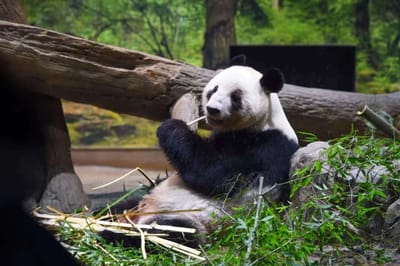
The last day was cold for Tokyo. On January 25, 2026, the 4,400 lottery winners who had beaten odds as steep as 24.6-to-1 filed past the Ueno panda house in silence, many wiping their eyes. Above their heads, two black-and-white shapes — Xiao Xiao and Lei Lei — chewed bamboo without a care. In the week before, more than 310,000 people had entered the final-viewing lottery. Two days later the twins boarded a China Southern charter flight at Narita, and a 54-year chapter closed: for the first time since Richard Nixon was in the White House, Japan had no giant panda.
How did the world’s most famous animal diplomacy story unfold, panda by panda, zoo by zoo? This is the complete record.
1972: The Gift That Launched a Love Affair
Japan’s panda era began as a diplomatic transaction. In September 1972 Prime Minister Kakuei Tanaka visited Beijing, and China and Japan normalized relations after decades of estrangement. China sealed the thaw the way it sealed others — with pandas. Kang Kang (“healthy and strong”) and Lan Lan (“orchid”) flew into Haneda Airport on October 28, 1972.
They were an instant national phenomenon. When the pair went on public display at Ueno Zoo on November 5, roughly 56,000 people queued — the line stretched about two kilometers and only about 18,000 made it inside. Over the following year the zoo drew a record of roughly 9.2 million visitors, nearly double its previous best. Ueno had not merely acquired two animals; it had acquired the two most photographed creatures in Japan.
The first chapter ended in grief. Lan Lan died at Ueno on September 4, 1979 from an acute intestinal torsion. Kang Kang followed on July 22, 1980. Japan, which had learned to love pandas in only seven years, buried both on national front pages.
Ueno’s Long Wait: From You You to Xiang Xiang
After the founding pair died, Ueno’s breeding luck failed for decades. A cub born in the mid-1980s died within days, and the zoo’s managers learned the hard way that panda neonatal care was still in its infancy.
Then came You You, born at Ueno in 1988 — the first cub at the zoo to survive. He grew into a healthy youngster, but under the ownership rules of the era he did not stay. In October 1992 You You flew to Beijing Zoo in a swap that brought a young male, Ling Ling, to Tokyo. Ling Ling became the lone face of Ueno’s panda house for sixteen years, outlasting every companion, until he died of kidney failure on April 30, 2008. For the first time since 1972, Ueno’s panda house stood empty — and grieving fans turned it into a shrine.
The turnaround arrived with the 2011 breeding pair. On February 21, 2011, China lent Ueno a new couple: Shin Shin (真真, also known in China as Xian Nü) and Ri Ri (比力, also romanized Bi Li). Weeks later the Great East Japan Earthquake struck, and the pair — publicly framed as a “gift of hope” — became an emotional anchor for a shaken nation. When the panda house reopened on April 1, 2011, more than 20,000 visitors came on day one.
The wait for a surviving cub finally ended on June 12, 2017, when Shin Shin gave birth to Xiang Xiang. She was Ueno’s first cub to survive in 29 years — since You You in 1988. Japan went wild. Roughly 320,000 people submitted name suggestions, and the winning name, meaning “fragrance,” was announced after a suspenseful public countdown. Viewing required a lottery; winners got minutes, and the rest got stuffed toys.
Xiang Xiang’s departure on February 21, 2023 — she flew to the Ya’an Bifengxia Base after a tearful public farewell — began Ueno’s long goodbye. It took 30 days of quarantine plus months of adaptation before she was shown to Chinese visitors that October. Parents Shin Shin and Ri Ri, both aging and Ri Ri managing hypertension, followed her home on September 29, 2024. The twins Xiao Xiao and Lei Lei, born June 23, 2021 and the last pandas in Japan, closed the era in January 2026 — reuniting the entire family of five at Bifengxia.
Wakayama’s Hin Dynasty: The Breeding Miracle
The most productive panda story in Japan was never in Tokyo. It unfolded at Adventure World in Shirahama, Wakayama Prefecture, on a breezy coast where Japan’s most ambitious cooperative breeding program took root.
1994: Male Ei Mei (永明) and female Rong Hin (蓉浜) arrived from Chengdu on September 6, 1994, in a research partnership that would outlast every other Japanese program. Rong Hin died of an intestinal torsion on July 17, 1997, without offspring.
2000: A new female, Mei Mei (梅梅), arrived pregnant in July. On September 6, 2000 she gave birth to Rau Hin (良浜) — Adventure World’s first surviving cub and the start of a dynasty.
What followed has no parallel in overseas panda breeding. Pairing Ei Mei with Mei Mei and, later, with her daughter Rau Hin, the program produced sixteen cubs that all survived — litters including Yu Hin (2001), Ryu Hin and Shu Hin (2003, Japan’s first surviving twin pair), Kou Hin (2005), twins Ai Hin and Ming Hin (2006), Japan’s first artificially-inseminated twins Mei Hin and Yong Hin (2008, the first of Rau Hin’s cubs), Kai Hin and You Hin (2010), You Hin (2012), Tou Hin and Sakura Hin (2014), Yui Hin (2016), Saihin (2018), and Fuhin (2020). Every “Hin” (浜) cub carries the family marker, and every one was born under an agreement that sent it back to China before adulthood.
Ei Mei became the oldest male giant panda in captive care worldwide, an extraordinary run of 28 years in Japan. He finally returned to Chengdu with daughters Sakura Hin and Tou Hin on February 22, 2023 — and died there of old age on January 16, 2025, at 32 years and 7 months. Rau Hin, the dynasty’s mother, stayed behind with three of her youngest — Yui Hin, Saihin, and Fuhin — until the four flew home together on June 28, 2025. That flight emptied Adventure World and ended Wakayama’s thirty-year panda chapter.
Kobe’s Troubled Trio: A Symbol and Two Mistakes
The third and smallest Japanese panda story is also the most bittersweet. Kobe Oji Zoo acquired pandas in July 2000 as a gesture of renewal after the 1995 Hanshin-Awaji earthquake, which had devastated the port city.
Its enduring star was Dan Dan (旦旦, originally named Shuang Shuang). She arrived on July 16, 2000 and became Kobe’s living emblem of reconstruction, drawing crowds for more than two decades. In her later years she suffered from heart disease, and after repeated treatment she died of heart failure at the zoo on March 31, 2024, at roughly 28 years old. Kobe has had no pandas since.
The zoo’s other two pandas are cautionary tales. Jin Zhu (锦竹) arrived in 2000 under the contract name “Xing Xing,” believed to be male — until zookeepers discovered in April 2002 that the panda was actually female. The mistake was corrected and the animal, now properly Jin Zhu, was returned to China in September 2002. Long Long (龙龙) replaced her, arriving in late 2002 as Kobe’s second “Xing Xing.” He died on August 13, 2010, from a rare anesthesia accident during a routine semen-collection procedure. Kobe’s lesson — that panda gender is not always obvious and that even routine procedures carry risk — became part of global keeper training lore.
Where They Are Now: The Great Return
By 2026, the full circle was complete. Every living panda that ever called Japan home now lives in China, most of them within a few enclosures of one another:
| Facility in Japan | Years active | Pandas hosted | Outcome |
|---|---|---|---|
| Ueno Zoo, Tokyo | 1972–2026 | Kang Kang, Lan Lan, You You, Ling Ling, Shin Shin, Ri Ri, Xiang Xiang, Xiao Xiao, Lei Lei | All returned home or died; last two left Jan 2026 |
| Adventure World, Wakayama | 1994–2025 | Ei Mei, Rong Hin, Mei Mei + 16 “Hin” cubs | Breeding program cleared June 2025 |
| Kobe Oji Zoo | 2000–2024 | Jin Zhu, Dan Dan, Long Long | Dan Dan died 2024; none since |
| Panda | Home in Japan | Year left Japan | Where now |
|---|---|---|---|
| You You | Ueno (born 1988) | 1992 | Died 2004, Beijing |
| Xiang Xiang | Ueno (born 2017) | 2023 | Ya’an Bifengxia Base |
| Ei Mei | Adventure World | 2023 | Died 2025, Chengdu |
| Tou Hin & Sakura Hin | Adventure World (born 2014) | 2023 | Chengdu Base |
| Rau Hin, Yui Hin, Saihin, Fuhin | Adventure World | 2025 | Chengdu Base |
| Shin Shin & Ri Ri | Ueno | 2024 | Ya’an Bifengxia Base |
| Xiao Xiao & Lei Lei | Ueno (born 2021) | 2026 | Ya’an Bifengxia Base |
The biggest cluster is at Ya’an Bifengxia Base, where Shin Shin, Ri Ri, Xiang Xiang, Xiao Xiao, and Lei Lei now form the only complete nuclear family of overseas-returned pandas in China. Fans of Japanese pandas can see them there today — China’s foreign ministry publicly welcomed Japanese visitors to do exactly that when the twins departed.
The Economics of Goodbye
Japan’s attachment to pandas was never only sentimental. Kansai University economist Miyamoto Katsuhiro estimated that Xiang Xiang generated ¥600-650 billion (roughly ¥27-30 billion RMB) in total economic benefit for Tokyo across her stay. The twins, Xiao Xiao and Lei Lei, produced an estimated ¥300 billion (about ¥15 billion RMB) in annual economic impact for the Ueno area through tickets, merchandise, and tourism. When the last pandas left, analysts warned that Japanese zoos collectively stood to lose roughly US$1.34 billion in annual revenue.
This helps explain a distinctive feature of the 2026 farewell: it was framed as an invitation, not a loss. Chinese officials and Japanese fans alike pointed to the Bifengxia Base as the natural next destination — a “see you in China” rather than a final adieu.
Did You Know? Japan’s most successful panda father, Ei Mei, also holds a longevity record: he was the oldest male giant panda ever held in captivity outside China, siring his last cub, Fuhin, at age 28. And when Ueno’s Shin Shin gave birth to Xiang Xiang in 2017 after a 29-year gap, it was the zoo’s first surviving cub since You You — a drought that made Wakayama’s success look even more remarkable.
Frequently Asked Questions
Are there any pandas in Japan today?
No. Since Xiao Xiao and Lei Lei left Ueno Zoo on January 27–28, 2026, Japan has had no giant pandas for the first time since October 1972. Adventure World’s last four pandas had already returned in June 2025, and Kobe’s Dan Dan died in March 2024.
Which pandas have lived in Japan?
Japan hosted pandas at three institutions: Ueno Zoo (Kang Kang, Lan Lan, You You, Ling Ling, Shin Shin, Ri Ri, Xiang Xiang, Xiao Xiao, Lei Lei), Adventure World in Wakayama (Ei Mei, Rong Hin, Mei Mei, and sixteen “Hin” cubs from Rau Hin to Fuhin), and Kobe Oji Zoo (Jin Zhu, Dan Dan, Long Long). You can read each individual’s full profile through the links throughout this article.
What about “Tong Tong”? Was a panda cub born at Ueno in 1986?
This is a persistent myth. The real Tong Tong was a cub in China’s studbook born on August 23, 1986 that died about 43 hours later — it had no connection to Ueno Zoo. Ueno’s first surviving cub was You You (1988), and its next surviving cub was Xiang Xiang (2017). The 1980s reports of an Ueno-born “Tong Tong” that lived to 2000 are incorrect.
Where are Japan’s former pandas now?
Nearly all live in Sichuan: Shin Shin, Ri Ri, Xiang Xiang, Xiao Xiao, and Lei Lei are at the Ya’an Bifengxia Base, while most of the Wakayama “Hin” family — including Rau Hin, Tou Hin, Sakura Hin, Yui Hin, Saihin, and Fuhin — are at the Chengdu Research Base. Several older returnees were later moved to zoos across China, from Shenzhen to Liuzhou to Guiyang.
Why did all of Japan’s pandas leave?
Because since China joined the CITES treaty in 1984, every giant panda abroad has been on a research loan rather than a gift, and every cub born overseas remains Chinese property that returns to China — usually by age four. The Japanese pandas also aged: Ri Ri developed hypertension, Dan Dan heart disease, and Ei Mei reached 32, an extreme old age. Their departures reflect both the ownership rules and the natural end of very long lives. See the wider history of pandas returning to China and the 80-year arc of panda diplomacy for context.
The Ueno panda house is quiet. Its enclosure was dismantled in August 2026, and Adventure World and Kobe no longer count pandas among their exhibits. But Japan’s relationship with the giant panda — born in a diplomatic handshake in 1972, raised on lottery tickets and birthday broadcasts, and kept alive by sixteen “Hin” cubs in Wakayama — did not die with the last flight out of Narita. It simply moved to Sichuan, where a family of five from Ueno now shares bamboo in the mountains. For fans who watched their whole lives from behind a fence in Tokyo, the panda era in Japan is over — and the panda era in Ya’an has just begun.
If you plan to visit them, the guide to meeting returning overseas pandas at Bifengxia explains what you will see — and why those 30-day quarantines and slow, patient first appearances matter so much to the pandas themselves.
Dr. Lin Chen
Conservation Genomics Editor
Conservation geneticist specializing in giant panda genomics, molecular ecology, and evolutionary biology. Validates all genetics and genome-related content on Panda Common.
View full profile →Tags in this article
Questions readers often ask
Are there any pandas in Japan now?
No. Since Xiao Xiao and Lei Lei left Ueno Zoo on January 27-28, 2026, Japan has been without a giant panda for the first time since 1972. Adventure World cleared its last four pandas in June 2025 and Kobe Oji Zoo's Dan Dan died in March 2024.
Which pandas have lived in Japan?
Japan's pandas were hosted at three institutions: Ueno Zoo in Tokyo (Kang Kang, Lan Lan, You You, Ling Ling, Shin Shin, Ri Ri, Xiang Xiang, Xiao Xiao, Lei Lei), Adventure World in Wakayama (Ei Mei, Rong Hin, Mei Mei and their sixteen 'Hin' cubs), and Kobe Oji Zoo (Jin Zhu, Dan Dan, Long Long).
Where are Japan's former pandas now?
Almost all returned to China: Shin Shin, Ri Ri, Xiang Xiang, Xiao Xiao and Lei Lei live at the Ya'an Bifengxia Base; the Wakayama 'Hin' family went to Chengdu and other Chinese bases. Most died in Japan at old age.
Will pandas come back to Japan?
No new loan has been announced. After a 54-year continuous presence (1972-2026), any return would require a new diplomatic and breeding agreement between China and Japan.
How many pandas has Ei Mei fathered?
Sixteen cubs that all survived, making him the most prolific giant panda sire ever to live outside China. The last four of his descendants returned to China in June 2025.