Table of contents (7 sections)
From WWF Logo to Olympic Mascot: How Panda Became the World’s Strongest IP
Key Fact: The giant panda is the most widely recognized animal symbol in the world — the unmoving logo of the World Wildlife Fund since 1961, the star of three Olympic-era mascots, and the face of a DreamWorks film franchise that has generated $1.8 billion in global box office revenue. The panda’s visual power derives from a rare combination of design advantages: high-contrast black-and-white coloration that reproduces perfectly in any medium, neotenous facial proportions that trigger universal human caregiving responses, and a gentle, plant-eating nature that aligns naturally with values of peace and harmony. No other animal combines these qualities — and no other animal has been leveraged into as many successful branding campaigns.
Key Takeaways
-
The panda became the world’s strongest animal IP because it is graphically simple and emotionally powerful at the same time. Few species work equally well as logo, mascot, toy, and film character.
-
Chi Chi and the WWF logo changed the scale of panda symbolism. Once the panda worked as a black-and-white line icon, it could travel through conservation, merchandising, and global media without losing recognizability.
-
Olympic mascots and Hollywood did not invent panda branding. They scaled an image system that was already proven by conservation design, Chinese state symbolism, and zoo celebrity culture.
If you are asking why the panda became such a powerful global symbol, the short answer is this: it combines ideal logo geometry, universal “baby schema” appeal, and almost no negative symbolic baggage. That makes it unusually adaptable across conservation, diplomacy, entertainment, and commercial branding.
In 1961, a small group of conservationists gathered in London to found an organization they called the World Wildlife Fund. They needed a logo — something that would communicate their mission instantly, across languages, across borders, across the gap between scientific urgency and public indifference. The animal they chose was not the most endangered species of the moment. It was not the lion or the elephant, both of which were proposed and rejected. It was a giant panda named Chi Chi, who had arrived at the London Zoo three years earlier and was, at that moment, the only panda living in the Western world.
Sir Peter Scott, one of the WWF’s founders, made the first sketch — a simple black-and-white rendering of Chi Chi’s rounded form, her eye patches slightly asymmetrical, her body simplified into an icon. He chose the panda, he later explained, because it was “an animal that is beautiful, endangered, and loved by the world.”
Sixty-four years later, that sketch is one of the most recognized symbols in human history. And the animal it depicts has become the most commercially and culturally leveraged species on Earth.
Why the Panda Works Better Than Almost Any Other Animal Symbol
The panda succeeds not merely because people like it, but because it solves several branding problems at once.
| Branding problem | Why the panda solves it |
|---|---|
| Needs to read at tiny or huge size | Black-and-white contrast stays legible without detail. |
| Needs emotional warmth | Round head, large eyes, and soft outline trigger caregiving instincts. |
| Needs cross-cultural safety | The panda does not carry the aggression of lions or the political baggage of eagles. |
| Needs to move between causes and commerce | It works in conservation, tourism, diplomacy, toys, film, and sports branding. |
This is the core reason the panda became stronger than a single mascot cycle or single logo launch. It is not just a famous image. It is a highly portable image architecture. The longer visual backstory for that portability is in our article on pandas in art, where the panda first becomes legible across multiple image traditions.
The Design Logic: Why the Panda Works as a Logo
The panda’s visual success as a symbol is not accidental. It rests on three design principles that graphic artists spend entire careers trying to achieve:
High contrast. The panda’s black-and-white coat provides perfect tonal separation without gray gradients, shadows, or color washes. A panda logo reads clearly at thumbnail size, on fax-quality reproduction, in black-and-white newspaper print, and on the side of a building. The contrast is so stark that even a crude silhouette — two black ears, two black eye patches, a black shoulder band — is instantly recognizable as a panda. Few other animals achieve this: a tiger silhouette without stripes is just a cat shape; an elephant silhouette without wrinkles is ambiguous. The panda silhouette is unmistakable.
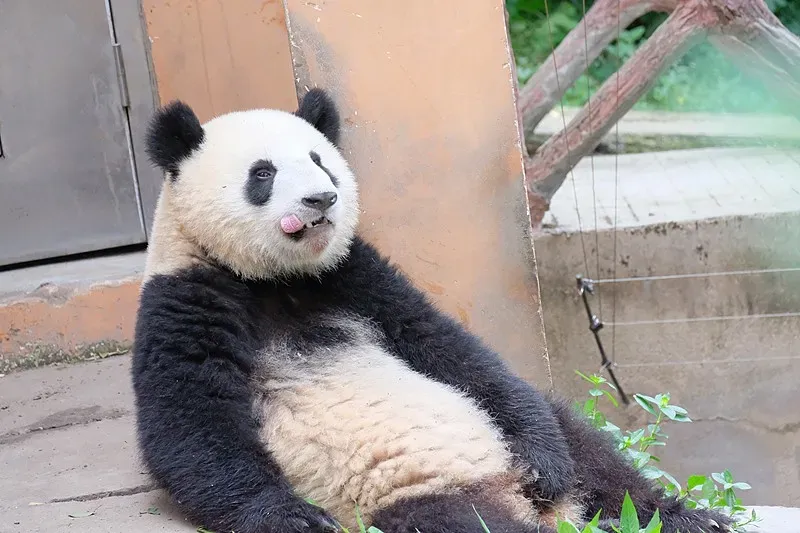
Neotenous proportions. The panda’s face triggers what biologists call the “baby schema” — a set of facial features (large head relative to body, round face, large eyes, small nose and mouth) that elicit caregiving responses across mammal species. The dark eye patches amplify this effect by making the eyes appear larger and more prominent — the same visual mechanism that makes human eye makeup attractive. When people say pandas are “cute,” they are reporting a genuine neurological response: their brain’s caregiving circuitry has been activated by a set of visual cues that evolved to ensure parents care for their infants.
Symbolic neutrality. Unlike eagles (nationalistic), lions (aggressive), or snakes (threatening), the panda carries no negative symbolic baggage. It is a vegetarian — gentle, unhurried, non-threatening. It has no history of attacking humans. It is associated with bamboo forests, a peaceful and beautiful natural setting. The panda’s symbolic profile is almost perfectly benign — an animal that symbolizes nothing except itself, and therefore can be made to symbolize anything: conservation, friendship, peace, China, the Olympics, childhood, cuteness, the planet.
Did You Know? The WWF panda logo has never been substantially redesigned. It has been refined — the line weight adjusted, the eye patch shape subtly tweaked, the proportions updated for digital reproduction — but the core design is the same sketch Sir Peter Scott made in 1961. This is extraordinarily rare in logo design, where most global brands redesign every 10-20 years. The panda logo’s longevity is a testament to how perfectly the original design captured the animal’s essential visual qualities.
Entity Hub: The Figures and Moments That Built Panda IP
Chi Chi and London Zoo
Chi Chi provided the specific face behind the abstract icon. Her celebrity made the panda familiar enough to become a trusted public symbol rather than a strange exotic animal.
Sir Peter Scott and WWF, 1961
Scott’s sketch converted panda charisma into logo logic. The WWF mark proved the animal could carry a cause globally with almost no explanatory text.
Pan Pan, Jing Jing, and Bing Dwen Dwen
These mascots show how the panda image adapted to different eras of Chinese public branding: simple cartoon, folk-modern Olympic identity, and high-tech collectible spectacle.
Po and DreamWorks
Po demonstrated that the panda could also carry narrative power, humor, and box-office scale. The animal was no longer only gentle. It could anchor a full entertainment franchise.
The Olympic Pandas: Three Eras, Three Designs
The panda’s role in Olympic and international sporting events traces a clear arc across three decades of design evolution, from simple cartoon to sophisticated digital character. Each mascot reflected the aesthetic and cultural sensibilities of its era.
1990: Pan Pan — The Beijing Asian Games
The first major sporting-event panda mascot was Pan Pan, designed for the 1990 Beijing Asian Games. Pan Pan was a conventional cartoon — a smiling panda holding a gold medal, rendered in simple, flat colors with thick black outlines. The design was unremarkable by contemporary standards but revolutionary in its context: it was the first time a Chinese sporting event had used a panda as its primary visual identity, and it established the template that all subsequent panda mascots would follow.
The real Pan Pan — studbook number 001, the most genetically prolific panda in history and the subject of our article on the Pan Pan family dynasty — was alive at the Chengdu Base during the 1990 games. The mascot was partly inspired by him, though the cartoon Pan Pan bore little resemblance to any actual panda.
2008: Jing Jing — The Beijing Summer Olympics
The 2008 Beijing Olympics introduced the Fuwa — five mascots representing the five Olympic rings, each embodying a Chinese cultural symbol. Jing Jing, the black panda Fuwa, represented the forest and was designed to communicate China’s commitment to environmental protection. His lotus-shaped headdress referenced Song Dynasty porcelain, merging the panda with Chinese artistic heritage.
Jing Jing was the first panda mascot designed for a truly global audience, and the design reflected this ambition: more stylized than Pan Pan, more culturally layered, more explicitly a “brand” rather than a simple cartoon. The Fuwa collectively generated an estimated $150 million in merchandise revenue, with Jing Jing consistently the most popular of the five characters.
2022: Bing Dwen Dwen — The Beijing Winter Olympics
The 2022 Beijing Winter Olympics produced what may be the most sophisticated panda mascot ever created: Bing Dwen Dwen, a panda encased in a transparent ice shell that resembled an astronaut’s helmet. The name combines “bing” (ice) with “dwen dwen” (a Beijing colloquialism for something sturdy and lovable). The design was selected from over 5,800 submissions from 35 countries.
Bing Dwen Dwen was a departure from the cute-animal template. The ice shell gave the character a technological, futuristic quality — a panda for the metaverse age. The “helmet” was actually a spacesuit, referencing China’s space program and the Winter Olympics’ theme of human technological achievement. The character’s heart-shaped palm print was a small but effective touch: warmth inside technology, emotion inside ice.
The public response exceeded all expectations. Bing Dwen Dwen merchandise sold out globally within days of the opening ceremony. Resale prices for the plush toy version reached ten times retail on secondary markets. The character generated an estimated $300 million in licensed merchandise sales — making it, by some measures, the most commercially successful Olympic mascot in history.
The Animated Panda: Kung Fu Panda and the Hollywood Dream
No discussion of panda branding is complete without DreamWorks Animation’s Kung Fu Panda franchise. The 2008 film — released the same year as the Beijing Olympics, a coincidence that amplified both properties — featured Jack Black as the voice of Po, a bumbling, noodle-loving panda who becomes a martial arts master. The film grossed $631 million worldwide. Three sequels and multiple television series followed, with the franchise total exceeding $1.8 billion.
The Kung Fu Panda films are notable for their handling of Chinese cultural elements — which they incorporated with a respect unusual for Hollywood productions of the era. The animation team studied Chinese architecture, calligraphy, and martial arts movement. The color palette was drawn from Chinese landscape painting. The musical score incorporated traditional Chinese instruments. The result was a film that Chinese audiences embraced (it became the first animated film to gross over 100 million yuan in China) rather than rejected as cultural appropriation.
The films also reshaped global perceptions of pandas. Before Kung Fu Panda, the panda was primarily associated with gentleness and passivity. Po’s character arc — from clumsy noodle-maker to confident warrior — introduced a narrative of panda competence that had been largely absent from Western panda imagery. The panda, the films argued, was not just cute. It was capable.
| Era | Mascot / Character | Event / Property | Design Language | Cultural Impact |
|---|---|---|---|---|
| 1961 | WWF Logo (Chi Chi) | World Wildlife Fund | Minimalist line drawing | Most recognized conservation symbol |
| 1990 | Pan Pan | Beijing Asian Games | Simple cartoon | Established panda-mascot template |
| 2008 | Jing Jing | Beijing Summer Olympics | Stylized folk art | $150M merchandise; cultural layering |
| 2008 | Po | Kung Fu Panda (DreamWorks) | 3D animation | $1.8B franchise; redefined panda narrative |
| 2022 | Bing Dwen Dwen | Beijing Winter Olympics | Tech-futurist | $300M+ merchandise; metaverse-era mascot |
Frequently Asked Questions
Why hasn’t the WWF changed its logo in 60 years?
Brand recognition is the primary reason — the panda logo is so universally associated with conservation that changing it would sacrifice decades of accumulated brand equity. Additionally, the logo’s simplicity (a line drawing of a black-and-white animal) means it has aged well; it doesn’t look dated the way a 1961 logo with period-specific typography or color schemes would.
Do the Olympic panda mascots use real pandas as models?
Indirectly. Jing Jing’s design incorporated elements of real panda anatomy — the pseudo-thumb was visible in some renderings — but did not depict a specific individual panda. Bing Dwen Dwen was fully stylized and bore no resemblance to any living panda. The mascots represent the concept of “panda” rather than specific pandas.
Which panda IP has generated the most revenue?
By cumulative revenue, the Kung Fu Panda franchise ($1.8B box office plus merchandise) likely exceeds individual mascot programs. By single-event merchandise sales, Bing Dwen Dwen’s estimated $300M+ in licensed merchandise sales may be the most commercially successful single panda-related product launch in history. Once the panda reaches this level of symbolic efficiency, it also becomes a natural vehicle for fundraising and corporate alignment — the conversion layer explored in our panda adoption and CSR guide.
The next time you see the WWF logo — on a product, a website, a donation form — take a moment to look at the shape of the eye patches. They were drawn from one specific panda, Chi Chi, in 1961. Sixty-four years later, her face is still watching over the global conservation movement she helped launch.
Pandacommon Editorial Team
Pandacommon is a global knowledge project documenting giant pandas, habitats, and conservation history. We combine verified data with engaging storytelling to build a deeper archive of the panda world.
Learn more about our mission →Tags in this article
Questions readers often ask
Why did the WWF choose a panda as its logo?
The WWF chose the giant panda as its logo in 1961 because the animal was both endangered and visually striking — black-and-white, instantly recognizable, and culturally neutral. The specific panda that inspired the logo was Chi Chi, a female panda who had arrived at the London Zoo in 1958. WWF co-founder Sir Peter Scott sketched the first logo based on Chi Chi, creating what would become one of the most recognized symbols in conservation history.
What makes the panda such a powerful visual symbol?
The panda's black-and-white coloration provides natural high contrast that reproduces well in any medium — print, digital, small scale, large scale. Its round face, large head relative to body, and dark eye patches create a neotenous (baby-like) appearance that triggers the human caregiving instinct. The panda's gentle, herbivorous nature aligns with universal values of peace and harmony. These qualities combine to make the panda uniquely effective as a symbol that transcends culture, language, and political boundaries.
How many Olympic mascots have been pandas?
Three major Olympic-related mascots have been pandas: Pan Pan (1990 Beijing Asian Games — not technically Olympic but closely associated), Jing Jing (2008 Beijing Summer Olympics, one of the five Fuwa), and Bing Dwen Dwen (2022 Beijing Winter Olympics). Each mascot design reflected the aesthetic and technological sensibilities of its era, from simple cartoon to high-tech 3D character.