Table of contents (9 sections)
Giant Pandas in Mexico: Chapultepec Zoo’s 50-Year Legacy, Xin Xin, and the 2026 Request
Key Fact: Mexico is the only country outside China that has ever owned giant pandas outright — a legal anomaly born of a 1975 state gift that China stopped making in 1982. Today that entire history rests on one 36-year-old bear, Xin Xin, at Chapultepec Zoo in Mexico City. In November 2026, President Claudia Sheinbaum asked Beijing for new pandas to keep the story going.
At the 2026 APEC leaders’ summit in Shenzhen, Mexican President Claudia Sheinbaum asked China to send a new giant panda to Chapultepec Zoo in Mexico City. In most diplomatic coverage, the request registered as a warm aside to a heavy trade agenda. In the longer arc of panda history, it is an attempt to keep alive an anomaly that exists nowhere else on Earth: for more than half a century, Mexico has been the only country outside China to own giant pandas outright.
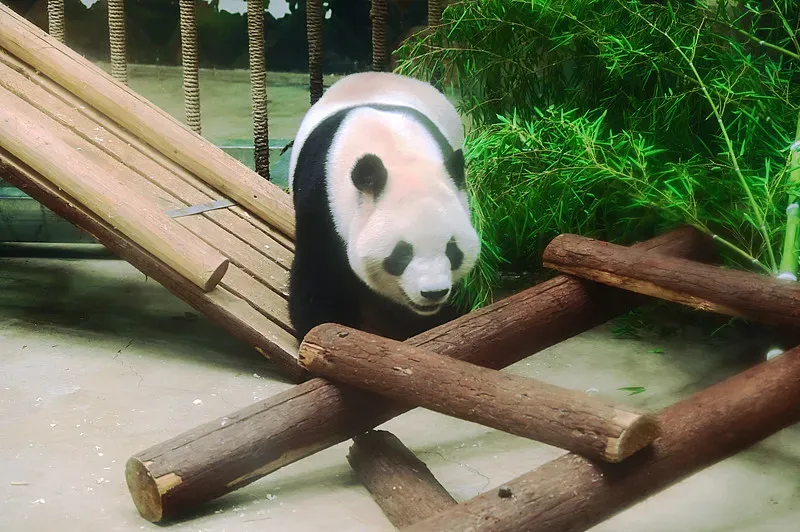
That era is nearing its natural end. Chapultepec Zoo now holds a single giant panda, Xin Xin, who turned 36 in July 2026. She is the last giant panda in Latin America, one of the oldest captive pandas ever recorded, and the final living descendant of a diplomatic rulebook that China retired more than four decades ago.
- Xin Xin, born July 1, 1990 at Chapultepec Zoo, is 36 — the last giant panda in Latin America and the only one in the world not owned by China.
- Ying Ying and Pe Pe arrived as unconditional state gifts in September 1975 and produced seven naturally conceived cubs, four of whom reached adulthood.
- China formally announced an end to outright panda gifting in 1982, with the research-loan framework that replaced it beginning in 1984 — which makes Xin Xin’s Mexican ownership legally unrepeatable: any new panda would arrive on a research loan, not as a gift.
Mexico’s 2026 Panda Request, Explained
On November 17, 2026, on the sidelines of the 33rd APEC Economic Leaders’ Meeting in Shenzhen, Mexican President Claudia Sheinbaum met with Chinese President Xi Jinping. Afterward, she confirmed that Mexico had asked China for new giant pandas. “Mexico is well regarded by all the countries of the world,” she told reporters, describing the visit as a chance to deepen cooperation in trade, science, culture, and tourism.
She noted that Xi Jinping was aware of the panda still living in Mexico and her age — 36. On the request itself, she said the Chinese authorities told her they “were going to review it” and “would look for a way to make it happen.”
The timing was deliberate. The year 2027 marks the 55th anniversary of diplomatic relations between China and Mexico, and Sheinbaum proposed declaring it the “Year of Mexico–China Tourism,” with a new panda arrival as a natural centerpiece. More urgently, Mexico City’s half-century unbroken stretch of housing giant pandas hangs on the health of a single, geriatric bear.
No timeline, pairing, or formal agreement was announced in Shenzhen. Even if talks move quickly, any new bear sent to Mexico City will arrive under a completely different legal reality than the ones that came in 1975.
1975: The State Gift That Brought Pandas to Latin America
China and Mexico established diplomatic relations in 1972. The following year, Mexican President Luis Echeverría became one of the first Latin American heads of state to visit Beijing, where Premier Zhou Enlai agreed to send a pair of giant pandas to Mexico City as a gesture of goodwill.
On September 10, 1975, two young wild-born pandas from Sichuan — a female named Ying Ying and a male named Pe Pe — touched down in Mexico City and moved into Chapultepec Zoo. They were the first giant pandas ever kept in Latin America.
Mexico was an early node in a global network of panda host facilities that would peak at more than 20 locations before the modern loan era contracted the map to roughly eighteen.
Crucially, they arrived under the old rules of panda diplomacy. In the gift era that ran until China’s 1982 policy decision, transferred pandas carried no strings attached. Ying Ying, Pe Pe, and any cubs they might produce belonged wholly to the Mexican state. Mexico was among the nine countries to receive one of the 23 pandas China gifted abroad between 1957 and 1982.
Settling mountain bears from central China into the Valley of Mexico required rapid adaptation. Because native Asian bamboo species were not commercially established in the region, Chapultepec’s botanical and veterinary teams planted bamboo groves directly on the zoo grounds, built a climate-controlled enclosure, and supplemented the pair’s diet with locally grown nopal (prickly pear cactus) pads — a distinctly Mexican adjustment that the bears readily accepted.
Every Giant Panda at Chapultepec Zoo (1975–Present)
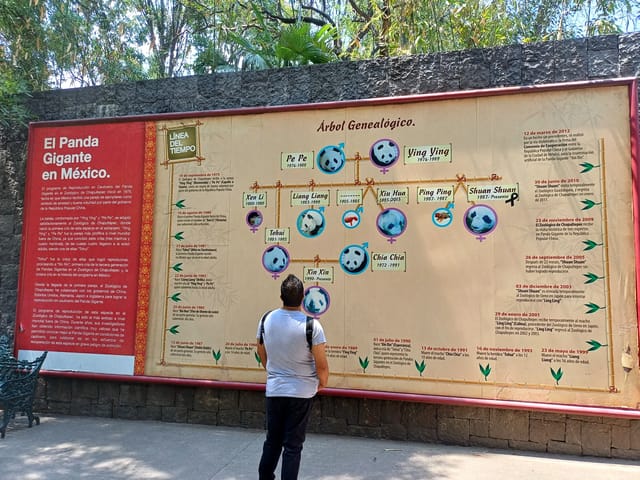
Across five decades, eleven giant pandas have lived at Chapultepec Zoo: the original founding pair, seven cubs born to Ying Ying and Pe Pe (four of whom survived infancy), one male brought in on breeding loan from London, and Xin Xin.
| English Name | Chinese Name | Lifespan / Dates at Zoo | Profile & Lineage |
|---|---|---|---|
| Ying Ying | 迎迎 | Mid-1970s – Jan 1989 (at zoo 1975–1989) | Female, studbook 165. Founding mother gifted in 1975; rescued in Baoxing, Sichuan in June 1975. Gave birth to all seven cubs conceived at Chapultepec. |
| Pe Pe | 贝贝 | 1975 – Jul 1988 (at zoo 1975–1988) | Male, studbook 167. Founding father; found wild in Yuexi County, Sichuan in July 1975 and died at Chapultepec on 20 July 1988. |
| Xen Li | 新丽 | Aug 1980 (lived 8 days) | First cub born to Ying Ying and Pe Pe; did not survive infancy. No studbook number recorded in the authoritative databases consulted. |
| Tohui | 朵蔚 | Jul 1981 – Nov 1993 | Female, studbook 234. Second cub; first giant panda born outside China to survive to adulthood; mother of Xin Xin. |
| Liangliang | 亮亮 | 1983 – 1999 | Male. Third cub; no studbook number recorded in the authoritative databases consulted. |
| Xiu Hua | 秀华 | 1985 – Apr 2013 | Female, studbook 291. Fourth cub (twin sibling died after two days). |
| Shuang Shuang | 双双 | Jun 1987 – Jul 2022 | Female, studbook 332. Fifth-litter twin (her twin brother died after three days); died aged 35. |
| Chia Chia | 佳佳 | Sep 1972 – Oct 1991 (at zoo late 1980s–1991) | Male, studbook 141. On breeding loan from London Zoo; fathered Xin Xin with Tohui. Distinct from the female panda (studbook 230) at Ocean Park Hong Kong. |
| Xin Xin | 欣欣 | Born Jul 1990 – Present | Female, studbook 360. Daughter of Tohui and Chia Chia; last panda in Latin America and the only giant panda not owned by China. |
Note: The seven cubs of Ying Ying and Pe Pe include three that died in infancy (Xen Li in 1980, the unnamed twin of Xiu Hua in 1985, and Shuang Shuang’s twin brother in 1987). Together with the founding pair, the London breeding loan Chia Chia, and Xin Xin, eleven giant pandas have lived at Chapultepec.
A Breeding Breakthrough: The Cub That Captivated Mexico
For decades, getting giant pandas to breed in zoos outside China was notoriously difficult, often relying on complex artificial insemination protocols with low success rates. Even the first captive panda birth in Beijing in 1963 was an uncertain, closely watched event. Chapultepec Zoo defied that trend almost immediately. Between 1980 and 1987, Ying Ying and Pe Pe produced seven cubs across five litters — every single one conceived through natural mating.
Their first cub, Xen Li, lived only eight days in August 1980. Eleven months later, in July 1981, Ying Ying gave birth to a female cub that thrived. She became the first giant panda born in captivity outside China to survive to adulthood.
A nationwide naming contest drew entries from across Mexico. The winning name, Tohui (often spelled Towi), was submitted by a four-and-a-half-year-old Indigenous boy and comes from the Rarámuri (Tarahumara) language of northern Mexico, meaning “child.”
Tohui quickly transcended zoo attendance records to become a fixture of 1980s Mexican pop culture. Singer Yuri recorded a hit children’s song titled “Osito Panda” in her honor, and Tohui’s likeness appeared on murals, postcards, school notebooks, and television broadcasts. When Tohui reached maturity, Chapultepec arranged a breeding loan with London Zoo, bringing the male Chia Chia to Mexico City. On July 1, 1990, Tohui gave birth to a female cub: Xin Xin.
Xin Xin: The Only Giant Panda Not Owned by China
In 1982, recognizing the ecological vulnerability of wild giant pandas and the need to fund habitat protection, China formally announced an end to gifting pandas to foreign governments — a policy decision put into practice when the research-loan model began operating in 1984. Ying Ying and Pe Pe had arrived seven years earlier, in 1975, during the long gift era rather than at its close. By the early 1990s, international transfers had consolidated into the modern cooperative research loan model: host institutions pay an annual conservation fee, and China retains ownership of all loaned adults as well as any cubs born abroad.
Xin Xin falls entirely outside that system. Because her grandparents were transferred unconditionally in 1975, Mexican law — and international studbook records — recognize her as Mexican property.
When her aunt Shuang Shuang died in July 2022 shortly after turning 35, Xin Xin became both the sole surviving panda in Latin America and the only giant panda anywhere on Earth not owned by China. Under modern conservation agreements, no foreign zoo will ever hold outright title to a giant panda again, making Xin Xin’s legal status a permanent historical outlier.
36 Years Old: Inside the Geriatric Care of Latin America’s Last Panda
In the wild, giant pandas typically live 15 to 20 years. In human care, where bears are protected from parasites, injury, and seasonal food shortages, lifespans regularly reach into the late twenties, though only a handful have ever crossed 35. Having celebrated her 36th birthday on July 1, 2026 — marked publicly at the zoo on July 4 with a cake of steamed rice, carrots, and apples — Xin Xin stands among the longest-lived giant pandas in history.
The protocols behind that longevity — softened food for worn molars, around-the-clock veterinary observation, and climate-controlled housing — are covered in depth in our guide to geriatric care for senior pandas.
Her daily routine is tailored to the realities of extreme old age. Senior keeper Joel Frías, who has worked with Xin Xin since 2000, begins each morning by checking her respiratory rate before preparing a soft, nutrient-dense breakfast of specialized biscuits, cooked rice, carrots, and crushed apple to accommodate worn molars.
She lives in a climate- and humidity-controlled pavilion under 24-hour veterinary observation. Keepers continue to provide sensory enrichment suited to her pace — including, in autumn 2026, a custom Day of the Dead (Día de los Muertos) piñata packed with favorite treats.
Her longevity has required careful medical management. In 2024, Mexico City’s Secretariat of the Environment (SEDEMA) publicly noted that Xin Xin had entered the final stage of her life cycle. She stabilized and continues to spend quiet hours in her habitat, which is why zoo staff and visitors treat each July birthday milestone as a cherished bonus. Public affection remains intense: in 2025, Mexico’s National Lottery issued 2.4 million commemorative tickets bearing her image, and visitors still travel from across Mexico and the United States to see her in person.
How International Panda Loans Work Today
If China approves Mexico’s November 2026 request, the new bear — or breeding pair — will arrive under a framework vastly different from the handshake diplomacy of 1975. The full arc from wartime gifts to modern research loans is traced in 80 Years of Panda Diplomacy.
- Fixed-Term Research Agreements: Modern partnerships typically run for 10 years, structured around joint veterinary research, behavioral studies, and breeding science.
- Conservation Funding: Host institutions generally contribute around US$1 million per year, with roughly 70% directed toward wild giant panda habitat restoration, corridor construction, and anti-poaching programs in China.
- Cubs Return to China: Any offspring born at a partner zoo remain Chinese property and typically travel to China between ages two and four to enter the global captive breeding pool.
- Rigorous Technical Vetting: Before signing an agreement, Chinese wildlife authorities inspect enclosure climate controls, dedicated bamboo harvests, veterinary lab capabilities, and quarantine protocols — a review process that routinely takes one to three years.
Why Chapultepec Zoo’s Case Is Stronger Than Most
Many cities lobby Beijing for giant pandas, yet Mexico City holds practical advantages that few prospective hosts can match:
- Five Decades of Institutional Memory: Chapultepec is the only zoo outside China to have sustained an unbroken, multi-generational, naturally breeding panda lineage over 50 years. Its veterinary and keeper teams already understand the species’ geriatric and reproductive biology firsthand.
- Existing Infrastructure: Unlike zoos that must spend tens of millions of dollars constructing a panda house from scratch, Chapultepec already operates a specialized, climate-regulated facility with established on-site bamboo cultivation.
- Favorable High-Altitude Climate: Sitting at more than 2,200 meters (7,350 feet) above sea level, Mexico City enjoys cool nights and mild daytime temperatures year-round — conditions remarkably close to the montane forests of Sichuan.
- Diplomatic Momentum: With the 55th anniversary of China–Mexico relations arriving in 2027, a new cooperative loan offers a high-visibility cultural anchor alongside broader economic talks.
Still, nothing is automatic. Every international placement is weighed against China’s domestic breeding priorities and strict welfare benchmarks.
What Comes Next for Mexico’s Pandas
Giant pandas occupy an unusual space in international relations: they translate abstract diplomatic treaties into something tangible that families experience across generations. Millions of Mexicans remember visiting Tohui as children and bringing their own children to see Xin Xin decades later.
Regardless of how Beijing responds to President Sheinbaum’s 2026 request, Xin Xin’s place in conservation history is secure. She is the living epilogue to an era when pandas crossed oceans as permanent gifts rather than temporary ambassadors. For Chapultepec Zoo, the immediate priority remains straightforward — keeping a 36-year-old bear comfortable, well-fed, and undisturbed — while waiting to see whether a new generation of pandas will eventually inherit her home.

Pandacommon Editorial Team
Pandacommon is a global knowledge project documenting giant pandas, habitats, and conservation history. We combine verified data with engaging storytelling to build a deeper archive of the panda world.
Learn more about our mission →Tags in this article
Questions readers often ask
Is Xin Xin still alive?
Yes. Born on July 1, 1990, Xin Xin is 36 years old as of late 2026 and lives at Chapultepec Zoo in Mexico City under specialized geriatric care.
Does China own Mexico's giant panda?
No. Xin Xin is the only giant panda in the world not owned by China. Her grandparents, Ying Ying and Pe Pe, were given to Mexico unconditionally in 1975 — seven years before China ended outright panda gifting — so she belongs to Mexico.
Will Mexico get a new giant panda?
Not yet. President Claudia Sheinbaum confirmed that Mexico asked China for new pandas during her November 2026 APEC visit, but no agreement, timeline, or specific bear has been announced. Chinese authorities said they would review the request. Any future panda sent to Mexico would arrive under a modern cooperative research loan, with ownership remaining with China.
How many giant pandas has Chapultepec Zoo had in total?
Eleven in total: the 1975 founding pair (Ying Ying and Pe Pe), seven cubs born to them between 1980 and 1987 (four of whom survived infancy: Tohui, Liangliang, Xiu Hua, and Shuang Shuang), one male on breeding loan from London Zoo (Chia Chia), and Xin Xin.