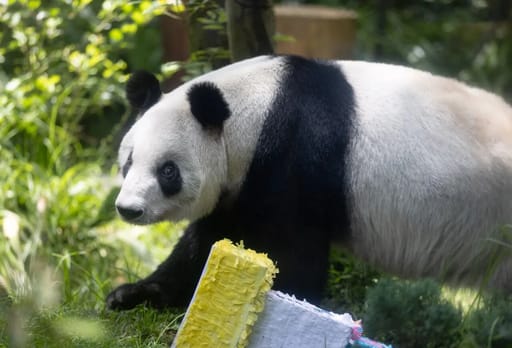
Xin Xin
欣欣
36 years old
chapultepec_zoo
Xin Xin (欣欣, "Hope", studbook #360) is a female giant panda born July 1, 1990 at Chapultepec Zoo in Mexico City. She is ...
View profilePanda archive
朵蔚
Tohui (朵蔚, studbook #234) was a female giant panda born in July 1981 at Mexico City's Chapultepec Zoo — the first giant panda born and surviving to adulthood outside China. Her birth sparked a national frenzy in Mexico: a nationwide naming contest was held, a hit song was recorded in her honour, and the zoo built its first veterinary hospital. She gave birth to Xin Xin (欣欣, #360) in 1990, sired by the London-born male Chia Chia (#141). She died in November 1993.
How to use this page
This page brings together the core facts, timeline, family graph, media, place journey, and related reading for Tohui.
Profile snapshot
Birth date
July 1, 1981
Birth place
Chapultepec Zoo
Current location
Chapultepec Zoo
Status
Deceased
Studbook
#234Archive activity
2 updates · 0 media
Narrative
Start with a concise summary, then continue into the full narrative record for Tohui.
Short version
Tohui (朵蔚, studbook #234) was a female giant panda born in July 1981 at Mexico City's Chapultepec Zoo — the first giant panda born and surviving to adulthood outside China. Her birth sparked a national frenzy in Mexico: a nationwide naming contest was held, a hit song was recorded in her honour, and the zoo built its first veterinary hospital. She gave birth to Xin Xin (欣欣, #360) in 1990, sired by the London-born male Chia Chia (#141). She died in November 1993.
Tohui (Chinese: 朵蔚, studbook 234) was a female giant panda born in July 1981 at Chapultepec Zoo in Mexico City. Her name comes from the Tarahumara (Rarámuri) word towi, meaning “child” — the result of a national naming contest. She was the daughter of Ying Ying (迎迎, #165) and Pe Pe (贝贝, #167), the pair gifted to Mexico by China in 1975.
Her studbook number is confirmed by both the Chinese national forestry authority and the pandapia panda database. An older number sometimes seen in fan sources, 251, is a cross-site indexing error and is not used here.
Tohui’s birth was a global milestone: she was the first giant panda born outside China to survive to adulthood. Her parents’ first cub, Xen Li, had been born in 1980 and survived only eight days; that cub’s studbook number is not recorded in the authoritative studbooks consulted for this page.
Zoo staff monitored Tohui around the clock and separated her from her mother to prevent accidental crushing. When it became clear she would survive, Mexico erupted in celebration.
President José López Portillo initially proposed naming her “Cancún”, but the public rejected the idea. A nationwide contest was held, and “Tohui” won. The name was chosen before the cub’s sex was known — towi is a gender-neutral term in Tarahumara.
Tohui became a pop-culture sensation in Mexico. First Lady Carmen Romano commissioned a song, “Osito Panda” (Little Panda), performed by teenage pop star Yuri. The single was a major hit and became one of Yuri’s signature songs. The queue to see Tohui stretched all the way to the Monument to the Niños Héroes. Her presence dramatically increased the zoo’s attendance and funding, enabling Chapultepec Zoo to open its first veterinary hospital.
The Bank of Mexico minted a commemorative coin for her fifth birthday, featuring Tohui in her mother Ying Ying’s arms.
In 1988 the male panda Chia Chia (佳佳, #141) arrived on loan from London Zoo to mate with Tohui. On 1 July 1990 Tohui gave birth to a female cub, Xin Xin (欣欣, #360), who survived and thrived. Chia Chia died in Mexico in October 1991. Xin Xin still lives at Chapultepec Zoo as of 2026, the last remaining descendant of the original Mexico pandas and the only giant panda in Latin America.
Tohui died in November 1993, aged about 12. Her taxidermied body was preserved and placed on permanent display at Chapultepec Zoo.
Tohui’s legacy is profound: she proved that giant pandas could successfully reproduce and thrive in captivity outside China, laying the groundwork for later international panda breeding programmes. She remains a beloved cultural icon in Mexico.
Tohui was one of the four surviving cubs of Ying Ying and Pe Pe. Their other offspring were a cub born in 1980 that lived eight days (Xen Li), a male cub born in 1983 (Liang Liang, 亮亮), a female cub born in 1985 (Xiu Hua, 秀华, #291), and a female cub born in 1987 (Shuang Shuang, 双双, #332). Detailed studbook numbers for Xen Li and Liang Liang are not available in the authoritative databases consulted for this page, so no numbers are asserted here.
Gallery
Images and video connected to Tohui.
Images and video for Tohui will be added later.
Evidence
Key updates and milestone events tied to Tohui.
Knowledge graph
See the core family graph first, then continue through related pandas and archive themes.
Related profiles
These profiles are linked through place, lineage, and broader archive context.
欣欣
Xin Xin (欣欣, "Hope", studbook #360) is a female giant panda born July 1, 1990 at Chapultepec Zoo in Mexico City. She is ...
View profile贝贝
Pe Pe (贝贝, studbook #167) was a wild-born male giant panda discovered in Yuexi County, Sichuan in July 1975. Sent to Bei...
View profile双双
Shuang Shuang (双双, studbook #332) was a female giant panda born June 15, 1987 at Mexico City's Chapultepec Zoo — the sec...
View profile宣宣
Xuan Xuan is a female giant panda born on 1975-01-01 at wild in the Qinling Mountains of China. She was entered into the...
View profile迎迎
Ying Ying (迎迎, studbook #165) was a wild-born female giant panda gifted to Mexico in 1975 alongside Bei Bei — the foundi...
View profileXin Xin
Pe Pe
Shuang Shuang
Xuan Xuan
Theme graph
This panda is connected to 3 themes in the broader archive graph.
Connected archive
This is the next layer around the profile: place journey, current geography, reading context, and nearby panda records.
Chapultepec Zoo
Mexico City, Mexico
Tohui is currently linked to Chapultepec Zoo.
Browse nearby, regional, and fast-moving panda profiles related to this archive entry.
佳佳
Jia Jia (佳佳, studbook #141) was a male giant panda born in September 1972, gifted to the United Kingdom in 1974 and hous...
View profile贝贝
Pe Pe (贝贝, studbook #167) was a wild-born male giant panda discovered in Yuexi County, Sichuan in July 1975. Sent to Bei...
View profile双双
Shuang Shuang (双双, studbook #332) was a female giant panda born June 15, 1987 at Mexico City's Chapultepec Zoo — the sec...
View profile佳佳
Jia Jia (佳佳, studbook #141) was a male giant panda born in September 1972, gifted to the United Kingdom in 1974 and hous...
View profile贝贝
Pe Pe (贝贝, studbook #167) was a wild-born male giant panda discovered in Yuexi County, Sichuan in July 1975. Sent to Bei...
View profile双双
Shuang Shuang (双双, studbook #332) was a female giant panda born June 15, 1987 at Mexico City's Chapultepec Zoo — the sec...
View profile冰星
Bing Xing is a male giant panda born on September 1, 2000 at Chengdu Research Base. He lived at Hangzhou Wildlife Park (...
View profile
成和花
Cheng Hehua (Hua Hua, 花花), nicknamed "Fruit Lai" (果赖) because she responds to this Sichuan dialect call, is China's top...
Trust
Information on this page is compiled from conservation institutions, official panda records, media archives, and the wider PandaCommon research workflow.
No external reference links are attached yet.
Library
The three newest articles from the panda library, updated as the archive grows.
culture
At the 2026 Global Panda Partners Conference in Chengdu, China's forestry authority reported 830 giant pandas in captivity, 13 local populations reconnected by ecological corridors, and about 1,900 in the wild — a figure that has roughly doubled since the 1980s.
Nov 4, 2026
culture
Giant pandas have never been sold. What foreign zoos pay is an annual conservation fee, not a purchase price; the largest costs sit in long-term care rather than the fee itself; and the values that matter most — ecosystem protection, watershed stability, cultural significance — cannot be transacted at all. This article separates the three, and explains why collapsing them into a single number produces misleading answers.
Nov 3, 2026
nature
Giant pandas do not hunt people, but they are bears with a lion-range bite and sharp claws. Every documented attack has been defensive, triggered by a person crossing a barrier, cornering the animal, or approaching a cub. The risk is low probability and high consequence — and almost entirely avoidable.
Nov 3, 2026
Move from this profile into more pandas, place histories, and the wider library.
Explore our panda profiles, place links, and archive journeys.