Table of contents (11 sections)
Is a Giant Panda Dangerous? What the Record Actually Shows
The short answer: yes, but only if you give it a reason to be. Giant pandas do not hunt or prey on humans, and no fatal attack has ever been reliably documented. But they are bears with a canine bite force near 1,300 newtons and sharp claws, and every recorded injury happened after a person climbed a barrier, blocked the animal’s route, or approached a cub. The danger is real, and almost entirely within human control (Smithsonian’s National Zoo; Swaisgood, Wang & Wei, 2016).
Key Takeaways
- Pandas do not hunt people, but “not a predator” is not the same as “harmless.” A giant panda’s canine bite force is comparable to a lion’s; its jaws evolved to crush thick bamboo hour after hour (Figueirido et al., 2014; Sun et al., 2024).
- Virtually every recorded bite happened after a human crossed a barrier or approached a cub. Courts and zoos have repeatedly ruled the animal not at fault (ECNS, 2016; China.org.cn, 2004).
- Wild pandas are more dangerous than captive ones not because they are fiercer, but because they are more fearful. A startled wild bear gives little warning; a zoo-habituated panda is more predictable (Xinhua, 2023; CGTN, 2017).
1. What “Dangerous” Actually Means Here
The confusion comes from treating one question as if it were three. In the first paragraph alone: an animal can be incapable of hunting you, capable of injuring you, and unlikely ever to meet you — all at once. Pandas are all three.
On the first count, they are not predators of humans and there is no verified case of a panda stalking, killing and consuming a person. On the second, their bite sits in lion range and their claws are several centimetres long. On the third, serious incidents since 2000 number around eighteen worldwide, and the thirteen in the table below are the ones with verifiable date, location and outcome. Brown, black and polar bears together account for dozens of fatal attacks worldwide every decade (Penteriani et al., 2016).
2. Why Pandas Do Not Hunt People
The giant panda is a true bear (Ursidae), but one that has taken an odd evolutionary turn. Roughly 99% of its diet is bamboo, and it must eat 12–38 kg (26–84 lb) a day — 10–15 kg of leaves and stems in winter, up to 38 kg of new shoots in spring — to survive on a digestive tract still built like a carnivore’s (USFWS; WWF, 2017). Our article on why pandas eat bamboo covers the physiology behind that intake.
Three facts explain why pandas do not treat humans as prey.
- Dietary specialization. Pandas lack the hunting instinct, chase-adapted limbs and predatory repertoire of big cats or wolves. Confirmed meat-eating is rare and almost always carrion or small prey.
- Energy strategy. Bamboo yields so little energy that pandas minimise movement, feed 10–16 hours a day and avoid conflict (WWF, 2017). Chasing a human wastes calories they cannot spare.
- No recorded predation on humans. After decades of monitoring by CCRCGP, forestry bureaus and reserves across Sichuan, Shaanxi and Gansu, there is no verified case of a giant panda stalking, killing and consuming a person. Every documented bite has been defensive (Swaisgood, Wang & Wei, 2016).
Brown, black and polar bears all have documented predatory attacks on humans. Pandas do not.
3. But They Are Still Bears
The Smithsonian’s National Zoo states plainly that “giant pandas can be as dangerous as any other bear.”
- Weight. Adult males reach up to 113 kg (250 lb) in the wild; females up to about 104 kg (220 lb). Captive individuals can exceed 125 kg (275 lb). Our guide to panda size and weight works through the full range.
- Build. Stocky body, thick neck, heavy bones, muscular forelimbs built for climbing and for wrestling bamboo.
- Claws. Sharp, curved, non-retractile claws several centimetres long. Shorter than a brown bear’s, but easily able to lacerate skin and muscle.
- Pseudo-thumb. An enlarged wrist bone acts as an opposable thumb for gripping bamboo, giving the panda a powerful grasp (Figueirido et al., 2014).
Bite force
Direct measurements on 46 captive pandas across age classes, published by CCRCGP researchers, put adult canine bite force at around 1,298 newtons (Sun et al., 2024). That canine figure is the one most often quoted in coverage of panda danger.
It is not the whole picture. Molar bite force — the teeth that actually pulverise bamboo — is estimated considerably higher, and the relevant comparison is the one that matters for a hand or a forearm caught between the jaws. Comparative studies of bears and big cats place panda biting performance at the high end for its body size, though absolute figures vary with method and tooth position (Wroe et al., 2005; Christiansen, 2007). Our guide to panda teeth and bite force works through the molar measurements in more detail.
Table 1. Canine bite force comparison (approximate, adults).
| Species | Scientific name | Approx. canine bite force (N) | Typical male weight (kg) | Primary source |
|---|---|---|---|---|
| Human | Homo sapiens | ~700 | 70–80 | Wroe et al., 2005 |
| Giant panda | Ailuropoda melanoleuca | ~1,298 | 85–113 | Sun et al., 2024; Smithsonian’s National Zoo |
| American black bear | Ursus americanus | ~1,400–1,800* | 60–250 | Christiansen, 2007 |
| Lion | Panthera leo | ~1,300–1,700 | 150–250 | Wroe et al., 2005; van der Meijden et al., 2023 |
| Brown / grizzly bear | Ursus arctos | ~1,800–2,400* | 180–400 | Christiansen, 2007 |
| Polar bear | Ursus maritimus | ~4,000–5,400* | 400–700 | Christiansen, 2007 |
*Bite-force figures vary by method; the table gives order-of-magnitude ranges.
A panda’s bite is squarely in lion range. Per kilogram of body weight, pandas outperform much larger bears because their skulls and jaw muscles are massively built for pulverising bamboo (Figueirido et al., 2014). A bite that shears mature bamboo can do the same to a human hand, wrist or calf.
4. Documented Incidents
Below are publicly documented incidents with a verifiable date, location, animal and outcome. Minor nips often go unreported, so this is not exhaustive.
Table 2. Selected documented giant panda bites on humans (2000–2024).
| Date | Location | Individual | Context | Injuries | Source |
|---|---|---|---|---|---|
| 2 Nov 2000 | Chengdu Research Base | Unnamed adult | 14-year-old climbed onto the pool ledge beside the enclosure and was pulled in | Bites and scratches to scalp, arms and legs; rated grade-9 and grade-10 disability | Sina News, 2000 |
| 2004 | Beijing Zoo | Jini | Student climbed the barrier to get close to the panda | Bite to the right foot; wounds about 2 cm long and 1 cm deep | China.org.cn / Xinhua, 2004 |
| Aug 2005 | Sichuan | Ximei | Journalists crossed a 1 m safety rail for photographs | Large section of flesh torn from the left arm; heavy bleeding | Sina Tech, 2005 |
| Sep 2006 | Beijing Zoo | Gu Gu | Drunken visitor climbed a 2 m barrier to “hug” the panda | Deep bites to the right calf; the man bit the panda back | The Telegraph, 2007 |
| Oct 2007 | Beijing Zoo | Gu Gu | 15-year-old crossed the 1.4 m barrier during feeding time | Severe leg wounds; bone exposed; flesh left in the ambulance | The Telegraph, 2007 |
| 2008 | Ocean Park, Hong Kong | An An | Keeper bitten on the left calf | Bleeding wound; park classified it as an administrative error, not animal fault | Ocean Park report, 2008 |
| 7 Jan 2009 | Beijing Zoo | Gu Gu | A 6-year-old threw a toy into the enclosure; an adult went in to retrieve it | Lacerations to the right leg, three tears to the left calf muscle, 7–8 cm long | China News Service, 2009 |
| 2011 | San Diego Zoo | Bai Yun | Keeper bitten and clawed on one leg, about 30 seconds | Seriously injured, not life-threatening | San Diego Union-Tribune, 2011 |
| 2012 | Longchi reserve, Wenchuan | Wild adult | Two villagers tried to catch the panda; it was held by a leg and the neck | Flesh torn from the left calf | Huaxi Metropolis Daily, 2012 |
| 1 Mar 2014 | Liziba village, Baishuijiang NNR | Wild adult | Panda wandered into the village for hours; bit a farmer tending tea | Open compound fracture of the tibia and fibula; severed artery; later compensated | Global Times, 2014 |
| 17 Dec 2016 | Tiantai Training Center, Wolong | Ximei (with cub Baxi) | Keeper Wei Hua was checking on the cub; the mother’s radio signal had not registered | Two broken wrists, torn foot tendons, part of the left hand lost; ~4 litres of blood lost | ECNS, 2016; CGTN, 2017 |
| Dec 2022 | Foping NNR, Shaanxi | Wild mother (with cub) | Rangers approached a crying cub; the mother charged | Thigh bite; a second bite was caught by a backpack | Xinhua, 2023 |
| 19 Sep 2024 | Chongqing Zoo | Ding Ding | Keeper shut an access door as the panda approached; the panda pursued and knocked the keeper down | Minor injuries; zoo confirmed both keeper and panda were unharmed beyond that | Chongqing Zoo statement, 2024 |
Every incident involved a human entering the panda’s space or closing off its route. None involved a panda leaving its area to seek out and attack a person. Courts and zoos have consistently ruled the animal not at fault: after the 2000 case a court held the research base not liable, allocating responsibility to the school and to the injured visitor.
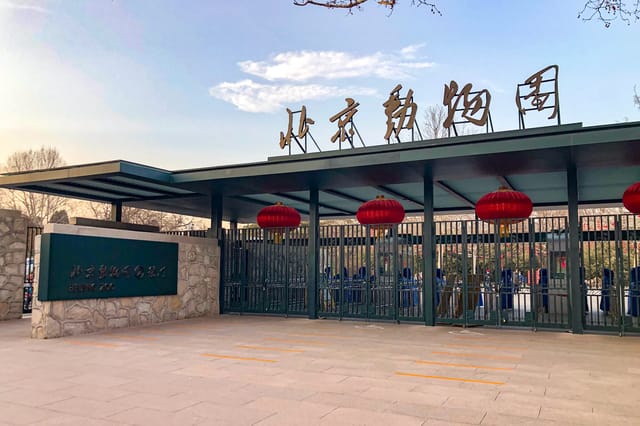
Gu Gu of Beijing Zoo. Gu Gu, born 25 September 1999, bit four intruders between 2006 and 2012. He was not vicious; he was a roughly 110 kg bear whose enclosure was repeatedly breached by people who mistook a sleeping animal for a plush toy. After the 2007 attack the zoo noted the barrier could not be raised higher without blocking public view; it was eventually raised and netted after the later incidents. He later hosted the US First Lady in 2017 without incident, and died at Beijing Zoo on 16 January 2025 aged 25. His profile in this archive records the same twenty-one years at Beijing Zoo.
Wei Hua and Ximei, 2016. The most severe panda injury on record happened to a professional. Wei Hua, a keeper with the China Conservation and Research Center, was checking on a cub named Baxi at Wolong when he encountered the mother, Ximei. Roughly 4 litres of blood loss, two broken wrists, torn foot tendons, and part of his left hand gone; doctors said he might never fully recover. The cause was not aggression but a tracking failure — the steep terrain had prevented Ximei’s radio signal from registering, so Wei did not know she was present (ECNS, 2016; CGTN, 2017). This was maternal defence in a situation no one had intended to create.
Wild incidents. Wild panda bites are even rarer. The 2014 Baishuijiang and 2022 Foping incidents are two of very few on record; in both the panda was cornered or defending a cub, and broke off once the person withdrew (Global Times, 2014; Xinhua, 2023). No wild panda has ever been recorded stalking or consuming a human.
5. When Pandas Actually Attack
Panda aggression is overwhelmingly defensive and falls into four triggers.
1. Protecting a cub. Maternal defence is the most dangerous scenario. For the first months after birth a cub is blind and helpless, and the mother is hyper-vigilant. She may not bluff-charge; she may simply charge and bite. The Wei Hua and Foping incidents fit this pattern (ECNS, 2016; Xinhua, 2023).
2. Cornered or blocked with no escape. Pandas in enclosures, or wild pandas surrounded by villagers and dogs, bite when they cannot retreat. The 2014 Baishuijiang panda had spent hours wandering the village before it bit a farmer; the 2024 Chongqing keeper was knocked down after shutting an access door the panda was heading for (Global Times, 2014; Chongqing Zoo, 2024).
3. Breeding-season arousal. Pandas converge during a short spring mating window from March to May. Males compete aggressively, vocalising, chasing and fighting. A 2019 PLOS ONE study found males housed next to rivals produced significantly more of the moan calls associated with aggression (Charlton et al., 2019). Keepers report elevated irritability during this window, and mating introductions bring animals into closer contact than routine husbandry does. Note that the 2024 Chongqing incident, sometimes filed under this heading, was not a breeding-season case — that panda is female.
4. Habituated, desensitised individuals. Captive pandas that have lost their fear of humans can be paradoxically more dangerous. An animal that no longer retreats is more likely to treat a reaching hand or a shouted taunt as something to swat or bite. A 2019 incident at Shenshuping, in which a visitor reached over a 1.6 m barrier to touch a cub and the base subsequently raised the fence, illustrates the point: a panda at the rail is not being friendly, it is close enough to grab a hand (ECNS, 2019).
6. Wild vs. Captive Risk
Wild pandas. A wild panda’s first response to a human is to leave. They live in steep bamboo forest at 1,500–3,000 m and detect people long before people detect them (Swaisgood, Wang & Wei, 2016). Attacks on hikers are essentially unheard of; the few recorded bites involved a mother with a cub or a cornered animal. The danger is that a frightened wild animal may give no warning — just a fast, silent rush out of dense bamboo. Our habitat guide covers where those encounters could realistically happen.
Captive pandas. Zoo pandas are desensitised to human sight and sound; many amble to the rail out of curiosity. That familiarity makes them look safe, which is why visitors keep concluding the barrier is optional. Captive pandas are more predictable, but predictability does not reduce bite force. Their tolerance of proximity is a social behaviour in its own right, covered in our article on why pandas live alone.
The most dangerous panda is not the angriest one; it is the one no longer afraid of you.
7. How to Stay Safe
“Keep a safe distance” is useless without specifics.
At the zoo or panda base:
- Stay behind every barrier. At Chinese panda bases, primary public barriers are typically 1.2–1.8 m tall; Shenshuping raised sections after the 2019 cub-touching incident (ECNS, 2019). International bear guidelines recommend vertical barriers of at least 3.6 m where dry moats are not used (GFAS, 2022; MPI NZ, 2013).
- Never reach through, over or under a rail. A 1.6 m wall is low enough for an adult to lean over, and for a panda to grab a hand.
- Do not climb in to retrieve items. In 2009 Gu Gu bit a man fetching a child’s toy (China News Service, 2009). Alert a keeper instead.
- Do not tap glass, shout, or mimic panda vocalisations.
- Never touch a cub, even at the rail. A cub within arm’s reach means a mother within charging distance.
If you encounter a wild panda: do not run; do not squat; back away slowly while facing the animal; give it an escape route; if a cub is visible, detour immediately; do not climb a tree unless the panda is already charging, since pandas climb well; if attacked, fight back at the face and muzzle and put an obstacle between you. No publicised panda attack has reached this stage.
Why “hold a cub for a photo” is the most dangerous act. A cub under six months looks like a stuffed animal, but its mother reads your proximity as a lethal threat. The Wei Hua and Foping incidents both involved proximity to a cub. Any facility inviting the public to hold a cub outside controlled professional settings is violating basic bear-safety norms.
8. Frequently Asked Questions
Have giant pandas ever killed anyone? No fatal attack has been publicly documented, in the wild or in captivity. Several people have sustained life-altering injuries — keeper Wei Hua lost partial use of his hands in 2016 — but no recorded bite has been fatal. That distinguishes pandas sharply from brown, black and polar bears, which kill people every year.
Can a panda bite your arm off? A canine bite force of about 1,300 newtons is not enough to cleanly sever an adult limb in one bite, but it is enough to crush bone, tear tendons and avulse large sections of soft tissue. The 2007 Gu Gu attack at Beijing Zoo exposed bone in the victim’s legs. A panda can permanently maim a hand, wrist or lower leg.
Are pandas more dangerous than black bears? An adult American black bear is larger, has a comparable or stronger bite, longer claws and far more predatory capability (Christiansen, 2007). Behaviourally, pandas are much less likely to initiate contact. A predatory black bear is more dangerous than any panda; a panda defending a cub is as dangerous as any bear its size.
Why do pandas attack zookeepers? Almost always one of three situations: the keeper is between a mother and her cub, as in the Wei Hua case; an animal is in breeding-season arousal and the keeper enters without proper shift-door protocol; or a routine movement goes wrong, as in Chongqing in 2024, when a keeper shut a door the panda was heading for and was knocked down in the chase. Accredited facilities use protected-contact protocols for adults to remove the first two risks entirely.
Are wild pandas dangerous to hikers? For nearly all hikers in panda habitat — Minshan, Qionglai, Qinling, Daxiangling, Xiaoxiangling, Liangshan — the risk is effectively zero. Pandas detect and avoid people long before a hiker sees them (Swaisgood, Wang & Wei, 2016). The two documented wild bites in recent memory both involved close-quarters encounters, with a mother and cub or a cornered animal (Xinhua, 2023; Global Times, 2014). Hike in groups, make noise, stay on trails, and never approach a cub.
Is it safe to touch a panda cub? No. A cub that looks abandoned is almost always watched by its mother from yards away in the bamboo. In captivity, touching a cub means reaching across a barrier installed to prevent exactly that; Shenshuping raised its fence after a visitor posted photos touching a cub’s head (ECNS, 2019). In the wild, approaching a cub is the most reliable way to trigger a defensive charge.
9. Explore Further
- Why pandas eat bamboo: the carnivore that became a specialist
- Panda teeth and bite force: how a bear crushes bamboo
- How big is the largest giant panda? Size and weight explained
- Where wild pandas live: the complete habitat guide
- Why pandas live alone: the ecology of solitary bears
- A day in the life of a panda keeper
- Panda rewilding: the history of the release programme
- Red panda vs giant panda: a comparison for young readers
Sources
A-level (peer-reviewed, government, or official institutional)
- Swaisgood, R., Wang, D. & Wei, F. (2016). Ailuropoda melanoleuca. The IUCN Red List of Threatened Species 2016: e.T712A45033386. https://dx.doi.org/10.2305/IUCN.UK.2016-2.RLTS.T712A45033386.en
- Figueirido, B., Tseng, Z. J., Serrano-Alarcón, F. J., Martín-Serra, A. & Pastor, J. F. (2014). Three-dimensional computer simulations of feeding behaviour in red and giant pandas relate skull biomechanics with dietary niche partitioning. Biology Letters, 10(4): 20140196. https://pmc.ncbi.nlm.nih.gov/articles/PMC4013707/
- Sun, M., Yan, X., Li, F., Tang, Y., Zhang, X., Dong, C., Huang, S., Zheng, Y., Luo, Y. & Zhou, S. (2024). Development of bite force and feeding rate in giant pandas and influencing factors. Acta Theriologica Sinica, 44(2).
- Charlton, B. D., et al. (2019). Influence of season and social context on male giant panda vocal behaviour. PLOS ONE, 14(11): e0225176. https://pmc.ncbi.nlm.nih.gov/articles/PMC6879133/
- Wroe, S., McHenry, C. & Thomason, J. (2005). Bite club: comparative bite force in big biting mammals. Proceedings of the Royal Society B, 272(1563): 619–625.
- Christiansen, P. (2007). Evolutionary implications of bite mechanics and feeding ecology in bears. Journal of Zoology, 272(4): 423–443.
- Smithsonian’s National Zoo and Conservation Biology Institute. Giant panda. https://nationalzoo.si.edu/animals/giant-panda
- U.S. Fish & Wildlife Service. Giant Panda (Ailuropoda melanoleuca). https://www.fws.gov/species/giant-panda-ailuropoda-melanoleuca
- Global Federation of Animal Sanctuaries (2022). Standards Appendix for Bear Sanctuaries. https://sanctuaryfederation.org/wp-content/uploads/2023/01/Bear-Standards-Appendix-2022.pdf
- Ministry for Primary Industries, New Zealand (2013). Zoo enclosure guidelines for containment area design (bears, Category C1). https://www.mpi.govt.nz/dmsdocument/33241/direct
- Penteriani, V., et al. (2016). Human behaviour can trigger large carnivore attacks in developed countries. Scientific Reports, 6: 20552.
B-level (mainstream media and institutional reports, cited for incident details)
- Xinhua News Agency (2004, Feb 2). Giant Panda Injures Intruder. China.org.cn. http://www.china.org.cn/english/China/86126.htm
- The Telegraph (2007, Oct 22). Panda attacks boy in Beijing zoo. https://www.telegraph.co.uk/news/earth/earthnews/3311260/Panda-attacks-boy-in-Beijing-zoo.html
- Global Times (2014, Mar 2). Visiting panda meets, bites villager. https://www.globaltimes.cn/content/845657.shtml
- ECNS (2016, Dec 30). Keeper mauled by mother panda. http://www.ecns.cn/2016/12-30/239592.shtml
- CGTN (2017, Dec 18). Panda-feeding is not about playing, it also has risks. https://news.cgtn.com/news/346b444f32637a6333566d54/index.html
- ECNS (2018, Feb 2). Cutest job in the world not so cushy. http://www.ecns.cn/2018/02-02/291281.shtml
- ECNS (2019, Apr 18). Panda park raises barrier after visitor touches cub. http://www.ecns.cn/m/news/panda/2019-04-18/detail-ifzhpeef7883440.shtml
- CRI (2023, Apr 25). Does giant panda bite people? https://news.cri.cn/2023-04-25/dc0978a4-59f1-d8d2-128c-1df62d2afc79.html
- Xinhua Daily Telegraph (2023, Feb). Foping ranger bitten by mother panda, December 2022. Reported via Foping National Nature Reserve channels; no public archive link available.
- Ocean Park Hong Kong (2008). Keeper injury report, classified by the park as an administrative rather than animal fault.
- The San Diego Union-Tribune (2011). Keeper injured by giant panda Bai Yun at San Diego Zoo.
- Huaxi Metropolis Daily (2012). Villagers bitten while attempting to capture a wild panda, Longchi reserve, Wenchuan.
- Chongqing Zoo (2024, 19 September). Official statement on the keeper incident involving the panda Ding Ding.
- WWF (2017). Giant Panda Factsheet. https://www.wwf.org.uk/sites/default/files/2018-01/WWF_WIW_2017_Factsheet_GiantPanda%20FINAL.pdf
- Britannica (2026). Giant panda. https://www.britannica.com/animal/giant-panda
- van der Meijden, A., et al. (2023). Measurement of voluntary bite forces in large carnivores. Journal of Experimental Biology.
Note on the red panda
The red panda (Ailurus fulgens, family Ailuridae) is a much smaller, unrelated species and is not discussed in this article. All references to “panda” above refer exclusively to the giant panda, Ailuropoda melanoleuca (family Ursidae).

Dr. James Thornton
Wildlife Ecology Editor
Wildlife ecologist specializing in forest ecology, protected area effectiveness, mammal community conservation, and human-wildlife coexistence in panda habitats.
View full profile →Tags in this article
Questions readers often ask
Have giant pandas ever killed anyone?
No fatal attack has been publicly documented, in the wild or in captivity. Several people have sustained life-altering injuries — keeper Wei Hua lost partial use of his hands in 2016 — but no recorded bite has been fatal. That distinguishes pandas sharply from brown, black and polar bears, which kill people every year.
Can a panda bite your arm off?
A canine bite force of about 1,300 newtons is not enough to cleanly sever an adult limb in one bite, but it is enough to crush bone, tear tendons and avulse large sections of soft tissue. The 2007 Gu Gu attack at Beijing Zoo exposed bone in the victim's legs. A panda can permanently maim a hand, wrist or lower leg.
Are pandas more dangerous than black bears?
An adult American black bear is larger, has a comparable or stronger bite, longer claws and far more predatory capability. Behaviourally, pandas are much less likely to initiate contact. A predatory black bear is more dangerous than any panda; a panda defending a cub is as dangerous as any bear its size.
Why do pandas attack zookeepers?
Almost always one of three situations: the keeper is between a mother and her cub, as in the 2016 Wei Hua case; the animal is in breeding-season arousal and the keeper enters without proper shift-door protocol; or husbandry procedures fail and the animal is not secured before entry. Accredited facilities use protected-contact protocols for adults.
Are wild pandas dangerous to hikers?
For nearly all hikers in panda habitat, the risk is effectively zero. Pandas detect and avoid people long before a hiker sees them. The two documented wild bites in recent memory both involved close-quarters encounters — a mother with a cub, or a cornered animal. Hike in groups, make noise, stay on trails, and never approach a cub.
Is it safe to touch a panda cub?
No. A cub that looks abandoned is almost always watched by its mother from yards away in the bamboo. In captivity, touching a cub means reaching across a barrier installed to prevent exactly that. In the wild, approaching a cub is the most reliable way to trigger a defensive charge.