Table of contents (9 sections)
A Panda Cub’s First Year: From Pink Mouse to Black-and-White Ball
🐼 Did you know? A newborn panda is about the size of a stick of butter — and looks nothing like the fluffy black-and-white bears you see in photos! In its first year, a panda cub goes through the most dramatic transformation in the bear family. Let’s follow the journey!
Key Takeaways
-
🐭 Panda cubs start tiny. At birth, they weigh just 100-150 grams — about 1/900th of their mother’s weight — and look more like pink mice than pandas. They are blind, hairless, and completely dependent.
-
👀 The first year is a complete transformation. In just 12 months, a cub goes from a blind, squeaking newborn to a fully furred, tree-climbing, bamboo-eating young panda — the most dramatic growth of any bear species.
-
🧗 Play is serious business. Every climb, tumble, and toy-chase builds the muscles, coordination, and confidence a panda needs to survive. Panda cubs learn by watching, copying, and trying — just like human children do.
Hello, young panda explorer! You’re about to follow one of the most amazing journeys in the animal kingdom: the first year of a giant panda cub’s life. Get ready to meet a creature so tiny it can fit in the palm of your hand — and watch it grow into a roly-poly, bamboo-munching, tree-climbing bundle of fluff!
Month 0: The Pink Mouse Stage 🐁
Imagine something smaller than your hand. Smaller than a juice box. About as heavy as a small apple or a stick of butter — just 100 to 150 grams. That’s how tiny a newborn panda cub is!
When baby pandas are born, they look nothing like their parents. They are completely pink — not a single black or white hair on their body. Their skin is so thin and pink that it looks almost see-through, like the inside of your eyelid. They are blind, with their eyes tightly sealed shut. Their ears are just tiny folded flaps of skin. They can’t walk, can’t crawl properly, and can barely even make sounds louder than a tiny squeak.
A newborn panda cub does only three things: drink milk, sleep, and squeak for more milk. Mother panda cradles the cub against her warm belly, where it nurses almost constantly — about every two hours around the clock. The mother doesn’t leave to eat or drink; she stays with the cub, holding it against her body, keeping it warm with her breath and the thick fur of her chest.
Why so tiny? Scientists think panda cubs are born so tiny because their mothers eat bamboo, which is low in energy. Instead of growing a big baby inside, the mother gives birth to a tiny cub that grows big outside by drinking her rich, fatty milk — which is actually pink in color! If a human baby was born at the same stage as a panda cub, it would weigh less than a bag of chips.
Month 1: The First Black Spots Appear 🎨
Around the end of the first week, something magical happens: faint gray patches begin to appear around the cub’s eyes. They look like someone gently smudged charcoal on the baby’s face. Then the ears begin to darken. By week three, the shoulder band — that black band across the upper back and front legs — starts to show.
This is the same order that panda coloration evolved, as explained in our article about why pandas are black and white. The eye patches and ear markings — used for recognizing friends — come first. The camouflage colors come later. The baby panda is literally retracing its species’ evolutionary history!
During this month, the cub spends 95% of its time either nursing or sleeping. Mother panda holds the cub almost constantly, often cradling it in one massive paw while she herself dozes. The cub’s only exercise is a slow, wobbly wriggle toward warmth if it slides away from its mother’s belly.
Month 2: Eyes Open! 👀
Between six and eight weeks, the cub’s eyes finally open. The first days of sight are blurry — everything looks like it’s underwater. The cub will blink frequently, squint in bright light, and seem confused by the shapes moving around it. But within two weeks, its vision sharpens, and the cub begins to recognize the most important shape in its world: the large, black-and-white face of Mother.
This is also the month when the cub’s vocal range expands beyond the basic squeak. The cub now makes a wider range of sounds — including a soft, high-pitched bleating noise that sounds a bit like a baby sheep. This “baa” sound is a friendly greeting, used between mothers and cubs to say “I’m here” and “I’m okay.” Our guide to panda vocalizations explores 12 different sounds pandas make.
Can the cub walk yet? Not really! At two months, the cub can crawl — a slow, determined belly-slide toward Mother — but its legs are still too weak to support its weight. It will be another two months before it can stand on all four paws.
Month 3-4: The Wobbly Walker 🚶
By three months, the cub has its full black-and-white coat, and it looks like a perfect miniature panda — just much, much smaller. It now weighs about 3-4 kilograms (6-9 pounds), roughly the size of a small house cat.
The big milestone this month: the cub can stand! The first attempts are hilarious and heartwarming. The cub pushes up on all four legs, sways dramatically from side to side, and usually topples over sideways onto the soft bedding. But with practice — and lots of failed attempts — the cub manages short, wobbly walks across the enclosure. Mother panda watches nearby, close enough to catch the cub if it rolls into danger.
Counter-intuitive fact! 🧠 Most people think baby pandas learn to walk by themselves, like human babies do. But panda cubs actually learn by watching their mother’s movements and copying her. They are visual learners — they watch, they try, they fall, and they try again. This is why cubs raised without their mothers (in cases where the mother rejects them) sometimes take longer to learn basic skills.
By four months, the cub is actively exploring its enclosure — wobbling toward interesting smells, pawing at bamboo stalks (though without eating them), and beginning to play with simple objects. At this age, the cub’s fur is incredibly soft — much softer than an adult panda’s coarse coat. If you could touch it (you can’t — but if you could), it would feel like the softest stuffed animal you’ve ever held.
Month 5-6: Climbing School 🏔️
This is when things get exciting! At five to six months, the cub begins climbing school — the most important class in panda kindergarten. Mother panda leads the way, climbing a sturdy tree trunk and looking back expectantly at the cub.
The cub’s first climbing attempts are painfully slow. It wraps its paws around the trunk but can’t get a grip. It slides back down, tail-first, and lands in a fluffy heap at the base of the tree. It tries again. And again. And again.
Learning to climb isn’t just about having fun — though the cub certainly seems to enjoy it. Climbing is a survival skill, explored in our article on panda climbing and swimming abilities. In the wild, a young panda that can’t climb a tree is vulnerable to predators like leopards and wild dogs. The cub doesn’t know this — it just knows that Mother goes up the tree, and Mother is where safety is.
By six months, most cubs can climb a few meters high, though getting back down is still a challenge. Going up is climbing. Going down is controlled falling.
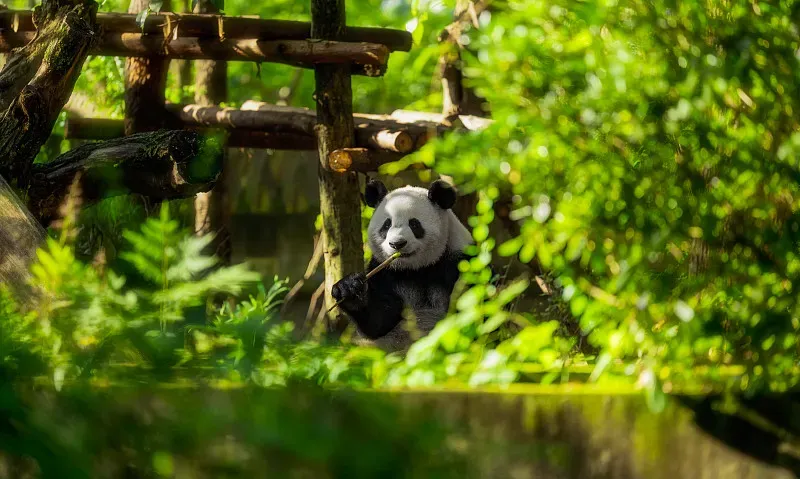
First taste of bamboo! 🎋 Around this age, the cub picks up its first bamboo stalk — not to eat, exactly, but to chew. The cub doesn’t have the jaw strength or the digestive system to actually eat bamboo yet. It’s just practicing. The stalk gets thoroughly gummed, then discarded. Mother panda watches and, in a behavior that keepers find endlessly amusing, will sometimes pick up the discarded stalk and eat it herself. Waste not.
Add these milestones to compare with other baby pandas in our panda family tree article!
Month 7-9: The Playful Phase 🎾
By seven months, the cub is fully mobile and increasingly independent. It still nurses from Mother but begins exploring further from her side — sometimes several meters away, though always within a hasty retreat if something startles it.
This is the golden age of panda play. The cub discovers toys — both natural (sticks, bamboo stalks, patches of snow) and enrichment items provided by keepers (balls, burlap sacks, puzzle feeders). Play serves a serious developmental purpose: it builds the muscles, coordination, and problem-solving skills the cub will need as an adult. Our article on environmental enrichment for pandas explains how keepers design these toys.
A typical play session looks like chaos in slow motion: the cub rolls over a ball, gets stuck underneath it, kicks its legs in the air, rights itself, and immediately pounces on a completely different toy. It has the attention span of a soap bubble and the energy of a wind-up toy.
Weight check! By nine months, the cub weighs 20-25 kilograms (44-55 pounds) — about as heavy as a medium-sized dog. That’s nearly 200 times its birth weight.
Month 10-12: Almost Grown Up 🐼
In the final months of its first year, the cub is eating bamboo regularly — though it still nurses from Mother as well. The transition from milk to bamboo is gradual, and the cub’s digestive system is developing the gut bacteria it needs to process bamboo efficiently — the same microbiome explored in our panda gut microbiome article.
The cub now weighs 30-35 kilograms (66-77 pounds) and looks unmistakably like a panda, not a panda cub. It can climb confidently, eat bamboo independently, and navigate its enclosure with the assurance of an animal that has learned to trust its own body.
At one year old, the cub has completed the most dramatic physical transformation of any bear species. It entered the world as a pink, hairless, blind creature weighing less than a grapefruit. It ends its first year as a miniature adult — fully furred, visually alert, physically coordinated, and beginning to develop the individual personality that will define it for the rest of its panda life.
Frequently Asked Questions
Does the mother panda have twins?
Yes! About 45% of panda pregnancies result in twins. But in the wild, the mother usually raises only one — she simply doesn’t have enough milk or energy for two. At panda bases, keepers use a special “twin swapping” technique: they rotate the cubs between mother and incubator, so both get milk and mother’s warmth. This is the twin swapping technique that has achieved near-100% twin survival in captivity.
When does a baby panda leave its mother?
In the wild, cubs stay with their mother for 18-24 months. In captivity, cubs are typically weaned and separated at around 12-18 months, when they are eating bamboo independently and no longer need milk. The separation is emotional for both mother and cub — and for the keepers who have watched them together for more than a year.
Can I see a baby panda at the zoo?
Baby pandas are usually born between July and September. The best time to see very young cubs is August through October, though many cubs are visible only through nursery cameras rather than in person. Check panda base websites for their “panda cam” links — watching a cub on camera is the next best thing to being there!
Why does a panda cub spend so much time sleeping?
Sleep is when growth happens! Panda cubs grow incredibly fast, and their bodies release growth hormones during deep sleep. A cub that sleeps 18 hours a day is doing exactly what it’s supposed to do — building muscle, bone, and fur while it dreams.
Want to learn more about what pandas eat as they grow up? Check out our article on panda cakes (wowotou) and the surprising things in a panda’s lunchbox!
Dr. Lin Chen
Conservation Genomics Editor
Conservation geneticist specializing in giant panda genomics, molecular ecology, and evolutionary biology. Validates all genetics and genome-related content on Panda Common.
View full profile →Tags in this article
Questions readers often ask
How much does a newborn panda weigh?
A newborn panda weighs only 100-150 grams — about as much as a stick of butter or a small apple! That's just 1/900th of its mother's weight, making panda cubs the smallest newborns relative to mother size of any mammal except marsupials like kangaroos.
When do baby pandas open their eyes?
Baby pandas open their eyes at 6-8 weeks old. Before that, they are completely blind and rely on their mother's warmth, scent, and milk to survive. When their eyes finally open, everything is blurry at first — it takes another few weeks for their vision to become clear.
When does a baby panda first eat bamboo?
Baby pandas start nibbling on bamboo at around 6 months old, but they still drink their mother's milk until about 9-12 months. The transition from milk to bamboo is gradual — they practice chewing on soft bamboo shoots long before they can actually digest them properly.
How does a baby panda learn to climb trees?
Mother pandas teach their cubs to climb by example. Around 5-6 months old, the cub will follow its mother as she climbs a tree, learning where to place its paws and how to grip the bark. The first attempts are wobbly and often end with the cub sliding back down, but by 8-10 months, most cubs are confident climbers.
Why are baby pandas born so tiny?
Scientists believe panda cubs are born so tiny because of the mother's bamboo diet. Bamboo is low in energy, so panda mothers can't provide as much nutrition to their developing cubs as other bears can. The cub is born prematurely by bear standards and does most of its growing outside the womb, drinking its mother's rich milk.