Twin Survival: Why Wild Panda Mothers Usually Raise Only One Cub
Key Fact: Nearly half of all panda pregnancies — approximately 45% — produce twins. But in the wild, the mother almost invariably abandons one cub within hours or days of birth, focusing her limited energy on the stronger infant. This is not cruelty — it is evolutionary arithmetic. A panda mother on a low-calorie bamboo diet simply cannot produce enough milk for two cubs, and attempting to raise both would risk losing both. In captivity, panda researchers have developed the “twin swapping” technique — rotating cubs between mother and incubator — that has achieved near-100% twin survival and transformed the captive breeding program from a struggle into a success.
Key Takeaways
-
45% of panda births are twins — a remarkably high rate for bears, but a reproductive strategy that fails in the wild due to energy constraints.
-
Selective abandonment is an evolutionary adaptation, not maternal failure. The mother allocates her limited resources to the cub with the best survival odds.
-
Twin swapping in captivity is one of panda conservation’s greatest technical achievements — a simple but ingenious protocol that saves both cubs without disrupting maternal care.
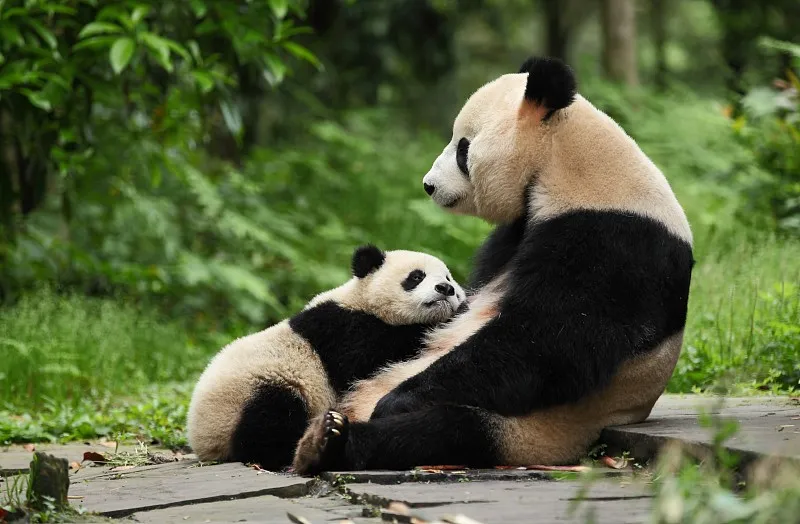
The birth itself is almost invisible — a tiny, pink, hairless creature, weighing little more than a stick of butter, emerging silently into the world. The mother, massive and gentle, scoops the newborn against her belly with a paw as large as the cub’s entire body. She begins to nurse, her body releasing the rich milk that will sustain her infant.
And then — a second birth. A second cub, equally tiny, equally pink, equally demanding.
The mother faces an immediate, brutal arithmetic problem. She has approximately 1,000 milliliters of milk per day to give. Each cub needs approximately 700 milliliters to survive. Together, they need 1,400 — 40% more than she can produce. Her body, sustained by a diet of bamboo that barely meets her own energy needs, cannot bridge the gap.
In the wild, the solution is swift and terrible. Within hours, the mother makes a choice — not conscious, but instinctive, programmed by millions of years of evolution that has never favored the gamble of raising two. She selects the stronger cub, the one that vocalizes more vigorously, the one that latches more securely. She ignores the other. The abandoned cub, too small to thermoregulate, too weak to crawl, dies within hours.
This is selective abandonment — and it is the reason wild panda twins almost never both survive.
The Energy Arithmetic of Panda Motherhood
To understand why panda mothers abandon twins, you must understand the energy economics of their existence. A lactating panda mother is the most metabolically stressed animal in the bear family.
Bamboo provides approximately 4,000-5,000 kilocalories per day to an adult panda — barely enough to maintain her own body weight. Lactation demands approximately 3,000 additional kilocalories per day for a single cub. For twins, the demand doubles to 6,000 additional kilocalories — exceeding her total daily energy intake, even if she ate continuously.
The mother cannot simply eat more. Her bamboo intake is already at maximum capacity — 38 kilograms per day is the upper physiological limit. She cannot supplement her diet with more energy-dense food, because no such food exists in her habitat. She is trapped by the energy ceiling that defines panda biology: bamboo supports one cub adequately, neither cub generously, and two cubs impossibly.
The evolutionary logic is cold but clear. A mother who attempts to raise both twins on insufficient milk will produce two underweight, immunocompromised cubs, both likely to die. A mother who concentrates her resources on one cub produces a single healthy infant with dramatically better survival odds. Over evolutionary time, the genes for selective abandonment outcompeted the genes for attempting the impossible.
Counter-intuitive fact! 🧠 The high twin rate itself is an evolutionary strategy. By producing two cubs but raising one, the mother gains a form of reproductive insurance: if one cub is stillborn or dies immediately, the other may survive. The second cub is not an “accident” — it is a backup, a genetic bet-hedging strategy that increases the odds that at least one offspring survives to reproduce. The cost — the inevitable death of one twin — is the premium on the insurance policy.
Twin Swapping: The Captive Solution
In the 1990s, researchers at the Chengdu Research Base confronted the twin problem directly. They had breeding females producing twins at the expected rate — but losing one cub almost every time. The captive breeding program, already struggling with low reproductive rates, could not afford to lose half of its cubs.
The solution was elegant in its simplicity: if the mother cannot feed both cubs simultaneously, let her feed them sequentially. Rotate the cubs — one with the mother, one in an incubator — swapping them every few hours. The mother nurses whichever cub is presented to her. The incubator keeps the other warm and fed with supplemental formula. Both cubs receive maternal antibodies through her milk. Both survive.
The protocol developed at Chengdu, now standard at panda breeding facilities worldwide, works as follows:
-
Immediately after birth: Both cubs are briefly examined by veterinary staff. The stronger cub is placed with the mother to begin nursing. The weaker cub is placed in a temperature-controlled incubator and fed colostrum-rich formula.
-
First 48 hours: Cubs are swapped every 2-3 hours. The mother receives each cub calmly — researchers discovered that panda mothers do not distinguish between their own twin cubs by individual identity during the first days, accepting whichever cub is presented.
-
Week 1-4: Swapping continues at 3-4 hour intervals. Both cubs gain weight. The mother’s milk production, stimulated by frequent nursing, increases to support the alternating schedule.
-
Month 1-3: Swapping frequency decreases as cubs become more robust. By 3 months, both cubs may be with the mother simultaneously for extended periods — the critical early window, when selective abandonment would have occurred in the wild, has passed. For a week-by-week account of how cubs grow during this period, see our guide to panda cub development from birth to independence.
The results transformed panda conservation. Twin survival in captivity rose from near-zero to over 95%. The Chengdu Research Base, which had struggled for years to produce enough cubs to sustain a genetically viable population, suddenly had the opposite problem: managing a baby boom.
The Scent Transfer Secret
One of the most remarkable discoveries of the twin-swapping research was that panda mothers identify their cubs by scent, not by visual recognition or individual vocalization patterns. This is why swapping works: if the cubs smell the same, the mother accepts both.
Keepers facilitate this by rubbing each cub with the same bedding material — a soft cloth that absorbs the mother’s scent from her enclosure. When a swapped cub is presented, it carries the familiar scent, and the mother responds with nursing behavior rather than rejection.
The scent-based recognition also explains why selective abandonment works in the wild: the mother bonds to the scent of the first cub she nurses extensively. The second cub, with a slightly different scent profile, is perceived as foreign — and in the wild, a foreign cub near a nursing mother would typically be a threat, not an offspring.
Frequently Asked Questions
Do wild panda twins ever both survive?
Extremely rarely. There are a handful of documented cases — typically when the mother is in exceptional physical condition, the bamboo is unusually nutritious that season, and both cubs are robust from birth. But these are exceptions that prove the rule: in the vast majority of wild twin births, one cub dies within the first week.
Does twin swapping affect the mother-cub bond?
Research suggests no long-term impact. Cubs raised through twin swapping develop normally, form strong bonds with their mothers during the periods they spend together, and show normal social behavior as adults. The swapping protocol is designed to maximize maternal contact time for both cubs, not replace maternal care.
How does twin swapping compare to similar techniques for other species?
Twin swapping was pioneered for pandas but has since been adapted for other species where mothers struggle with multiple births — including some primate species and certain carnivores. However, the panda version is uniquely successful because panda mothers’ scent-based recognition system makes them unusually tolerant of cub rotation.
In the nursery at Chengdu, a keeper lifts a cub from an incubator and carries it to its mother’s enclosure. The mother, dozing, opens her eyes, sniffs the approaching cub, and pulls it to her belly without hesitation. In the wild, this second cub would be dead. Here, it is simply the next in rotation — alive, growing, and unaware that it owes its existence to a keeper’s arms and a mother’s inability to count.