Table of contents (12 sections)
10 Quirky Panda Habits Kids Always Ask About
🐼 Key Fact: Pandas do some of the strangest things in the animal kingdom — rolling down hills for fun, pooping 40 times a day (with surprisingly pleasant-smelling results), and sleeping more than almost any other large animal. Every quirky panda habit has a scientific reason behind it — and some of those reasons will surprise you!
Key Takeaways
-
🤸 Every quirky panda habit has a biological reason. Rolling for fur cleaning, sleeping for energy conservation, sitting upright for efficient eating — nothing is random. Pandas are perfectly adapted to their bamboo-based lifestyle.
-
🧠 Pandas are smarter than they look. Controlled body rolls down hills, scent-marking communication, tool-like use of their pseudo-thumb, and the ability to learn complex medical training routines all point to an intelligence that’s often underestimated because pandas move slowly and sleep a lot.
-
💩 The poop is serious science. Panda droppings tell researchers almost everything they need to know about wild panda populations — identity, diet, health, and genetics. Next time you see panda poop, remember: you’re looking at data!
Hey panda fans! Have you ever watched a panda video and thought, “Wait… why is it doing THAT?” You’re not alone! Pandas are some of the quirkiest animals on Earth. They roll, they tumble, they eat sitting up like humans, and they spend most of their lives doing things that seem completely weird.
But here’s the secret: every strange panda habit has a scientific reason behind it. Let’s explore the 10 most-asked questions about panda behavior — and the cool answers!
1. Why Do Pandas Roll Around So Much? 🤸
You’ve seen the videos: a panda at the top of a grassy hill, tucking into a ball, and rolling — bouncing and tumbling — all the way to the bottom. Then climbing back up to do it again!
Pandas roll for three main reasons:
First: It feels good! Rolling scratches hard-to-reach places on their back and sides. Think about how you might roll over in bed to get comfortable — pandas do the same thing, just with more style.
Second: It cleans their fur. When a panda rolls through grass or snow, loose fur gets pulled away by friction. It’s like a natural brushing session.
Third: It cools them down. On hot days, pandas roll onto cool patches of ground or tile, pressing their bellies against the cold surface. A panda’s belly has less insulating fur, so belly-to-floor contact helps release body heat — like pressing your face against a cool pillow on a summer night.
Young pandas roll the most — they’re playful and energetic, and rolling is basically their version of a somersault. Older pandas still roll, but more for comfort than for fun. If pandas had a gymnastics team, the cubs would be the stars and the adults would be the coaches saying, “I used to do that, but my back hurts now.”
🧠 Did you know? The stereotype that pandas are clumsy isn’t really true! When a panda rolls downhill on purpose, it’s showing excellent body control — it tucks its head, protects its spine, and knows exactly how to land. Wild pandas use controlled body slides to descend steep slopes without wasting energy. It looks silly, but it’s actually smart!
2. Is Panda Poop Really Not Smelly? 💩
This is the question kids love to ask — and the answer is genuinely surprising.
Panda poop does NOT smell as bad as the poop of most animals. Why? Because pandas eat almost nothing but bamboo — no meat, no fish, no rich food that creates strong-smelling waste. Fresh panda droppings smell a bit like dried hay, fresh-cut grass, or green tea. Some keepers say it has a faint, earthy sweetness, like damp leaves in a forest.
Pandas poop A LOT — up to 40 times a day! That’s because bamboo is hard to digest. A panda’s digestive system can only extract about 17-20% of the nutrients from bamboo, so the other 80% passes right through. The result is a constant stream of fibrous, greenish-yellow droppings that look like compressed sawdust.
Scientists LOVE panda poop. By collecting and analyzing panda droppings in the wild, researchers can identify individual pandas (by the DNA in the poop), figure out what each panda eats (by the bamboo species in the poop), and check their health (by analyzing the bacteria in the poop). One wild panda’s entire life story can be read from its poop! Our article on scat DNA analysis and panda census methods explains this fascinating science.
Want an even cooler poop fact? In some research centers, panda poop is recycled into paper! The undigested bamboo fibers make a rough, fibrous paper that’s used for souvenirs and art projects. Yes — you can literally write a letter on recycled panda poop.
3. Why Do Pandas Sleep So Much? 😴
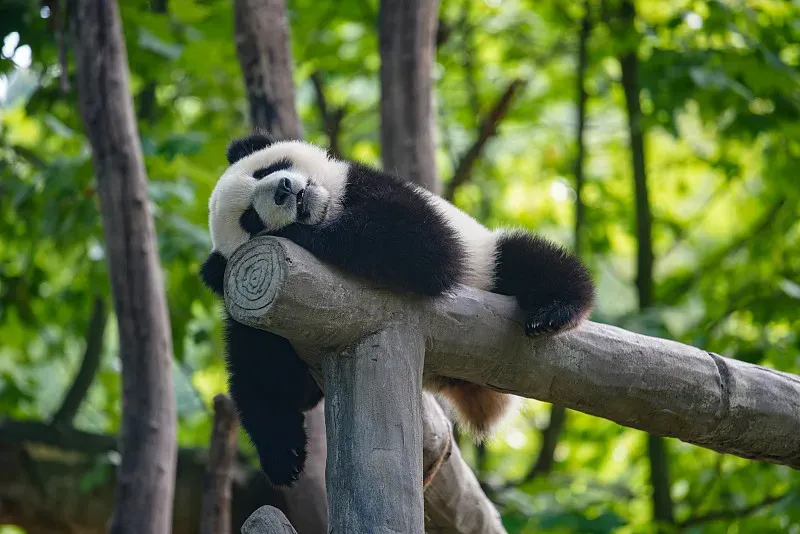
If pandas had a report card, “Sleeping” would be their best subject, and “Staying awake” would be their worst. A giant panda sleeps between 10 and 16 hours every single day!
The reason goes back to bamboo. Bamboo is basically the celery of the bear world — it fills you up but gives you almost no energy. A panda has to eat 12-38 kilograms (26-84 pounds) of bamboo daily just to get enough calories to survive. That’s like a human eating 200 salads a day.
But digesting bamboo is also tiring work. So pandas adopt a simple life strategy: eat as much as possible, then sleep for as long as possible to conserve energy. Eat, sleep, repeat. It’s not the most exciting lifestyle, but it works — pandas have been following this schedule for about 2 million years.
Pandas sleep in some of the weirdest positions you’ll ever see. Sometimes they sleep flat on their backs with all four paws in the air (this is called the “starfish” and it means they feel completely safe). Sometimes they sleep draped over a tree branch like a furry towel. Sometimes they sleep sitting up, with their chin resting on their chest, like someone who fell asleep on a long bus ride.
4. Do Pandas Get Bored of Eating Bamboo? 🎋
Imagine eating the same food 99% of the time for your entire life. You’d get bored, right?
Pandas don’t seem to get bored of bamboo, but they ARE picky about WHICH bamboo they eat — and which PARTS of the bamboo. Throughout the year, they chase the tastiest bamboo parts through the mountains:
- Spring (March-May): Tender new bamboo shoots, like asparagus tips. Sweet, juicy, and easy to digest. The panda equivalent of a seasonal farmers’ market treat.
- Summer (June-August): Bamboo leaves from mid-elevation forests. Leaves are more nutritious than stalks and stay green all summer.
- Autumn (September-November): A mix of leaves and stalks as pandas begin moving to lower elevations.
- Winter (December-February): Thick bamboo stalks from lower elevations, where the bamboo hasn’t frozen. The stalks contain stored sugars, giving pandas a carbohydrate boost for the cold months — like eating pasta before a winter marathon!
They also enjoy treats! Pandas in captivity get apples, carrots, and special “panda cakes” called wowotou — baked biscuits made from grains, soybeans, and vitamins that supplement their bamboo diet. Our panda cake nutrition guide has the full recipe!
5. Can Pandas Swim? 🏊
Surprise: pandas are good swimmers! In the wild, wild pandas regularly cross rivers and streams. They paddle with their front paws and steer with their back legs. Their thick, oily fur repels water and keeps them buoyant, like a built-in life jacket.
At zoos and panda bases, many pandas have pools in their enclosures — especially during the hot Sichuan summers when temperatures regularly exceed 30°C (86°F). Pandas will wade into the water, splash around, and even swim short laps. Some pandas clearly enjoy it; others tolerate it only when they’re too hot to do anything else.
Our article on panda climbing and swimming superpowers explores these skills in more detail!
One famous swimming panda was a wild panda rescued in 2008. During the Wenchuan earthquake, this panda reportedly swam across a flooded river to escape a collapsing hillside — a dramatic survival story that impressed even the veteran researchers who witnessed it.
6. Why Do Pandas Sit Like Humans to Eat? 🪑
Watch a panda eating bamboo, and you’ll notice something strange: it often sits upright, leaning against a rock or a tree trunk, holding its bamboo stalk with both paws, munching away exactly like a person eating corn on the cob.
This sitting posture is actually an energy-saving trick! By leaning against something, the panda uses less muscle effort to support itself and can focus its energy on the serious business of chewing bamboo — which takes enormous jaw power.
The panda holds the bamboo stalk with both front paws, using its pseudo-thumb (discussed in our pseudo-thumb evolution article) to grip the stalk while rotating it between bites. The whole process looks so humanlike that visitors to panda bases often do a double-take: “Wait, is that panda… sitting at a table?“
7. Do Pandas Ever Eat Meat? 🥩
Counter-intuitive alert! Most people think pandas eat ONLY bamboo. But in the wild, pandas have been observed eating small animals — rodents, birds, even carrion (dead animals) — when the opportunity arises!
Pandas are classified as carnivores by their anatomy: they have the sharp teeth, short digestive tract, and digestive enzymes of meat-eating animals. Their wild ancestors definitely hunted. When wild pandas today occasionally eat meat, they’re not being strange — they’re briefly returning to their evolutionary roots.
But these meat-eating moments are rare. Bamboo still makes up over 99% of a wild panda’s diet. The occasional mouthful of meat is more like a protein snack than a meal replacement. In captivity, keepers don’t feed meat to pandas — they get all their protein from bamboo, panda cakes, and occasional eggs.
8. Why Do Pandas Sneeze So Loudly? 🤧
If you ever visit a panda base and hear what sounds like someone loudly clearing their throat, don’t worry — it’s probably just a panda sneezing!
Pandas sneeze just like humans do — to clear their nasal passages of dust, bamboo fiber fragments, and other irritants. But because pandas have large lungs (to support their 100-kilogram bodies), their sneezes are LOUD. A panda sneeze has been recorded at over 80 decibels — about as loud as a garbage truck passing by.
The most famous panda sneeze in history happened in 2006, when a baby panda at the Chengdu Base sneezed so unexpectedly that its mother jumped in surprise and almost dropped the cub. The video became one of the first viral panda videos on YouTube, and 18 years later, people still watch it and laugh.
9. Why Are Pandas Awake at Odd Hours? 🕐
Pandas don’t follow a strict day-night schedule. They’re described as “crepuscular” — meaning most active during dawn and dusk — but they’re actually active in short bursts throughout both day and night.
The reason is, again, bamboo. Because bamboo is so low in energy, pandas can’t afford to be active for long stretches. They alternate between short eating sessions (1-2 hours), brief periods of movement or play, and longer sleeping periods. This pattern repeats around the clock, 24 hours a day.
In captivity, pandas adjust somewhat to their keepers’ schedules — they know when food will arrive and are usually awake for morning and afternoon feeding sessions. But at night, when the base is quiet, they still wake up multiple times for midnight bamboo snacks.
10. Can Pandas Recognize Themselves in a Mirror? 🪞
This is one of the most debated questions in panda behavior science. Some animals — chimpanzees, dolphins, elephants — can recognize their own reflection as “me.” Most animals think the reflection is another animal.
Pandas fall somewhere in the middle. When researchers at the Chengdu Base placed mirrors in panda enclosures, the pandas reacted in interesting ways: young pandas approached the mirror curiously and sometimes tried to interact with their reflection as if it were another panda cub. Adult pandas typically sniffed the mirror thoroughly, then lost interest — suggesting they figured out it wasn’t a real panda.
But whether they recognized the reflection as THEMSELVES — as “me” — remains unproven. The mirror test is tricky with pandas because their vision isn’t their primary sense; they rely more on smell to identify individuals. A panda might not care about a mirror reflection because it has no scent — which, to a panda, means it’s not a real panda anyway!
Frequently Asked Questions
Do pandas communicate with each other by rolling?
Not directly — but scent-marking while rolling IS a form of communication! Pandas have scent glands around their tail area, and when they do a specific back-and-forth rolling motion against a tree or rock, they’re leaving behind their scent — like leaving a handwritten note that says “Panda was here.”
Why do mother pandas lick their cubs so much?
Licking serves multiple purposes: it cleans the cub, stimulates its digestive system (important for newborns who can’t toilet on their own), and strengthens the mother-cub bond through physical contact. It also transfers scent — marking the cub as belonging to this particular mother.
Can you tell a panda’s mood by how it behaves?
Absolutely! A relaxed panda sits or lies with limbs loose and ears forward. An agitated panda paces, vocalizes (barking or honking), and may swipe at the ground. A playful panda rolls, tumbles, and engages with toys or enrichment items. Keepers learn to read these signs quickly — it’s an essential part of their daily work, as our article on a day in the life of a panda keeper describes.
Love learning panda fun facts? Test your knowledge with our Panda Expert Quiz and see if you’re a true panda expert!
Pandacommon Editorial Team
Pandacommon is a global knowledge project documenting giant pandas, habitats, and conservation history. We combine verified data with engaging storytelling to build a deeper archive of the panda world.
Learn more about our mission →Tags in this article
Questions readers often ask
Why do pandas roll around so much?
Pandas roll for fun, comfort, and cleaning! Rolling helps scratch hard-to-reach places, shake off loose fur, and — on hot days — cool their bellies against the cool ground. It's also just playful behavior, especially in young pandas. Think of it as a panda's version of a somersault.
Is panda poop really not smelly?
Panda poop is much less smelly than the poop of meat-eating animals! Because pandas eat almost nothing but bamboo, their droppings smell more like fresh-cut grass or dried hay than like typical animal waste. Scientists actually use panda poop to study their health and even identify individual pandas by DNA.
Do pandas get bored of eating bamboo?
Pandas don't seem to get bored, but they are picky! They prefer different parts of bamboo in different seasons — tender shoots in spring, leaves in summer, and stalks in winter. They also enjoy occasional treats like apples, carrots, and special 'panda cakes' made from grains and vitamins.
Why do pandas sleep so much?
Pandas sleep 10-16 hours a day because bamboo is very low in energy. Their bodies are designed to conserve energy whenever possible — so when they're not eating, they're usually sleeping! It's like when you feel sleepy after a big meal, except for pandas, it's their whole life strategy.
Can pandas swim?
Yes — and they're actually good swimmers! Pandas will swim across rivers and streams in the wild. In zoos, many pandas enjoy splashing in pools on hot days. They use a dog-paddle style and can cross surprisingly wide bodies of water.