Table of contents (9 sections)
Learn to Draw a Giant Panda in 5 Easy Steps 🐼🎨
🎨 Key Fact: The secret to drawing a recognizable panda comes down to three features: a round, pear-shaped body in black and white; small, rounded black ears; and the distinctive dark eye patches that slope slightly downward toward the nose. Master these three features and your panda will be instantly recognizable — even from across the room!
Key Takeaways
-
✏️ Round body + dark ears + eye patches = panda. Focus on the three key features and your drawing will read as a panda even if other details aren’t perfect.
-
🔍 Real pandas aren’t perfect circles. They’re slightly pear-shaped, with broader bottoms and a gentle curve to their backs. Adding these subtle shapes makes your drawing look more realistic.
-
🖐️ The pseudo-thumb is the secret detail. Adding a small bump on the inside of the front paw shows you know real panda anatomy — it’s the special wrist bone they use to grip bamboo!
Hello, young artist! Ready to draw the world’s most beloved black-and-white bear? Grab your pencil, paper, and coloring tools — we’re going to create a panda masterpiece in just five steps. Even if you’ve never drawn an animal before, you can do this!
The best part? A panda’s simple black-and-white pattern makes it one of the easiest animals to draw — and one of the most fun to color in!
[Image: The completed panda drawing — a cute, round panda sitting and holding a bamboo stalk, showing all five steps in sequence from basic shapes to final colored artwork]
Before You Start: What You’ll Need
- ✏️ A pencil (any kind works — a regular #2 pencil is perfect)
- 🧹 An eraser (for fixing and adjusting shapes)
- 📄 A piece of paper (any size — printer paper is great)
- 🖍️ Black and white coloring tools (crayons, colored pencils, or markers)
- 🖊️ Optional: a black pen or fine marker for outlining
Ready? Let’s draw!
Step 1: Draw the Basic Body Shape ⭕
Start with a large oval for the panda’s body, tilted slightly to the right. The oval should be wider at the bottom than the top — think of a pear or a teardrop shape.
Then draw a circle on top for the head. Make it about one-third the size of the body oval. Don’t worry if it’s not perfectly round — real pandas have slightly squarish faces!
    _______
   /       \        ← Head circle
  |  ●   ●  |
   \  ___  /
    \_____/
      ||
     /  \
    /    \           ← Body oval (wider at bottom)
   /      \
  /        \
 /          \
(____________)
Real Panda Tip 🔍: Pandas have broad shoulders and a rounded back — not a perfect circle shape. The pear-shaped body is one of the details that makes your drawing look more like a real panda and less like a cartoon bear!
Step 2: Add the Ears and Legs 🦵
Ears: Draw two small arches on top of the head — one on each side. Panda ears are round, not pointy, and they stick out sideways more than upward. Keep them small — about the size of a coin relative to the head.
Front legs: Draw two curved columns coming down from the upper body. Panda front legs are thick and muscular — think tree trunks, not twigs.
Back legs: Draw two larger, wider shapes at the bottom sides of the body. When pandas sit, their back legs spread out to the sides.
Feet: Panda feet are wide and flat, with five toes on each paw (though you only need to draw 3-4 toes to make them look realistic).
Real Panda Tip 🔍: Panda front legs are BLACK from the shoulder down, but the back legs often show a mix of black and white. Check photos of real pandas to see where the black fur starts and ends — it’s different for every panda!
Step 3: Draw the Face Details 👀
This is where your panda comes to life!
Eye Patches: Draw two oval patches around the eyes. They should be tilted — wider at the bottom, narrower at the top, and sloping slightly downward toward the nose. No two pandas have exactly the same eye patches, so yours will be unique!
Eyes: Inside each eye patch, draw a small circle with a tiny dot in the middle. Color the area around the dot dark, leaving a small white highlight — this makes the eyes look alive and shiny.
Nose: Draw a small triangle or rounded diamond in the center of the face, slightly below the eyes. Panda noses are dark, so color it in fully.
Mouth: Draw a small curved line beneath the nose — a gentle smile or a straight line. Pandas don’t really smile, but a small curve makes your drawing look friendly!
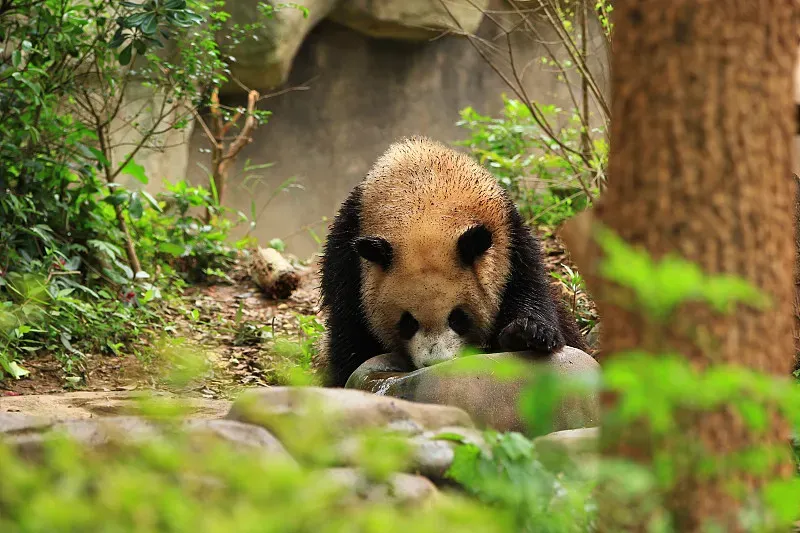
[Image: Close-up of the panda face, showing the correct eye patch shape — ovals tilted slightly downward toward the nose, with small bright eyes inside the dark patches]
Real Panda Tip 🔍: The eye patches aren’t just for decoration! Scientists believe each panda’s unique eye patch pattern helps them recognize each other — like a natural name tag. Your panda’s eye patches are its personal signature!
Step 4: Add the Details That Make It a Real Panda 🎨
Now add the small details that separate a panda drawing from just any bear drawing:
The Pseudo-Thumb: On the inside of the front paw, draw a small bump — the panda’s “sixth finger.” This enlarged wrist bone helps pandas grip bamboo. It’s a small detail that shows you know real panda anatomy! Learn more in our pseudo-thumb evolution article.
The “Vest” Pattern: Color the shoulders and front legs black. The black should wrap across the upper back like a vest, leaving the belly and lower back white. This is the panda’s natural camouflage pattern — dark on top to blend with forest shadows, white below to blend with snow. Our article on why pandas are black and white explains the full science!
Fur Texture: Add small, short strokes around the edges of the body to suggest thick, slightly shaggy fur. Panda fur isn’t smooth — it’s thick and a bit coarse, especially on the back.
Nose Detail: Add two small dots above the nose for nostrils — this gives the face more character.
Bamboo (Optional): Draw a bamboo stalk in one of the panda’s front paws. A few leaves at the top of the stalk make it recognizable. Pandas hold bamboo diagonally across their body when eating — not straight up and down.
Real Panda Tip 🔍: Panda fur has a slight oily texture that repels water. In your drawing, adding a few curved lines in the fur (especially on the back) can suggest this thick, water-resistant quality!
Step 5: Color It In! 🖍️
Time to bring your panda to life with color!
Black areas to color:
- ✅ The ears (fully colored)
- ✅ The eye patches (leave the eye circles inside uncolored)
- ✅ The shoulders and front legs (the “vest”)
- ✅ The back legs (from the hip down)
White areas to leave or color lightly:
- ⬜ The face (except eye patches and nose)
- ⬜ The belly and chest
- ⬜ The lower body
Special details:
- 🖤 Color the nose dark gray or black
- 🌸 Add a tiny touch of pink inside the ears (panda ear skin is light pink!)
- 👁️ Leave a small white dot in each eye for the catch-light
- 🎋 If you added bamboo, color it green
[Image: The finished panda in color — showing the correct black areas (ears, eye patches, shoulder band, legs) and white areas (face, belly), with a green bamboo stalk held diagonally in one paw]
Common Mistakes to Fix ✨
❌ Mistake 1: Perfectly round eye patches. Real panda eye patches are teardrop-shaped, wider at the bottom and tilting toward the nose.
❌ Mistake 2: Pointy ears. Panda ears are round and small, not pointy like a cat’s ears. Think soft half-circles.
❌ Mistake 3: Coloring the whole body black. Only the shoulders, front legs, back legs, ears, and eye patches are black. The face, belly, and lower back stay white.
❌ Mistake 4: Forgetting the pseudo-thumb. This tiny wrist bump is what makes pandas pandas! Without it, your drawing looks more like a generic bear.
❌ Mistake 5: Bamboo held straight up and down. Real pandas eat bamboo diagonally across their mouths, rotating it as they chew.
Show Off Your Artwork! 🖼️
You’ve done it — you’ve drawn a giant panda! Here are some fun things to do with your artwork:
- 🏠 Hang it on your wall or refrigerator
- 📸 Have a grown-up help you photograph it and share with family
- 🎁 Give it as a gift to a panda-loving friend
- 📚 Start a panda drawing collection — try drawing a baby panda, a panda eating bamboo, or a panda climbing a tree!
Want to keep practicing? Here are three challenges for your next panda drawing:
-
Baby Panda Challenge: Draw a baby panda with a much bigger head, shorter legs, and extra-fluffy fur. How small can you make it compared to the mama panda?
-
Action Panda Challenge: Draw a panda doing something — climbing a tree, swimming, rolling down a hill, or snoozing in the sun!
-
Panda Family Challenge: Draw three pandas together — a mama panda, a baby panda, and a papa panda. Make each one’s eye patches slightly different so they each have their own “signature”!
The best artists practice every day. Every panda you draw will be better than the last one. And remember — just like real pandas, no two panda drawings are exactly the same. Your panda is one of a kind! 🐼✨
Pandacommon Editorial Team
Pandacommon is a global knowledge project documenting giant pandas, habitats, and conservation history. We combine verified data with engaging storytelling to build a deeper archive of the panda world.
Learn more about our mission →Tags in this article
Questions readers often ask
What materials do I need to draw a panda?
All you need is a pencil, an eraser, a piece of paper, and something to add color — crayons, colored pencils, or markers in black, white, and pink for the nose. A black pen or fine marker for outlining is optional but makes your panda look extra sharp!
How do I make my panda look more realistic?
Three details make a panda look more like a real animal: draw the body slightly pear-shaped (wider at the bottom), add a slight curve to the back (not a perfect circle), and include the pseudo-thumb — a small bump on the inside of the front paw. The 'real panda tips' in each step will help!
Can I draw a baby panda instead?
Yes! To draw a baby panda, make the head bigger compared to the body, draw shorter legs, and add extra fluffiness to the fur. Baby pandas also have pinker noses and smaller, rounder eye patches.