Table of contents (7 sections)
Why Are Pandas Black and White? Camouflage and Social Communication
Key Fact: The giant panda’s black-and-white coat pattern is a rare dual-purpose adaptation in the animal kingdom — white fur conceals the animal against snow-covered landscapes, black fur breaks up its body outline in forest shadow, and the distinctive eye patches function as individual identity signals among pandas themselves. This pattern is so effective that, in their native high-altitude bamboo forests, wild pandas can disappear from view at a distance of less than 30 meters.
Key Takeaways
-
Black and white serves two purposes simultaneously. The white fur camouflages pandas against snow, the black fur against forest shadow — a dual-environment adaptation rarely seen in large mammals. The eye patches, meanwhile, evolved for individual recognition rather than concealment.
-
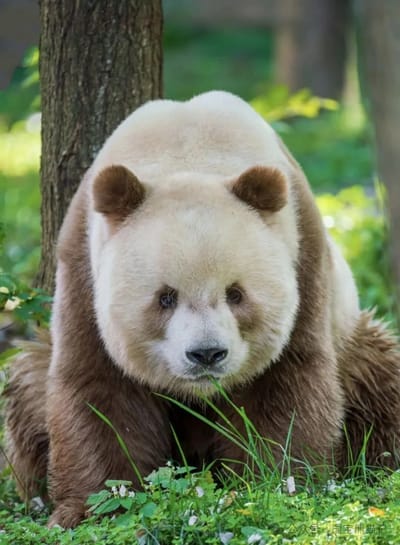
The brown panda Qi Zai is not an anomaly but a window. His coloration demonstrates that coat-color genetics in pandas are more complex than a simple black-and-white binary, and his existence in the genetically distinct Qinling population raises questions about how local environments shape coloration.
-
Panda cubs are born pink for a reason. The delayed development of pigmentation mirrors the evolutionary sequence in which these traits appeared — sensory and communicative features developing first, and camouflage features emerging more gradually as the animal faced predation pressure.
The first time you see a giant panda in high-contrast photography — the searing white of its belly against the ink-black of its shoulders — the pattern looks almost too dramatic to be natural. It reads like a cartoonist’s design choice, not an evolutionary strategy. And yet, in the fog-draped bamboo forests of Sichuan’s Minshan Mountains, that same pattern performs an extraordinary visual trick: it makes a 100-kilogram bear nearly invisible.
On a January morning at 2,600 meters in the Foping Nature Reserve, a field researcher watches through binoculars as a wild panda moves through a patch of snow-dusted arrow bamboo. When the panda steps into a shaft of winter sunlight reflecting off fresh powder, its white belly and face merge seamlessly with the snow. When it passes into the deep shadow beneath a stand of fir trees, the black legs and shoulders dissolve into the darkness between trunks. The animal does not disappear entirely — but it fragments, its outline breaking into separate, indecipherable pieces. A predator scanning the slope would register a few unrelated patches of light and dark. Not a panda.
This is not a coincidence. It is the product of approximately two million years of natural selection, decoded in a landmark 2017 study by Tim Caro and colleagues at UC Davis, who compared panda coloration against 195 other carnivore species and 39 bear subspecies. Their conclusion overturned decades of casual speculation: the panda’s black-and-white coat solves two problems at once.
The Camouflage Hypothesis: A Coat for Two Worlds
The panda’s habitat spans some of the most visually complex terrain on Earth. In summer, the bamboo forests are a mosaic of emerald green leaves, dark brown trunks, and patches of deep shadow where sunlight barely penetrates the canopy. In winter, the same slopes are blanketed in snow — the Minshan Mountains receive an average of 80 centimeters of snowfall annually, with some elevations recording over 150 centimeters.
The panda’s white fur matches the snow. The black fur matches the shadows. And critically, neither pattern works in isolation — the two-color scheme succeeds precisely because it rapidly alternates between light and dark, matching whichever background the animal currently occupies.
This is known as background matching across microhabitats — an evolutionary strategy documented in relatively few large mammals. Most camouflaged species optimize for a single background type: white arctic foxes for snow, tawny lions for savanna grass, striped tigers for tall reeds. The panda, unique among bears, matches two radically different backgrounds in a single coat pattern because its habitat demands it.
Did You Know? The panda’s white face is not solid white. In many individuals, a subtle gradient of cream to pale gray extends from the cheeks toward the muzzle. Under magnification, individual guard hairs show alternating bands of pigment — a microscopic-level blending mechanism that softens the transition from white to black, further breaking up the visual outline.
The 2017 Caro study quantified this effect through digital image analysis. When photographs of wild pandas were superimposed onto photographs of their actual habitats and analyzed through a predator’s-eye-view algorithm, the contrast between panda and background was significantly lower than would be expected by chance. The white belly matched snow reflectance values; the dark shoulders matched shadow reflectance values. The panda, in numerical terms, was genuinely well-camouflaged.
| Camouflage Type | Mechanism | Panda Example | Comparable Species |
|---|---|---|---|
| Background matching (snow) | White fur matches snow reflectance | Belly, face, neck | Arctic fox, snowshoe hare |
| Background matching (shadow) | Black fur matches forest shade | Legs, shoulders | Malayan tapir (juvenile) |
| Disruptive coloration | High-contrast edges break body outline | Black-white boundary at midsection | Giant anteater, orca |
| Countershading | Darker above, lighter below (partial) | Dark shoulders + white belly | Many fish species |
| Social signaling | Distinctive facial pattern for recognition | Black eye patches | Badger, raccoon |
The Qinling Counterpoint: When the Pattern Breaks
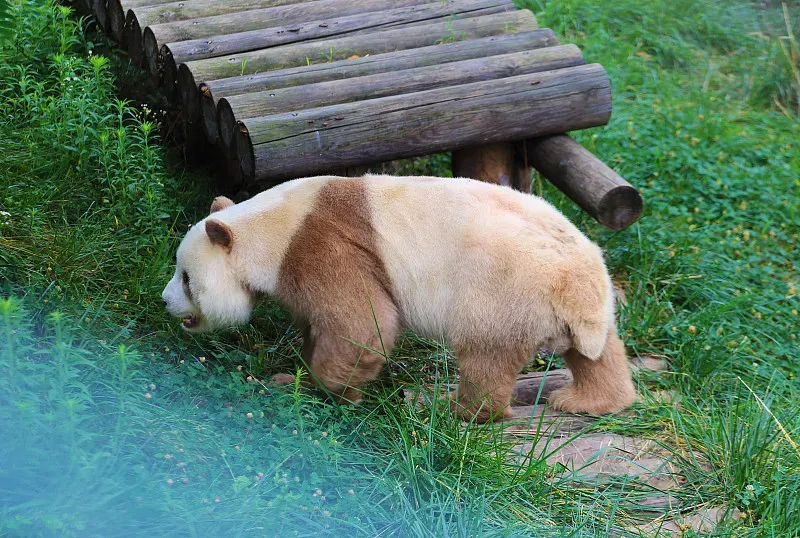
No discussion of panda coloration is complete without addressing the most famous exception to the rule. Qi Zai, studbook number 802, is the world’s only captive brown giant panda. Discovered as a two-month-old cub in 2009 in the Qinling Mountains of Shaanxi Province — abandoned, underweight, and uniquely colored — Qi Zai lacks the black pigmentation that defines his species. Where a typical panda carries black, Qi Zai carries a soft chocolate brown.
Qi Zai belongs to the Qinling subspecies (Ailuropoda melanoleuca qinlingensis), a genetically distinct population separated from the Sichuan pandas by approximately 10,000 years of isolation. Qinling pandas generally have slightly lighter coloration than their Sichuan counterparts — their black is less intensely black, trending toward dark brown. But Qi Zai’s color is an extreme outlier, likely caused by a recessive mutation affecting the MC1R gene pathway that controls melanin production. His story is told more fully in our exploration of brown pandas and the Qinling subspecies.
Qi Zai’s existence challenges the camouflage hypothesis in an intriguing way. If brown coloration is maladaptive in a snow-and-shadow environment, why did the recessive gene persist in the Qinling population? One possibility is that the Qinling habitat — which receives less snowfall than the Minshan range and features more deciduous broadleaf forest — imposes different visual selection pressures. Another theory is that the mutation is simply neutral: neither helpful nor harmful enough for natural selection to eliminate it. Qi Zai is a living data point in the ongoing argument about just how tightly evolution optimized the panda’s color palette.
The Eye Patch Mystery: A Social Signal, Not a Disguise
While the white body fur and black limbs show clear evidence of camouflage function, the panda’s most distinctive feature — the dark patches surrounding each eye — appears to have evolved for an entirely different reason.
Caro’s team analyzed eye patch variation across 658 individual pandas and found that no two pandas have identical eye markings. The patches vary in shape, size, orientation, and the degree to which they extend toward the muzzle. Some pandas, like the celebrity He Hua, have nearly perfectly round, symmetrical eye patches. Others have elongated patches that trail toward the ears like tears. The variation is not random — it is consistent within individuals across their lifespan, suggesting a genetic basis.
This level of individual variation points toward a social signaling function. In the dense bamboo understory where visibility rarely exceeds 10 meters, recognizing a familiar individual quickly can mean the difference between peaceful coexistence and an energy-wasting confrontation. Pandas are generally solitary, but their territories overlap, and encounters between neighbors occur regularly. The eye patches — high-contrast, individually distinctive, and visible even in low light — may serve as natural “name tags” that allow pandas to identify each other at a glance.
Behavioral observations at the Chengdu Research Base support this theory. When unfamiliar pandas are introduced to each other — as occurs during breeding introductions — both animals spend significantly more time staring at each other’s faces than at any other body part. The eye region receives the most fixations, with gaze duration averaging 4-6 seconds — unusually long for a species not known for facial expressiveness.
As discussed in our analysis of how pandas navigate by smell and sound, the olfactory system remains the primary social medium for pandas. But the visual cue of eye patches appears to serve as a rapid-recognition supplement — the panda equivalent of glancing at a face before checking a scent mark.
Thermoregulation: A Competing Theory
Not all researchers agree that camouflage and social signaling tell the whole story. An alternative hypothesis proposes that the black-and-white pattern serves primarily as a thermoregulatory device.
The argument goes like this: black fur absorbs solar radiation more efficiently than white fur, while white fur reflects it. By concentrating black fur on the body’s dorsal surface and extremities — the areas most exposed to sun — and white fur on the ventral surface and face, pandas might maintain thermal balance across the extreme temperature fluctuations of high-altitude habitats. Minshan Mountain pandas experience annual temperature ranges from -15°C in January to +25°C in July. A coat that dynamically responds to solar exposure could theoretically reduce the energy cost of thermoregulation.
The 2017 Caro study tested this hypothesis by comparing panda coloration to a database of 39 bear subspecies and found only weak support. The thermoregulatory model would predict that bears living at higher altitudes or colder latitudes would show more pronounced black-white contrast — but this pattern was not observed. Polar bears, living in the coldest environment of any ursid, are uniformly white with black skin beneath. Sun bears, living in tropical Southeast Asia, have the darkest uniform coats. The correlation between temperature extremes and coat contrast was too inconsistent to support thermoregulation as the primary driver.
That said, the two explanations are not mutually exclusive. The dark shoulders and light belly could serve modest thermoregulatory benefits while the primary evolutionary pressure came from camouflage and social signaling. Evolution rarely optimizes for a single variable.
From Pink to Patterned: How Panda Cubs Develop Color
Every panda begins life without the black-and-white coat that will eventually define it. Newborn cubs, weighing just 100–150 grams, emerge from the womb nearly hairless and startlingly pink — the color of raw skin visible through a sparse covering of fine, translucent hairs. Their eyes are sealed shut. Their ears are barely visible as small folds of skin. At this stage, they look less like miniature pandas and more like the fetal stage of any mammal.
Within 48 hours of birth, the first dark pigmentation appears — a faint gray wash spreading outward from the eye sockets. By the end of the first week, the eye patches are clearly visible, though still more gray than black. The ears begin to darken around day 10. The shoulder band — the black band that wraps across the upper back and extends down the forelegs — appears last, becoming fully pigmented only after the cub reaches one month of age. This developmental sequence is discussed in greater detail in our guide to panda cub development, but the key point is that the black fur arrives in the same anatomical order as it would have evolved: sensory organs first (eye patches for recognition, ear markings for sound localization), then motor structures (legs for locomotion), and finally the dorsal camouflage band.
By three months, the cub wears a perfect miniature version of the adult coat — though its fur feels different. Cub fur is extraordinarily soft, almost like chinchilla down, with a slight warmth to the touch. Only as the panda approaches its first year does the fur thicken into the coarse, slightly oily adult coat, whose texture resembles a dense wool blanket that has been lightly waxed — water beads on the surface and rolls away rather than soaking through.
Frequently Asked Questions
Are there white pandas with no black at all?
To date, no albino giant panda has been confirmed in the wild or in captivity. However, in May 2019, an infrared camera trap in the Wolong National Nature Reserve captured images of an all-white panda — a young animal with completely white fur and reddish eyes, consistent with albinism. The images were published by Chinese state media and generated intense scientific interest. The individual appeared healthy, suggesting that albino pandas can survive in the wild, but the rarity of the condition indicates strong selection pressure against it.
Do pandas shed their black-and-white coat seasonally?
Pandas undergo one major molt per year, typically in late spring, during which they shed their thick winter undercoat. The guard hairs — the longer, coarser outer hairs that carry pigmentation — are replaced more gradually. During the molt, a panda may look patchy or temporarily discolored, but the underlying black-and-white pattern remains constant.
Can you identify a panda solely by its eye patches?
Researchers at the Chengdu Research Base have developed a machine-learning algorithm that can identify individual pandas by their facial markings with over 93% accuracy — comparable to facial recognition systems used for humans. The algorithm analyzes the shape, symmetry, and subtle perimeters of the eye patches, which are as unique to pandas as fingerprints are to people. This technology is explored in our analysis of AI-powered panda identification and conservation technology.
This article draws on Tim Caro et al. (2017) “Why is the giant panda black and white?” in Behavioral Ecology, infrared camera trap data from Wolong National Nature Reserve, and behavioral observation records from the Chengdu Research Base of Giant Panda Breeding.

Dr. Lin Chen
Conservation Genomics Editor
Conservation geneticist specializing in giant panda genomics, molecular ecology, and evolutionary biology. Validates all genetics and genome-related content on Panda Common.
View full profile →Tags in this article
Questions readers often ask
Why are giant pandas black and white?
Pandas evolved their black-and-white pattern for two distinct reasons. The white fur provides camouflage in snowy environments, while the black patches on the shoulders and legs help the animal blend into the dark shadows of temperate forests. The black eye patches may serve as social signaling devices, helping pandas recognize each other as individuals across distances in dense bamboo undergrowth.
Do all pandas have the same black-and-white pattern?
No — and this is key to the social communication theory. Each panda has a unique arrangement of black facial markings, particularly around the eyes. Researchers at the Chengdu Research Base have documented that pandas use facial recognition-like mechanisms to distinguish familiar from unfamiliar individuals, and the distinctive eye patches are a critical visual cue.
Why is Qi Zai — the brown panda — not black and white?
Qi Zai, the only known brown giant panda in captivity, owes his unusual coloration to a recessive genetic mutation affecting melanin production. His existence in the Qinling Mountains, where the Qinling subspecies already shows subtle color differences from Sichuan pandas, suggests that coat color genetics are more complex in pandas than previously thought.
Do panda cubs have the same color pattern as adults?
No. Panda cubs are born almost entirely pink, with only a faint suggestion of where black patches will later appear. The full black-and-white pattern develops gradually over the first month, with the eye patches darkening first, followed by the ears, the shoulder band, and finally the legs.
Could the black-and-white pattern be for thermoregulation?
Some researchers have proposed this theory — that black fur absorbs solar heat while white reflects it, helping pandas maintain a stable body temperature across the extreme temperature swings of high-altitude habitats. However, the 2017 study by Caro et al. found limited evidence for this hypothesis compared to the camouflage and communication explanations.