Table of contents (4 sections)
China’s Giant Panda National Park: The Six Mountain Range Habitats
Key Fact: The Giant Panda National Park, formally established in October 2021, protects 27,134 square kilometers across Sichuan, Shaanxi, and Gansu provinces. Within its boundaries lie 1,864 wild giant pandas — approximately 75% of the global wild population — distributed across six mountain ranges, each with a distinct microclimate, bamboo composition, and panda subpopulation. The park represents the single largest protected area ever created for a single species.
Key Takeaways
-
Panda habitat is not uniform. Each of the six mountain ranges has a distinct climate, bamboo composition, and panda subpopulation. Conservation strategies must be tailored to these microhabitat differences — there is no one-size-fits-all panda habitat plan.
-
Fragmentation is the greatest threat. The Daxiangling range, with fewer than 30 pandas and documented genetic bottlenecking, is a warning sign. The park’s ecological corridor program is the most important infrastructure investment in wild panda survival today.
-
The park includes people. With 180,000 residents living within its boundaries, the park’s co-management model represents a deliberate departure from exclusionary conservation. Its success or failure will be judged not only by panda population trends but by whether local communities benefit from protection.
The mist does not lift at this elevation. At 2,800 meters in the Minshan Mountains of northern Sichuan, the air is perpetually saturated — cold droplets suspended in a near-visible haze that coats every bamboo leaf in a slick film of moisture. The arrow bamboo here grows in dense, shoulder-high thickets, its stalks emerging from soil that never fully dries, a carpet of moss and decaying leaf matter that releases the thick, fungal scent of ancient forest floor.
This is the sensory reality of wild panda habitat — not the manicured bamboo groves of a zoo enclosure but a vertical world of steep limestone slopes, perpetually wet air, and the constant background percussion of water dripping from canopy leaves. The temperature at this elevation hovers around 8°C even in midsummer. In January, it drops to -12°C, and the bamboo stiffens with frost, each stalk snapping with a crystalline crack when broken.
For the wild pandas of Minshan — the largest of six mountain-range populations — this high, cold, wet world is home.
The Six Ranges: A Geographic Atlas
The wild giant panda population is not distributed evenly across the landscape. It is divided into approximately 33 isolated subpopulations, clustered within six mountain ranges that form the panda’s last remaining strongholds. Understanding these ranges — their elevations, bamboo species, and population densities — is essential to understanding panda conservation itself.
| Mountain Range | Province(s) | Elevation Range | Dominant Bamboo | Est. Panda Population | Key Characteristic |
|---|---|---|---|---|---|
| Minshan | Sichuan, Gansu | 1,800–3,500m | Bashania fargesii, Fargesia denudata | ~800 | Largest population; highest elevation |
| Qionglai | Sichuan | 1,600–3,500m | Bashania faberi, Fargesia robusta | ~550 | Second largest; core of Wolong Reserve |
| Daxiangling | Sichuan | 1,500–3,000m | Yushania spp., Fargesia spp. | ~30 | Smallest, most fragmented; critical bottleneck |
| Xiaoxiangling | Sichuan | 1,500–3,200m | Fargesia denudata, Bashania spp. | ~50 | Moderate; connected to Qionglai via corridors |
| Liangshan | Sichuan | 1,400–3,200m | Yushania glauca, Fargesia spp. | ~150 | Southernmost; distinct bamboo composition |
| Qinling | Shaanxi | 1,300–3,000m | Bashania fargesii, Fargesia qinlingensis | ~350 | Genetically distinct subspecies; lower elevation |
Minshan Mountains: The Panda’s Northern Fortress
Drive north from Chengdu for six hours, and the Sichuan Basin’s subtropical warmth gives way to the Minshan range — a spine of jagged limestone peaks running 500 kilometers southeast-to-northwest along the eastern edge of the Tibetan Plateau. This is panda country at its most dramatic: vertical cliffs draped in old-growth conifer forest, valleys so narrow that direct sunlight reaches the forest floor for only three hours a day in winter.
The Minshan range holds more pandas than any other — roughly 800 individuals across 10 subpopulations, the largest of which (in the Pingwu County area) contains over 200 pandas. The key to Minshan’s productivity is bamboo diversity: at least seven Bashania and Fargesia species grow across the elevation gradient, providing pandas with year-round access to different bamboo parts — shoots at lower elevations in spring, leaves at mid-elevations in summer, and stalks at higher elevations in winter.
The Minshan pandas follow this vertical “bamboo calendar” with remarkable precision. Infrared camera data from the Wanglang National Nature Reserve shows pandas moving upward at an average rate of 180 meters per month from April through August, tracking the emergence of new bamboo shoots as snow melts at progressively higher elevations. In autumn, they reverse direction, descending to lower-elevation winter ranges where Bashania fargesii stalks contain elevated sugar concentrations — a seasonal carbohydrate loading strategy that helps them survive the energetic demands of winter.
Qionglai Mountains: The Scientific Heartland
The Qionglai range lies immediately west of the Sichuan Basin, its eastern slopes rising sharply from the Chengdu Plain to peaks exceeding 4,000 meters. This is the range that hosts the Wolong National Nature Reserve — established in 1963, it was China’s first panda reserve and remains the epicenter of panda research, home to the China Conservation and Research Center for the Giant Panda at Shenshuping.
Qionglai’s climate is wetter than Minshan’s — annual precipitation can exceed 1,800 millimeters, creating a mist-soaked forest where moss covers every surface, the tree branches drip with epiphytic ferns, and the bamboo grows so densely that traversing the understory without a machete is nearly impossible. This moisture regime supports a different bamboo composition, dominated by Bashania faberi at lower elevations and Fargesia robusta above 2,400 meters.
The Wolong pandas — roughly 150 individuals within the reserve itself, plus another 400 in adjacent protected areas — have been subjects of continuous scientific observation since the 1970s. The research is discussed further in our examination of four national panda surveys, but the key ecological finding is this: Qionglai pandas are behaviorally distinct from their Minshan counterparts. They exhibit shorter daily movement distances, possibly because the denser bamboo understory requires less travel to meet nutritional needs. They also show a preference for higher-elevation summer ranges, retreating above 3,000 meters during the warmest months — an elevation at which the air temperature rarely exceeds 15°C even in July.
Qinling Mountains: The Eastern Frontier
Cross the tectonic boundary from Sichuan into southern Shaanxi, and the mountains change character. The Qinling range is older, more weathered, its peaks rounded rather than jagged, its valleys wider and shallower. This is the only range where the Qinling subspecies of giant panda lives — approximately 350 animals in a region that receives significantly less snow than the Sichuan ranges, and where deciduous broadleaf forest mixes with conifers in a pattern unique among panda habitats.
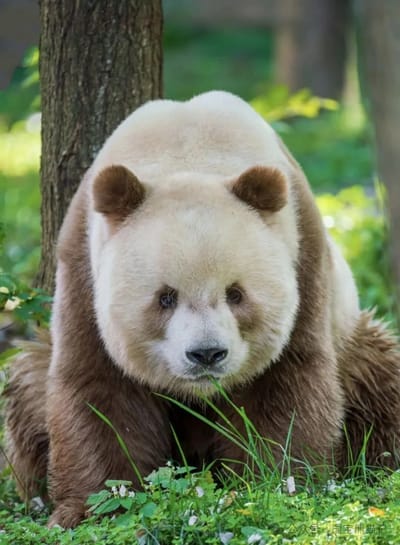
The Qinling pandas differ from Sichuan pandas in measurable ways: their skulls are rounder and slightly smaller, their molar teeth show distinctive wear patterns suggesting a diet slightly higher in leaf material versus stalk material, and — most visibly — their black fur tends toward dark brown, a color gradient exemplified by Qi Zai, the world’s only brown panda, whose unique pigmentation is analyzed in depth in our exploration of brown pandas and the Qinling subspecies.
The lower snow cover in Qinling has an unexpected ecological consequence: pandas here descend to lower elevations in winter less frequently than their Minshan counterparts, because the bamboo at middle elevations remains accessible even when snow at higher elevations would bury it. This behavioral difference has conservation implications. Climate models project that Qinling’s lower-elevation bamboo — Bashania fargesii below 1,600 meters — faces the greatest risk of dieback under warming scenarios, which would disproportionately affect the Qinling population.
Daxiangling and Xiaoxiangling: The Fragmented Sisters
If the Minshan and Qionglai ranges represent the panda’s prosperous core, the Daxiangling and Xiaoxiangling ranges represent its fragile periphery.
Daxiangling is the smallest of the six panda ranges — a narrow ridge of forest sandwiched between the Dadu River to the south and the expanding agricultural footprint of Ya’an City to the north. Fewer than 30 pandas survive here, in a habitat crisscrossed by roads and hemmed in by farmland. Genetic analysis of fecal DNA samples shows that the Daxiangling pandas already exhibit signs of inbreeding — reduced heterozygosity compared to the Minshan population — a warning sign that without active genetic intervention, this subpopulation faces a long-term viability crisis.
Xiaoxiangling, slightly larger with approximately 50 pandas, is separated from the Qionglai population to its north by a major highway and a strip of agricultural land. The ecological corridor program — discussed in our article on wildlife corridors and habitat connectivity — has prioritized reconnecting Xiaoxiangling to Qionglai through a series of underpasses and reforested corridors. Early camera trap data suggests the corridor is being used, but not yet by pandas; smaller mammals like takin and tufted deer have been photographed crossing first, with pandas, more cautious about novel routes, expected to follow as vegetation matures.
Liangshan Mountains: The Southern Frontier
The Liangshan range, spanning the border between Sichuan and Yunnan provinces, is the southernmost panda habitat on Earth. Its bamboo composition is distinct — dominated by Yushania glauca, a species adapted to the Liangshan’s relatively drier climate, with annual precipitation averaging 800–1,000 millimeters, significantly less than the 1,500–1,800 millimeters typical of Qionglai.
Liangshan’s pandas — approximately 150 individuals across four subpopulations — face a unique challenge: the range’s lower elevation means that even the highest peaks barely reach 3,200 meters, leaving less vertical room for pandas to retreat upward as temperatures rise. A 2021 modeling study published in Nature Climate Change identified Liangshan as the range most vulnerable to bamboo habitat loss under a 2°C warming scenario, projecting a potential 60% reduction in suitable habitat by 2070. The conservation strategy for Liangshan centers on aggressive bamboo diversity protection — maintaining the full elevation gradient of Yushania and Fargesia species to provide resilience against climate-driven composition shifts.
The Park Itself: Governance, Corridors, and the Local Community
The Giant Panda National Park is not a single contiguous wilderness. It is a network — 64 existing nature reserves stitched together by new protected corridors into a unified management structure overseen by the National Forestry and Grassland Administration. The governance model is layered: the central administration in Beijing sets policy and allocates funding, while provincial-level park bureaus in Sichuan, Shaanxi, and Gansu handle daily management, anti-poaching patrols, and community liaison.
One of the park’s most innovative features is its approach to human communities. Unlike older “fortress conservation” models that forcibly relocated villages, the National Park employs a co-management system: approximately 180,000 people live within the park’s boundaries, and many of them are now employed as park rangers, bamboo forest monitors, or eco-tourism guides. The program represents a deliberate attempt to avoid the historical tension between poverty and protection — the recognition that people who live inside the panda’s habitat must have a stake in preserving it.
Did You Know? Contrary to the common assumption that wildlife reserves are empty of humans, the Giant Panda National Park contains over 600 settlements. The park’s ecological compensation program pays households for verified conservation outcomes — reduced logging, maintained bamboo cover, and successful wildlife corridor use — rather than simply paying them to relocate. It is a results-based model that other nations’ protected area systems are now studying.
The corridors themselves are the park’s most critical infrastructure. The 2015 Fourth National Survey identified 33 isolated panda subpopulations, of which 22 were classified as “small populations” with fewer than 30 individuals — below the threshold for long-term genetic viability. The park’s 27 planned corridors (of which 14 are now operational) are designed to reconnect these fragments. Each corridor is a strip of reforested land, typically 500–2,000 meters wide, planted with native bamboo and canopy tree species, crossing under or over linear infrastructure. The results so far are mixed but improving — the Tuolanggou corridor in the Xiaoxiangling range, for example, has now been confirmed by camera trap to be used by at least three individual pandas, the first confirmed gene-flow between previously isolated populations in that region.
Frequently Asked Questions
How does the National Park differ from the old system of individual reserves?
Before 2021, panda habitat was protected through a patchwork of 64 separate reserves, each managed independently with different standards, budgets, and priorities. A panda crossing from one reserve to an adjacent unprotected area lost all legal protection the moment it crossed the boundary. The National Park unified these patches under a single management system with consistent protection standards — so a panda moving from Wolong Reserve into the new corridor area enjoys the same level of protection throughout its home range.
What is the difference between the Giant Panda National Park and the panda bases (Chengdu, Bifengxia)?
The National Park protects wild panda habitat — the bamboo forests where pandas live, breed, and die without direct human intervention. The panda bases (Chengdu Research Base, Bifengxia, Dujiangyan) are captive facilities focused on breeding, research, and public education. The two systems are complementary but distinct: the bases maintain the captive insurance population, while the National Park protects the wild population. The connection between them is the rewilding program, which trains captive-born pandas for release into National Park territory.
Can tourists visit the Giant Panda National Park?
Portions of the park are open to visitors, but access is far more restricted than at facilities like the Chengdu Research Base. Wanglang Nature Reserve and Tangjiahe Nature Reserve — both within the Minshan range — offer guided eco-tourism programs with limited daily visitor quotas. The wild panda viewing experience is not like visiting a zoo; sightings are rare and require patience, silence, and luck. The park prioritizes conservation over tourism, and the visitor experience reflects that philosophy.
This article draws on data from China’s Fourth National Giant Panda Survey (2011–2014), the Giant Panda National Park Master Plan (2019), IUCN habitat assessment reports, and camera trap datasets maintained by the Chinese Academy of Sciences’ Institute of Zoology.

Dr. James Thornton
Wildlife Ecology Editor
Wildlife ecologist specializing in forest ecology, protected area effectiveness, mammal community conservation, and human-wildlife coexistence in panda habitats.
View full profile →Tags in this article
Questions readers often ask
How big is the Giant Panda National Park?
The Giant Panda National Park covers approximately 27,000 square kilometers — roughly the size of Massachusetts or Rwanda. It spans three provinces (Sichuan, Shaanxi, and Gansu) and encompasses portions of six mountain ranges, 1,600 plant species, and over 1,800 wild giant pandas — about 75% of the entire wild population.
What are the six mountain ranges that host wild pandas?
The six ranges are: Minshan (largest population), Qionglai (second largest), Daxiangling (smallest, most fragmented), Xiaoxiangling (moderate population), Liangshan (southernmost), and Qinling (genetically distinct subspecies). Each range has unique bamboo species and climate conditions.
How does the Qinling habitat differ from the Sichuan habitats?
Qinling pandas live at lower average elevations (1,300–3,000m vs. 2,000–3,500m in Sichuan), experience less snowfall, and inhabit more deciduous broadleaf forest relative to coniferous forest. These differences likely contributed to the genetic divergence of the Qinling subspecies over approximately 10,000 years of isolation.
What is the biggest threat to these six habitats?
Habitat fragmentation caused by roads, railways, and agricultural expansion remains the single greatest threat. While the National Park has consolidated protection, historical fragmentation has created isolated subpopulations in the Daxiangling and Xiaoxiangling ranges that are at risk of genetic bottlenecks. The park's ecological corridor program is specifically designed to reconnect these fragments.
How is climate change expected to affect the six ranges?
Climate models project that warming temperatures will shift bamboo species composition upward in elevation. The lower-elevation edges of panda habitat — particularly in the Qinling and Daxiangling ranges — may lose suitable bamboo cover by 2070. The park's conservation strategy prioritizes protecting high-elevation 'climate refugia' where pandas can retreat as temperatures rise.