Guardians of the Forest: Infrared Cameras and Wild Panda Monitoring
Key Fact: Hidden in the bamboo forests of China’s six panda mountain ranges, approximately 5,000-7,000 infrared camera traps operate continuously — triggered by the body heat of passing animals, photographing wild pandas in their most private moments. These cameras, maintained by rangers who trek through remote terrain on foot, have transformed panda science: documenting previously unknown behaviors, providing the first images of wild cubs with their mothers, and generating the data that underpins population estimates and conservation planning. The camera trap network is the quiet infrastructure of wild panda knowledge — invisible to the pandas, indispensable to the scientists.
Key Takeaways
-
Infrared cameras provide non-invasive, continuous monitoring of wild pandas, revealing behaviors that direct human observation could never capture.
-
Camera trap data has revised our understanding of panda behavior — pandas are more social, more nocturnally active, and more behaviorally complex than previously believed.
-
The camera network depends on human rangers who trek through dangerous terrain to maintain the devices, embodying the human commitment behind conservation technology.
Deep in the Wolong Reserve, at 2,700 meters elevation, a small rectangular device is strapped to a fir tree. It is camouflaged, weather-sealed, and silent. Its infrared sensor scans the forest floor continuously. When a warm body passes within range — a panda, a takin, a golden pheasant — the sensor triggers the shutter. The panda, unaware it has been photographed, continues eating bamboo in the gray mountain dawn.
This is the camera trap network — one of the largest and most systematic wildlife monitoring systems ever deployed for a single species. It is the reason we now know that wild panda mothers keep their cubs for up to two years, that pandas are active at all hours of the day and night, and that the species is not as solitary as a century of assumptions suggested.
The Technology of Invisible Watching
An infrared camera trap is a simple device: a weatherproof housing containing a digital camera, an infrared motion sensor, and a battery pack that can last 3-6 months in the field. The sensor detects the heat signature of a passing animal. The camera, pre-focused to the distance where an animal is most likely to pass, captures a rapid burst of images — typically 3-5 frames per trigger event.
The cameras record metadata as precisely as the images themselves: the exact time and date of each trigger, the temperature, the moon phase. This metadata allows researchers to analyze not just which pandas were present but when they were active — building a picture of wild panda daily rhythms, seasonal movements, and behavioral patterns.
The images are not high art. They are surveillance photography — functional, often partially obscured by vegetation, sometimes capturing nothing but the rear end of a panda disappearing into bamboo. But cumulatively, across thousands of cameras and millions of images, they form a portrait of wild panda life more intimate and comprehensive than any researcher could assemble through direct observation.
What the Cameras Have Revealed
The camera trap network has been operational in its current systematic form for approximately 15 years. The data it has generated has fundamentally revised the scientific understanding of wild panda behavior:
Social lives of solitary animals. Pandas were long described as solitary — individuals that met only to mate and otherwise avoided each other. Camera trap data has complicated this picture significantly. The cameras have documented friendly encounters between unrelated pandas, including nose-to-nose greetings, shared use of the same bamboo patches without aggression, and what appears to be play behavior between subadults. Pandas may not live in groups, but they are not asocial.
Around-the-clock activity. Early panda researchers, limited to daylight observation, assumed pandas were primarily crepuscular — active at dawn and dusk. Camera trap timestamps reveal that pandas are active at ALL hours, with peaks of foraging activity at dawn, dusk, and midnight. The panda’s sleep-wake cycle is more flexible and opportunistic than the crepuscular model suggested. Our article on 10 quirky panda habits explores these behavioral patterns.
The handstand scent-marking behavior. One of the most extraordinary camera-trap discoveries is the “handstand” scent-marking behavior: a panda approaches a tree, turns around, lifts its hind legs off the ground in a handstand position, and deposits scent from its anogenital gland as high on the trunk as possible. The behavior, documented primarily in males, is believed to advertise the marker’s size — the higher the mark, the larger the panda.
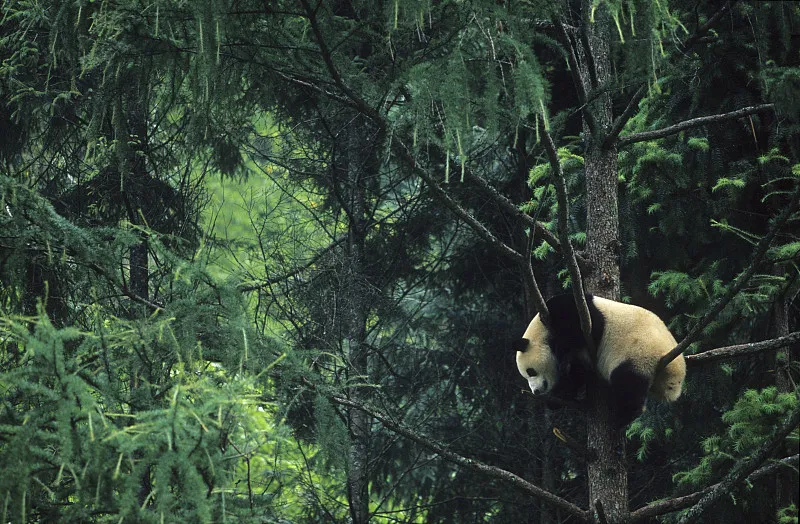
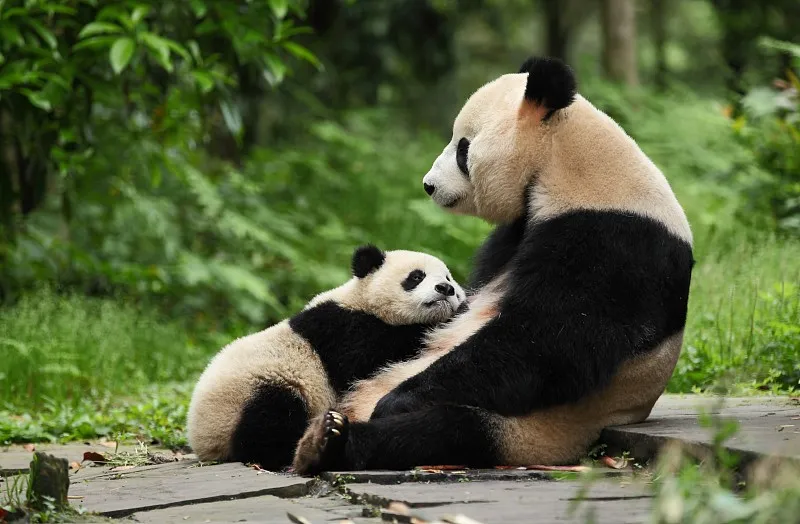
Mother-cub relationships. Camera traps following specific mother-cub pairs over months have revealed the duration and intimacy of wild panda maternal care. Cubs stay with their mothers for 18-24 months — longer than many captive-management timelines assumed. Mothers teach their cubs to climb, to select bamboo, to recognize danger. The camera-trapped record of these long maternal relationships has informed the rewilding program’s mother-led training protocol, described in our article on panda rewilding.
Did You Know? Camera traps have also captured species that were thought to be locally extinct. In 2021, a camera trap in the Liangshan range photographed a clouded leopard — a species that had not been documented in that area for over 30 years. The panda camera network functions as a biodiversity monitoring system for the entire forest ecosystem, not just for pandas.
The Human Network Behind the Machines
The camera trap network would not function without the human rangers who maintain it. These rangers — hundreds of them, employed by the Giant Panda National Park and affiliated reserves — walk the camera grid on foot, covering 15-25 kilometers per day through terrain that is steep, slippery, and sometimes dangerous.
Each camera must be checked every 3-6 months. The ranger replaces the batteries, swaps the SD card, cleans the lens, and confirms the camera is still aimed correctly. The data cards are brought back to the research station, where the images are downloaded, catalogued, and analyzed. A single ranger may be responsible for 20-30 cameras across a territory of several dozen square kilometers.
The rangers are the human face of the monitoring network — and their work, described in our article on the lives of panda forest guardians, represents one of the least glamorous but most essential aspects of modern conservation. The cameras are the technology; the rangers are the infrastructure.
Frequently Asked Questions
Do the cameras ever bother the pandas?
Remarkably, no. The cameras are silent, emit no visible light (they use infrared flash for night photography), and are positioned off trails where pandas pass naturally. There is no evidence that pandas alter their behavior in response to camera traps — a critical requirement for data that purports to represent natural behavior.
How are all those images analyzed?
The volume of camera trap data is enormous — millions of images per year. Increasingly, AI image-recognition algorithms are used to pre-sort the images, flagging those that contain pandas or other species of interest for human review. The AI systems, described in our article on AI and technology in panda conservation, can identify individual pandas by their unique eye patch patterns with over 93% accuracy.
What’s the most surprising thing cameras have photographed?
Beyond the charismatic mammals, camera traps have documented surprising species interactions: a golden pheasant riding on a takin’s back, a red panda sharing a tree with a giant panda below, and — in one remarkable sequence — a panda cub playing with a fallen camera trap, batting it with its paws like a toy before its mother gently nudged the cub away.
On a tree in the Minshan Mountains, a camera trap waits in the darkness. Its sensor scans the cold air. Hours pass. Then — a warmth, a movement, a silent shutter click. The panda does not pause. It does not know it has been photographed. It simply continues through the bamboo, its image now stored on a memory card that a ranger, walking through snow, will retrieve in three months’ time. The photograph will join millions of others, one more data point in the slow, patient accumulation of knowledge about a species that has been revealing itself, frame by frame, ever since the first camera was strapped to a tree.