Panda Roommates: The Rich Biodiversity of Bamboo Forest Ecosystems
Key Fact: Walk through a panda’s bamboo forest and you enter one of the most biodiverse temperate ecosystems on Earth — part of the Mountains of Southwest China biodiversity hotspot, one of only 34 global biodiversity hotspots. The forest hosts golden snub-nosed monkeys with startling blue faces, massive shaggy takin that look like mythological beasts, red pandas dozing in high bamboo branches, clouded leopards (vanishingly rare), and over 10,000 plant species. Every hectare protected for pandas shelters thousands of other organisms. The panda may be the forest’s most famous resident, but it is far from its only one.
Key Takeaways
-
The panda’s forest hosts an extraordinary species community — from canopy-dwelling monkeys to forest-floor herbivores to rare predators.
-
Species partition the forest by height and diet — pandas on the ground, red pandas in trees, golden monkeys in the canopy, each occupying distinct ecological niches.
-
Panda conservation is ecosystem conservation — protecting panda habitat protects everything that lives there.
The bamboo forest at dawn is not silent. The first sound is the chatter of golden snub-nosed monkeys high in the fir canopy — a troop of 30 moving through the branches, their golden-orange fur catching the first light, their blue faces startling against the green. Below them, a takin — massive, shaggy, its curved horns sweeping back from a broad head — moves slowly through the bamboo, its heavy body parting the stalks like a ship through water. A golden pheasant scratches in the leaf litter. A red panda, the giant panda’s smaller namesake, curls on a high bamboo branch, its rusty fur and striped tail making it almost invisible against the autumn leaves.
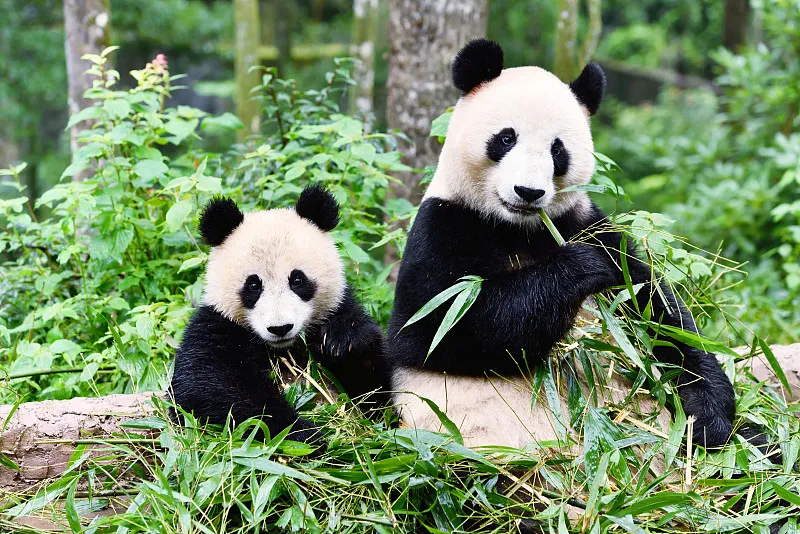
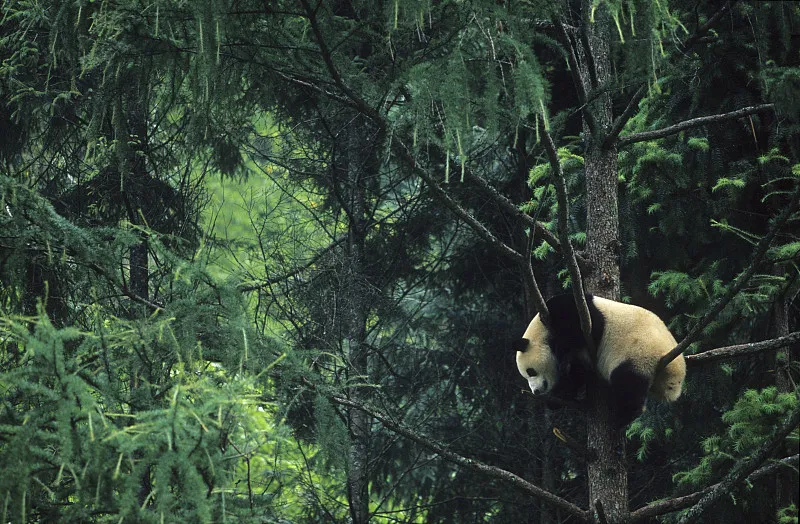
And somewhere in the thick bamboo, unseen, a giant panda chews methodically, indifferent to all of them.
This is the panda’s forest — not a monoculture of bamboo stalks but a complex, layered ecosystem where dozens of vertebrate species and thousands of plants and insects coexist across multiple forest strata. The panda is the umbrella, explored in our article on the umbrella species effect. But the umbrella shelters a community worth knowing in its own right.
The Canopy Dwellers
Golden snub-nosed monkey (Rhinopithecus roxellana). These primates are among the most beautiful monkeys on Earth — golden-orange fur, pale blue faces, and a tolerance for cold unmatched by any other non-human primate. They live in large troops at elevations of 1,500-3,400 meters — the same elevation range as pandas — and survive winter temperatures that drop below -10°C by huddling together in dense clusters. They are primarily leaf-eaters, competing minimally with pandas for bamboo.
Birds. The forest hosts an extraordinary avian community: golden pheasants (the males resplendent in red, gold, and blue), Temminck’s tragopans (pheasant-relatives with elaborate courtship displays), Sichuan jays, and numerous smaller species. The dawn chorus in a panda forest rivals any tropical rainforest in diversity and volume.
The Forest Floor
Takin (Budorcas taxicolor). These large, shaggy goat-antelopes look like creatures from mythology — massive bodies, thick golden-brown fur, curved horns. They share the panda’s trails, the panda’s bamboo patches, and the panda’s seasonal migration patterns, moving up and down the mountain with the seasons. Takin and pandas coexist with minimal conflict — both eat bamboo, but takin are less specialized and consume a wider variety of plants.
Tufted deer (Elaphodus cephalophus). Small, shy deer with a distinctive tuft of dark hair on their foreheads and tiny antlers hidden beneath. They browse on forest understory plants, avoiding direct competition with bamboo-specialist pandas.
The Shared Bamboo Niche
Red panda (Ailurus fulgens). The giant panda’s smaller, unrelated namesake — explored in our comparison of red pandas and giant pandas. Red pandas share the bamboo diet but not the bamboo space: they live primarily in trees, descending to the ground less frequently than giant pandas. The two species have partitioned the bamboo forest vertically, reducing competition. Both evolved the pseudo-thumb for bamboo gripping independently — one of the most striking examples of convergent evolution in mammals.
The Predators
Clouded leopard (Neofelis nebulosa). Once the panda’s primary natural predator, capable of killing even adult pandas. Now vanishingly rare in panda habitat — camera trap surveys detect them only occasionally. Their decline is a loss for the ecosystem but has removed the primary predation pressure on pandas except for cubs, which may be taken by smaller predators.
Asiatic black bear (Ursus thibetanus). The panda’s distant cousin — both are bears, but they occupy different dietary niches. Black bears are omnivores, eating fruit, insects, and occasional small animals. They share the forest with pandas but rarely compete directly.
Did You Know? The panda’s forest is part of the Mountains of Southwest China biodiversity hotspot — one of only 34 global hotspots identified by Conservation International. These hotspots cover just 2.3% of Earth’s land surface but contain over 50% of the world’s plant species and 42% of terrestrial vertebrates. The panda is the most famous species in one of the most biologically significant regions on the planet.
Frequently Asked Questions
Do pandas and red pandas ever fight?
Extremely rarely — they occupy different spaces (ground vs. trees) and have no reason to conflict. When they encounter each other, they typically ignore each other entirely.
What would happen to the ecosystem if pandas disappeared?
The bamboo forest would persist, and most species would survive. The panda is not a keystone species in the ecological sense — the ecosystem does not depend on it. But the loss of the panda would almost certainly mean reduced protection for the forest itself, as explored in our article on the umbrella species effect. The panda’s ecological importance is as a conservation flagship, not as an ecosystem engineer.
Are any of the panda’s forest neighbors also endangered?
Yes. The golden snub-nosed monkey is endangered. The red panda is endangered. The clouded leopard is vulnerable. Several bird species are near-threatened. The panda’s forest is a refuge for multiple threatened species — another reason its protection matters.
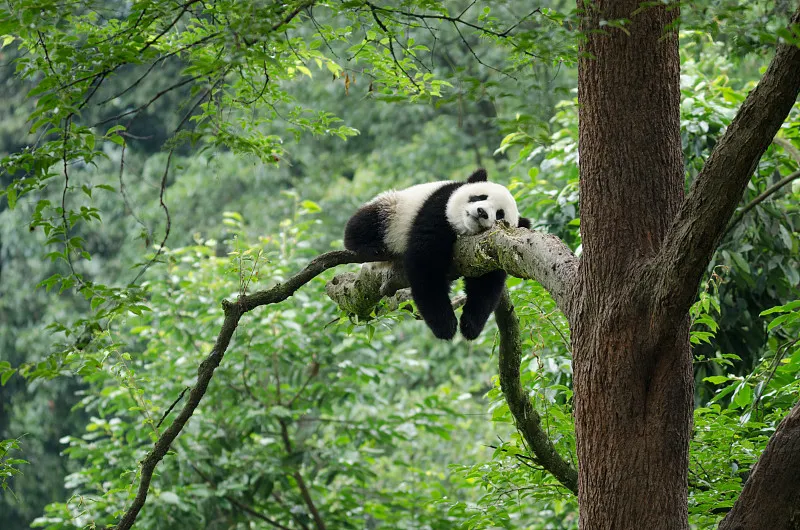
At dusk, the golden monkeys settle into their sleeping clusters, the takin retreat to higher slopes, the red panda curls tighter on its branch. The panda, having eaten for twelve hours, settles against a tree trunk and closes its eyes. The forest does not sleep — it shifts from the diurnal community to the nocturnal, from the birds and monkeys to the owls and flying squirrels. The panda is one thread in this tapestry. Protecting the tapestry protects every thread.