Table of contents (12 sections)
The Umbrella Effect: Protecting Pandas Protects Thousands of Species
Key Fact: The giant panda is what conservation biologists call an “umbrella species” — an animal whose habitat protection inadvertently shelters thousands of other species. The Giant Panda National Park’s 27,000 square kilometers protect not just 1,864 pandas but over 10,000 plant species, approximately 900 vertebrate species, and entire mountain ecosystems that rank among the world’s 34 biodiversity hotspots. Every dollar invested in panda habitat is a dollar invested in golden monkeys, takin, clouded leopards, red pandas, and the uncounted insects, fungi, and microorganisms that constitute one of the richest temperate ecosystems on Earth. The measurable return: $10-27 in ecosystem services for every $1 invested.
Key Takeaways
-
Protecting pandas protects everything that shares their forest — from charismatic mammals like golden monkeys to the insects and fungi that underpin the ecosystem.
-
The panda outperforms every other umbrella species in biodiversity ROI — no single-species conservation program on Earth protects more species per dollar than panda habitat protection.
-
The umbrella is not perfect — it favors forest species over non-forest species, and the charismatic species bias is a legitimate concern — but the evidence shows it works.
Minshan, Dawn
Walk through the bamboo forests of the Minshan Mountains at dawn, and the panda is probably the last animal you’ll see. First comes the sound: a rustling in the canopy overhead, and then a flash of golden-orange fur and a startling blue face — a golden snub-nosed monkey, leaping from fir branch to fir branch, its troop of 30 chattering and calling. Then the movement at the forest edge: a takin, massive and shaggy, its golden-brown coat blending into the autumn leaves, its curved horns catching the low morning light. A red panda, the giant panda’s smaller namesake, dozes on a high bamboo branch. A golden pheasant scratches through the leaf litter.
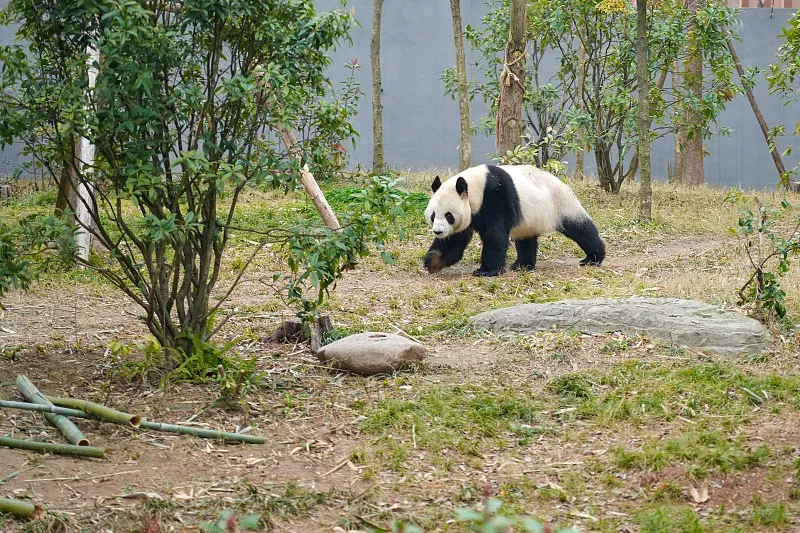
None of these animals knows it, but each of them owes its protected existence, in part, to the panda — the animal they may never see but whose conservation umbrella shelters them all. The panda in this forest is not its apex predator, not its keystone engineer, not its dominant competitor. It is simply its most famous resident — and by being famous, it attracts the resources that keep the entire forest standing.
What Is an Umbrella Species?
The umbrella species concept rests on a simple spatial argument: some species require such large, intact habitats that protecting them automatically protects everything else that lives there. The term was formalized in conservation biology in the 1980s, alongside related concepts like flagship species (charismatic animals that attract public support) and keystone species (animals whose ecological role is disproportionately large relative to their biomass). Pandas function as both umbrella and flagship species simultaneously — they attract funding because they are charismatic, and that funding protects habitat because their range requirements are extensive.
An effective umbrella species must meet three criteria: a large home range (so protecting it covers substantial area), habitat overlap with many other species (so the umbrella is well-populated), and sufficient public appeal to attract conservation resources (so the umbrella is funded). The panda meets all three at an exceptional level.
Why Pandas Became China’s Conservation Umbrella
The panda’s role as China’s conservation umbrella was not planned — it emerged from the convergence of several factors that no other species could replicate.
Global recognition. The panda is the most recognized conservation symbol on Earth. The WWF logo, designed in 1961, made the panda the face of global conservation before China’s panda protection program even existed. When China began investing in panda conservation in the 1970s and 1980s, it was investing in an already-established global icon.
Political capital. Pandas are a matter of national pride and diplomatic soft power in China. The funding that flows to panda conservation — national government budgets, provincial allocations, international grants, corporate sponsorships — exceeds what any less iconic species could attract. This is not an accident of nature but a political reality: the panda opens doors that remain closed for the golden monkey or the takin.
Habitat scale. The panda’s habitat requirements — large, connected, elevationally diverse bamboo forests — overlap almost perfectly with the habitat requirements of the entire temperate forest ecosystem of central and western China. Protecting habitat for pandas means protecting habitat for nearly every forest species in the region.
The question “Why the panda and not the golden monkey?” answers itself: the panda attracts resources that the golden monkey cannot. A conservation program focused on the golden monkey would protect a fraction of the area, with a fraction of the budget, and would not employ the same number of forest rangers or establish the same network of reserves.
Measuring the Umbrella Effect
How much biodiversity does panda conservation actually protect? The data from individual reserves within the Giant Panda National Park provides a quantitative answer.
| Protected Area | Established | Area (km²) | Panda Pop. | Confirmed Mammal Species | Confirmed Bird Species | Vascular Plant Species | Endemic Plant Species |
|---|---|---|---|---|---|---|---|
| Wolong | 1975 | 2,000 | ~100 | 107 | 273 | 4,000+ | ~150 |
| Wanglang | 1963 | 323 | ~30 | 83 | 217 | 3,100+ | ~90 |
| Tangjiahe | 1978 | 400 | ~40 | 95 | 251 | 2,800+ | ~75 |
| Foping | 1978 | 350 | ~60 | 78 | 198 | 2,400+ | ~60 |
| Fengtongzhai | 1975 | 390 | ~50 | 88 | 229 | 3,200+ | ~100 |
The pattern is consistent: every protected area established for pandas harbors 80-110 mammal species, 200-270 bird species, and thousands of plant species. Multiply these numbers across the 67 protected areas that existed before the Giant Panda National Park consolidated them, and the scale of biodiversity protection becomes clear.
Species Living Under the Panda Umbrella
The community sheltered by panda protection spans the full taxonomic range of the temperate forest ecosystem.
Mammals
-
Golden snub-nosed monkey (Rhinopithecus roxellana) — Endangered. One of the most beautiful primates on Earth, with golden-orange fur and a startling blue face. Lives in troops of 20-60 individuals at elevations of 1,500-3,400 meters, overlapping the panda’s entire elevation range. Panda reserves protect some of the largest remaining populations.
-
Takin (Budorcas taxicolor) — Vulnerable. A massive, shaggy goat-antelope that looks like a creature from mythology. Shares panda trails, bamboo patches, and elevation migration patterns. Camera trap data confirms takin use of panda corridors.
-
Red panda (Ailurus fulgens) — Endangered. The giant panda’s smaller namesake, sharing its bamboo diet but not its ground-level niche. Red pandas live primarily in trees, partitioning the bamboo forest vertically with their larger namesake.
-
Clouded leopard (Neofelis nebulosa) — Vulnerable. Once a predator of panda cubs, now vanishingly rare. Every camera trap image of a clouded leopard in a panda reserve is a data point demonstrating the umbrella’s reach.
-
Asiatic black bear (Ursus thibetanus), tufted deer (Elaphodus cephalophus), Sichuan takin (subspecies), leopard cat (Prionailurus bengalensis), Siberian weasel (Mustela sibirica).
Birds
- Golden pheasant (Chrysolophus pictus) — males resplendent in red, gold, and blue; the most photographed bird in panda habitat.
- Temminck’s tragopan (Tragopan temminckii) — a pheasant-relative with elaborate courtship displays.
- Chinese monal (Lophophorus lhuysii) — one of the most endangered pheasants in the world, found almost exclusively in protected panda habitat above 3,000 meters.
- Sichuan jay (Perisoreus internigrans), white-browed tit-warbler, and over 200 other bird species confirmed within the park.
Amphibians and Reptiles
The moist, shaded bamboo forest floor provides ideal habitat for amphibians. Several species are endemic to individual mountain ranges — found nowhere else on Earth.
Plants
Over 10,000 vascular plant species have been recorded within the Giant Panda National Park, including rare orchids, medicinal herbs (many used in traditional Chinese medicine), endemic rhododendrons, and the 30+ bamboo species that form the foundation of the ecosystem. The park contains some of the largest remaining old-growth temperate forests in China.
Case Study: Wolong Nature Reserve
Wolong, established in 1975 as one of China’s first panda reserves, provides the longest-running data on the umbrella effect. Twenty years before Wolong was designated, the area was actively logged. The forests that now shelter pandas and golden monkeys were being cut for timber.
The transformation after protection is documented in the scientific literature. Logging ceased in 1975-1976. Forest regeneration began immediately. By 1995, camera traps and field surveys confirmed that populations of golden snub-nosed monkeys, takin, and other forest mammals had increased significantly. Plant surveys documented the recovery of old-growth forest indicators — mosses, lichens, understory herbs — that had been suppressed by logging.
Wolong’s most important contribution to umbrella species science is the demonstration of a lag effect: biodiversity recovery following habitat protection takes 20-30 years to reach equilibrium. The full benefits of the umbrella are not immediate. They accumulate over decades.
Panda vs Other Umbrella Species
The panda is not the only umbrella species in conservation history. Comparing it to other well-known umbrellas reveals its exceptional performance.
| Umbrella Species | Region | Area Protected (km²) | Threatened Species Sheltered | Primary Mechanism | Cost per km² per Year |
|---|---|---|---|---|---|
| Giant Panda | Central China | 27,000 (GPNP) | 100+ vertebrate species | Reserve system + corridor network | ~$15,000 |
| Northern Spotted Owl | US Pacific Northwest | ~100,000 | ~50 vertebrate species | Logging restrictions on federal land | ~$2,000 |
| Florida Panther | South Florida | ~10,000 | ~40 vertebrate species | Reserve protection + wildlife crossings | ~$25,000 |
| Bengal Tiger | India (reserves) | ~38,000 | 80+ vertebrate species | Tiger reserve network + anti-poaching | ~$12,000 |
The panda and tiger umbrellas are the most comparable — both operate in biodiverse Asian ecosystems with overlapping conservation strategies. The panda umbrella protects a higher density of threatened species per square kilometer than the tiger umbrella, reflecting the extraordinary biodiversity of the Mountains of Southwest China hotspot relative to tiger habitat.
Criticism: The Umbrella Is Not Perfect
The umbrella species concept has legitimate critics, and addressing their concerns strengthens the argument rather than weakening it.
The charismatic bias. Conservation funding disproportionately flows to charismatic species, and umbrella species strategies can reinforce this bias. Species that are not covered by any umbrella — amphibians in non-forest habitats, low-elevation river species, alpine meadow plants — receive disproportionately little attention.
The coverage gap. The panda umbrella protects forest species. It does not protect species in agricultural landscapes, river systems, or high alpine zones. Approximately 30-60% of China’s terrestrial vertebrate species have range overlap with the panda umbrella — meaning 40-70% do not.
The single-species risk. An umbrella strategy tied to a single species is vulnerable to that species’ decline. If the panda population were to collapse, political support for panda habitat protection might decline, removing the umbrella from the species that depend on it.
These criticisms do not invalidate the umbrella approach. They contextualize it. The panda umbrella is not a complete biodiversity strategy for China. It is the most effective single tool available, and it must be complemented by other conservation approaches for habitats and species it does not cover.
Key Metrics: The Umbrella by the Numbers
| Metric | Value |
|---|---|
| Total protected area (GPNP) | 27,000 km² |
| Estimated panda population protected | 1,864 (all wild pandas) |
| Mammal species within the park | ~150 |
| Bird species within the park | ~400 |
| Vascular plant species | 10,000+ |
| Global biodiversity hotspot | Yes (Mountains of Southwest China) |
| Carbon stored | 2-3 billion tons |
| Annual ecosystem service value | $2.5-7.5 billion |
| Conservation cost per year | ~$100 million |
| Benefit-to-cost ratio | 10:1 to 27:1 |
Frequently Asked Questions
How much does panda conservation cost compared to its biodiversity benefits?
Economic analyses estimate that the ecosystem services provided by panda habitat are worth 10-27 times the annual cost of panda conservation. The carbon storage value alone — from the intact forests of the Giant Panda National Park, as explored in our article on panda habitat as carbon sink — is estimated at $200-750 million per year, exceeding the entire annual budget for panda conservation globally.
What happens to other species if panda protection is reduced?
The umbrella works both ways: if panda habitat protection is reduced, the other species under the umbrella lose their protection too. The interdependence is absolute — and it is the strongest argument for maintaining panda conservation at current or increased levels. Losing the panda would mean losing the umbrella, and everything under it.
Are there species that only survive because of panda protection?
Yes. Several plant species with extremely restricted ranges — found only within individual panda reserves — would likely be extinct if their habitat had not been protected for pandas. The Sichuan golden monkey (a subspecies of golden snub-nosed monkey) has its largest remaining population in panda reserves. For these species, the panda umbrella is not helpful — it is essential.
Could ecotourism replace government funding for umbrella species protection?
Partially. Panda reserves attract significant ecotourism, particularly Wolong and the research bases near Chengdu. Ecotourism revenue contributes to local conservation funding and provides economic alternatives to logging and farming. However, ecotourism alone cannot fund the full reserve system — government investment remains the primary funding source, and the panda is the species that sustains that political commitment.
Does the umbrella concept apply to other Chinese species?
China has explored umbrella species approaches for several other threatened ecosystems, including the Siberian tiger (northeastern forests), the Yangtze finless porpoise (freshwater river ecosystem), and the snow leopard (high-altitude plateau ecosystem). Each functions as an umbrella for its specific habitat type. None has achieved the scale or funding consistency of the panda umbrella.
Your Turn
The panda does not know it is an umbrella. It simply lives in a forest, eating bamboo, indifferent to the golden monkeys in the canopy and the takin in the valley and the orchids blooming in the shade. But every hectare of that forest protected for the panda is a hectare protected for everything else. The truest measure of panda conservation is not the number of pandas — it is the number of species that survive because pandas did. Read our article on the species that share the panda’s forest to meet the neighbors under the umbrella, and our analysis of habitat corridors to understand how the umbrella is being stitched back together.

Dr. James Thornton
Wildlife Ecology Editor
Wildlife ecologist specializing in forest ecology, protected area effectiveness, mammal community conservation, and human-wildlife coexistence in panda habitats.
View full profile →Tags in this article
Questions readers often ask
What is an umbrella species?
An umbrella species is a species whose conservation indirectly protects many other species that share its habitat. By protecting the large, contiguous habitat that pandas require — bamboo forests across six mountain ranges — conservation programs automatically protect the thousands of other plants and animals that live in those same forests. The panda's habitat requirements are so extensive that they create a 'conservation umbrella' covering entire ecosystems.
How many other species benefit from panda conservation?
The Giant Panda National Park alone protects over 10,000 plant species and approximately 900 vertebrate species, including endangered mammals like the golden snub-nosed monkey, takin, clouded leopard, red panda, and Asiatic black bear, as well as birds, amphibians, reptiles, and countless insects and fungi. The park's 27,000 square kilometers encompass some of the most biodiverse temperate forests on Earth.
How does the panda compare to other umbrella species like the spotted owl?
The panda's umbrella is far larger in scale. The northern spotted owl's protection in the US Pacific Northwest covers approximately 100,000 square kilometers of old-growth forest. The panda's umbrella covers 27,000 square kilometers of the Giant Panda National Park, but with a much higher density of threatened species per hectare. The Mountains of Southwest China biodiversity hotspot, which overlaps panda habitat, contains one of the highest concentrations of plant endemism on Earth.
Does focusing on pandas mean other species get ignored?
This is a legitimate criticism. 'Charismatic megafauna' like pandas attract disproportionate conservation funding. However, evidence from panda reserves shows the umbrella is effective — camera trap surveys document thriving populations of non-panda species within reserves. The real question is whether alternative funding models (direct ecosystem conservation without a flagship species) would attract the same level of resources. Available evidence suggests they typically do not.
What is the ROI of panda conservation in terms of biodiversity?
Economic analyses estimate that the ecosystem services provided by panda habitat — carbon storage, water purification, biodiversity maintenance, ecotourism — are worth 10-27 times the annual cost of panda conservation. Every dollar invested in panda habitat protection generates $10-27 in measurable ecosystem benefits, excluding the intrinsic value of species preservation.
Could another species serve as China's conservation umbrella?
In theory, yes — the golden snub-nosed monkey or the takin could serve as a focal species. However, no other species matches the panda's global recognition, political support, and funding attraction. The panda is the only species that can sustain the level of investment needed to protect 27,000 square kilometers of habitat. Switching to a less charismatic umbrella would likely reduce total conservation funding.
Are there species that don't benefit from the panda umbrella?
Yes. Species that require habitat types not covered by panda protection — low-elevation rivers, agricultural landscapes, alpine meadows above the bamboo line — are not sheltered by the panda umbrella. This is a known limitation of any single-species umbrella strategy: it protects the habitat of the focal species but not all habitats in the landscape. Complementary conservation strategies are needed for non-forest species.
How much of China's threatened biodiversity does the panda umbrella cover?
Approximately 30-40% of China's terrestrial vertebrate species have at least part of their range within the Giant Panda National Park. For forest-dependent threatened species in central and western China, the coverage is substantially higher — estimated at 60-70%. The panda umbrella does not cover all of China's biodiversity, but it covers an extraordinarily large share of it.