Panda Superpowers: Climbing Trees and Swimming Skills 🏔️🏊
🦸 Key Fact: Don’t let the slow waddle fool you — giant pandas are secretly athletic! They can climb 20-meter trees, swim across flooded rivers, and sprint at 32 km/h when they need to. Pandas learn to climb at just 5 months old, practicing on tree trunks until they can scramble to the highest branches to escape danger. And their thick, slightly oily fur doubles as a natural life jacket, keeping them buoyant and warm in the cold mountain streams where they swim.
Key Takeaways
-
🧗 Baby pandas learn to climb at 5-6 months old — and the learning process involves a LOT of tumbling back down! By 8-10 months, most cubs are confident tree-climbers.
-
🏊 Pandas are natural swimmers with water-resistant fur that acts like a built-in flotation device. They doggy-paddle across rivers and enjoy splashing in pools on hot days.
-
🏃 Pandas can sprint at 32 km/h — as fast as a human — when they really need to. Their slow, relaxed walking is a choice, not a limitation!
Hello, young explorer! Today we’re uncovering the SECRET superpowers of the giant panda. You might think pandas are all about eating and sleeping — and they definitely love both — but hiding beneath that round, fluffy exterior is a surprisingly athletic animal with some serious survival skills.
Ready to discover what pandas can REALLY do? Let’s climb a tree, swim a river, and uncover the hidden athlete inside every panda!
Panda Superpower #1: Tree Climbing 🧗♀️
Panda Kindergarten: Climbing Class
At 5-6 months old, every panda cub enrolls in the most important class at panda kindergarten: Climbing 101. The teacher is Mom. The classroom is a tree trunk. And the homework? Climb. Fall. Climb again.
Here’s how a typical climbing lesson goes:
Step 1: Watch and Learn. Mother panda climbs a sturdy tree — one with thick bark and a gentle angle — and settles on a branch a few meters up. She looks down at the cub. The message is clear: “Your turn.”
Step 2: The First Attempt. The cub wraps its front paws around the trunk and tries to pull itself up. But the bark is slippery, the cub’s leg muscles are still developing, and gravity is not cooperating. The cub slides back down — tail first, in a fluffy heap at the base of the tree.
Step 3: Try, Try Again. The cub tries again. And again. Each attempt gets a LITTLE higher. The mother watches from above, occasionally bleating encouragement — the sheep-like “baa” sound that means “you’re doing great, keep going!”
Step 4: Success! By 8-10 months old, most cubs can climb 3-5 meters high. Going up is the easy part — climbing down is trickier. Cubs often descend backward, feeling with their back paws for the next foothold, like climbing a ladder in reverse.
Why climb? In the wild, climbing is a survival skill. A young panda on the ground is vulnerable to predators like leopards and wild dogs. But a panda high in a tree is safe — most predators can’t climb as well as a panda can, and those that can are too heavy for the outer branches where pandas perch. The baby panda’s first year diary has the full growth timeline!
[Image: A 7-month-old panda cub gripping a tree trunk with all four paws, halfway up, looking back at the camera with a comical expression of concentration mixed with uncertainty]
Do Adult Pandas Still Climb?
Yes — but they’re more selective about it. An adult panda weighs 100-135 kilograms (220-300 pounds), and climbing that much weight up a tree is a serious workout. Adult pandas climb when they have a good reason:
- Escaping danger
- Reaching high bamboo branches
- Finding a cool, breezy spot on a hot day
- Getting away from an annoying visitor (in the wild)
When an adult panda climbs, it’s surprisingly graceful. The thick, rough paw pads grip bark like natural climbing shoes. The powerful front legs — the same muscles that crush bamboo stalks — pull the panda’s weight upward. And the pseudo-thumb, which we explored in our panda pseudo-thumb article, provides extra gripping power.
Panda Superpower #2: Swimming 🏊
The Panda Doggy-Paddle
Here’s a fact that surprises almost everyone: pandas can swim — and they’re actually pretty good at it!
Wild pandas regularly cross rivers and streams in their mountain habitat. When a panda encounters water it can’t wade through, it doesn’t turn back — it jumps in and swims. The technique is a simple doggy-paddle: front paws churning the water, back legs steering, head held above the surface.
Several features make pandas natural swimmers:
Water-resistant fur. Panda fur contains a thin coating of natural oil that repels water. Drops bead on the surface and roll off rather than soaking through — like a built-in rain jacket. This oil also helps the fur trap air bubbles, providing extra buoyancy.
Natural buoyancy. The thick underfur — the dense, wooly layer beneath the outer guard hairs — traps air against the skin. A panda in water floats slightly higher than a similarly-sized animal without this air-trapping insulation.
Powerful front legs. The same shoulder and arm muscles that help pandas climb also power their swimming stroke. A panda’s paddling is strong and efficient.
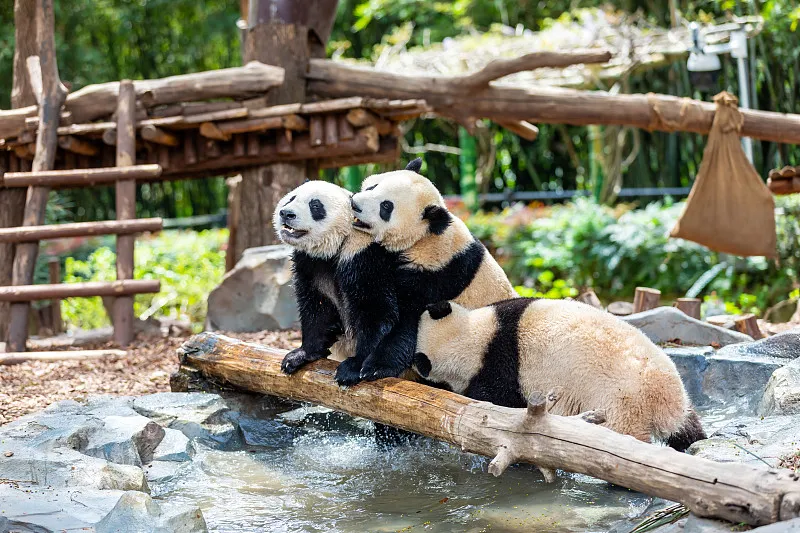
Cooling effect. On hot Sichuan summer days, pandas at bases with pools will wade in, splash around, and sometimes swim short laps. The water cools their thick-furred bodies — a welcome relief when temperatures cross 30°C (86°F). Our article on how pandas beat the tropical heat explains more about panda cooling strategies!
The Earthquake Panda: A True Survival Story 🌊
During the devastating 2008 Wenchuan earthquake, villagers in the Qionglai Mountains reported seeing something incredible: a wild panda swimming across a flooded river to escape a collapsing hillside. The earthquake had triggered landslides that sent walls of mud and rock crashing into the valley. The river swelled, flooded, and carried debris downstream.
And through it all, one wild panda swam — front paws paddling, head above the churning brown water — until it reached the far bank and disappeared into the surviving bamboo.
This story became legendary among panda researchers. It proved that pandas aren’t just casual swimmers — they can swim through dangerous conditions when their lives depend on it. It also supported the geological evidence that pandas can disperse across rivers, explaining how different panda populations maintain genetic connections despite the river barriers that divide their habitat.
Panda Superpower #3: Sprint Speed 🏃
Ready for the most surprising panda stat of all? A giant panda can run at speeds up to 32 kilometers per hour (20 miles per hour). That’s as fast as a human sprinter!
Pandas don’t run this fast often because:
- Bamboo is a low-energy diet — sprinting burns calories pandas can’t spare
- Pandas rarely need to chase anything or run from anything
- The dense bamboo understory isn’t great for running
But when a panda DOES run — startled by a sudden noise, chasing away a rival, or escaping danger — it moves with surprising speed and power. The short, muscular legs that look slow and waddling are actually designed for explosive bursts. Think of a panda’s build like a weightlifter: lots of strength, moderate endurance, and the ability to move fast when motivated.
The Athletic Panda vs. The Relaxed Panda
| Skill | Panda Level | Fun Comparison |
|---|---|---|
| Climbing | ⭐⭐⭐⭐⭐ Expert | Better than most dogs, worse than most cats |
| Swimming | ⭐⭐⭐⭐ Good | Better than you’d expect, but no Olympic medals |
| Running | ⭐⭐⭐ Decent | Surprising sprint speed, terrible endurance |
| Rolling | ⭐⭐⭐⭐⭐ World Class | Possibly the best animal roller on Earth! |
| Eating bamboo | ⭐⭐⭐⭐⭐ Legendary | 12-38 kg per day. No animal comes close |
And pandas are full of even more surprises — discover more quirky panda habits that will make you smile!
Your Panda Challenge: Next time you’re at a playground or park, try these panda-inspired activities:
-
🧗 The Climb: Find a climbing structure and practice going up AND down carefully, like a panda cub learning to descend a tree backward.
-
🏊 The Paddle: In a pool (with adult supervision!), practice the doggy-paddle — front arms churning, head above water — just like a panda crossing a river.
-
🏃 The Sprint: Run as fast as you can for 5 seconds. That’s how pandas run — short bursts, not long distances!
Now you know: pandas are WAY more athletic than they look. They climb like gymnasts, swim like lifeguards, and sprint like track stars. The slow waddle? That’s just their RELAXED mode. When pandas need to perform, they’ve got superpowers! 🐼💪