Table of contents (9 sections)
The Origin of Pandas: Species History & Evolution
The giant panda is a true bear, but it is not just any bear. It represents its own deep lineage within the bear family — one that diverged long ago and then spent millions of years doing something no other bear has done: a bone turned into a finger and a gut turned into a bamboo processor — one lineage’s bet on one plant. This page is the overview pillar for panda origins on Panda Common. It delivers the through-line conclusions of four lines of evidence — fossils, diet, anatomy, and genome — and routes each layer to its dedicated deep-dive page. Because the origin of the panda is not a single moment. It is a layered story, and you only see the whole animal by reading all four layers at once.
The Fast Answer: A Layered Summary
Giant pandas are bears with their own lineage within the bear family. An early ancestor often cited from the fossil record is Ailurarctos. Over millions of years, the lineage shifted from a carnivorous diet toward a near-exclusive bamboo diet. That shift involved a dietary transition, the evolution of a pseudo-thumb, and gene-level changes that modern genomics can now read directly. Whole-genome sequencing confirms the broad timeline and the demographic history of the species.
Here is the four-layer map this site uses for any panda origin question:
- Fossils — what the skeleton says about the panda’s place among bears
- Diet — when and why pandas became bamboo-eaters
- Anatomy — how a carnivore’s body handles bamboo
- Genome — what the DNA confirms about timing and population history
Each layer is a different kind of evidence. Each has its own deep-dive page. This page gives you the conclusions and the routes.
Before we go deeper, one observation about how pandas are usually introduced. Most English-language readers first meet the panda as a country fact — pandas come from China — or as a conservation headline. What gets lost is that the panda’s origin is one of the cleanest demonstrations in biology of a lineage betting everything on a single resource. The species’ journey from rare carnivore to bamboo-specialist is what made it both so unique and so vulnerable: the same adaptations that carved its ecological niche — the bamboo diet and the pseudo-thumb — also tied its fate to one plant. Understanding the origin answers the deeper conservation question people actually bring: this animal is weird and threatened — how did it get this way? The ancestral story is not trivia. It is the evolutionary framework beneath every modern conservation claim on this site.
Layer 1 — Fossils: What the Skeleton Says
The fossil record places the giant panda in its own lineage among bears. The often-cited early panda-lineage ancestor is Ailurarctos, a genus known from fossil material found in Asia. The branch conclusion is straightforward: pandas are not direct descendants of any living bear species. They are an early-diverging lineage that has been on its own evolutionary path for millions of years.
The panda’s skeleton tells this story in its proportions and specializations. The full phylogenetic argument — the specific fossil sites and the stratigraphic reasoning — is carried by the deep dives on this site, and I am a genomics editor, so I defer to that evidence where it belongs. What matters for the overview is the shape of the family tree: the panda is a branch, not a twig grafted onto another bear’s branch.
→ Route: The Ancestral Carnivore and the Pleistocene Frame — where the lineage begins, and the fossil-era context behind the panda’s family tree.
Layer 2 — Diet: When Pandas Became Bamboo-Eaters
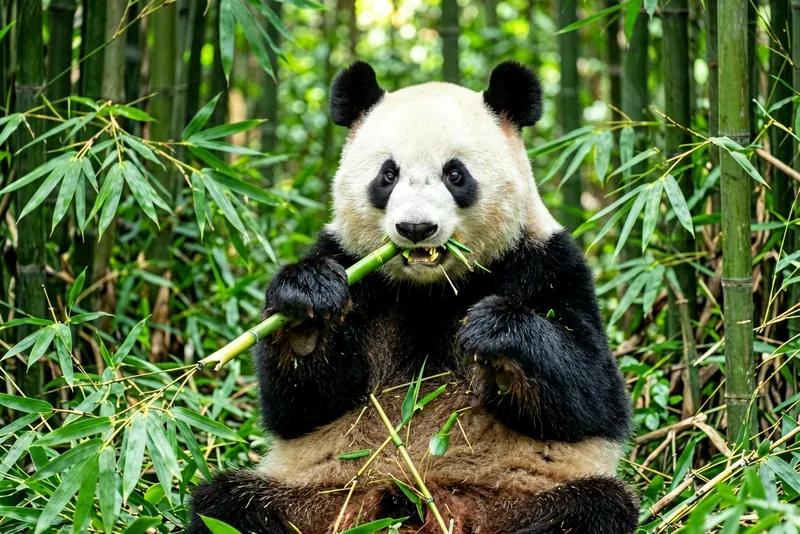
The most dramatic turn in the panda’s origin story is dietary. The lineage began as a carnivore — its bear ancestors ate meat — and over evolutionary time shifted toward a diet made almost entirely of bamboo. This is not a casual preference. It is a near-total commitment: bamboo makes up the overwhelming majority of the modern panda’s diet.
How do we know when and why this happened? The evidence comes from multiple lines, most notably stable-isotope analysis of the dietary record, which reconstructs the shift from animal-based to plant-based food sources. I will not re-derive that argument here — the diet-evolution stable-isotope page carries the full evidence trail. The through-line conclusion is this: the panda’s bamboo diet is a behavioral and ecological adaptation, not a genetic identity change. The genome still carries the machinery of a carnivore.
→ Route: The Diet Evolution: Stable-Isotope Evidence — the full reconstruction of the dietary switch.
Layer 3 — Anatomy: The Body That Handles Bamboo
A carnivore’s body is not built to eat bamboo. The panda solved this problem with one flagship adaptation: the pseudo-thumb, an enlarged radial sesamoid bone that functions as a “sixth finger.” It is not a true digit — it is a wrist bone that evolved to do a finger’s job — and it made bamboo gripping and handling possible. This is the anatomical answer to the question of how a carnivore’s body manages an herbivore’s diet.
The digestive system is the other half of the story, and it is genuinely strange: the panda’s gut remains structurally carnivore-like, yet it copes with bamboo. Part of the answer lies in the gut microbiome, which plays a critical role in bamboo’s cellulose metabolism — the breakdown of tough plant material that a carnivore’s own genome was never designed to handle. The mechanics of the pseudo-thumb and the details of the digestive system each have their own dedicated pages; I will not copy their arguments here.
→ Route: The Pseudo-Thumb: A Wrist Bone That Became a Finger · The Panda Digestive System — full mechanical and physiological detail.
Layer 4 — Genome: What the DNA Confirms
This is my home territory. The giant panda genome was sequenced and assembled by an international team led by BGI-Shenzhen, with the Institute of Zoology of the Chinese Academy of Sciences in Beijing among the collaborating institutions — work that fundamentally changed how we understand panda evolutionary biology. The genome, roughly 2.4 gigabases in size (Li et al. 2010, Nature 463:311–317), revealed that the panda carries all the genetic machinery of a carnivore despite its almost exclusively bamboo diet. That single finding confirmed what the fossils and anatomy had suggested: the panda is genetically a carnivore that chose, behaviorally and ecologically, to become a herbivore.
Whole-genome sequencing has also given us the demographic history of the species — the rises and falls in population size, the bottlenecks, the long-term trends that shaped the genetic diversity we see today. This is population genetics applied directly to conservation: understanding how much diversity the species carries, how it is structured across its range, and what that means for reserve design and corridor planning. The full sequencing story, including the mechanics and the specific findings, lives on the genome-sequencing page.
→ Route: The Giant Panda Genome: Sequencing & Demography — the molecular evidence in full.
Why Each Layer Is a Different Kind of Evidence
The origin of the panda is not one question. It is four questions, each answered by a different scientific tool:
| Layer | Evidence type | What it establishes | Deep dive |
|---|---|---|---|
| Layer 1 — Fossils | Skeletal / fossil | The skeleton places the panda in its own lineage among bears and shows us the branch point — an early-diverging lineage. | the fossil and lineage framing |
| Layer 2 — Diet | Stable isotopes | The stable-isotope record reconstructs when and how the shift from carnivore to bamboo-eater happened. | the diet-evolution stable-isotope page |
| Layer 3 — Anatomy | Anatomy | The pseudo-thumb and the digestive system show how the body made the shift physically possible. | the pseudo-thumb page |
| Layer 4 — Genome | Whole genome | Whole-genome sequencing confirms the evolutionary history, the demographic past, and the genetic underpinnings of adaptation. | the genome-sequencing page |
Only by reading all four together do you get “the origin of the panda.” That is why this site splits these into dedicated deep-dive pages rather than one mega-article: each layer deserves its own full argument, and this overview page is the map that connects them.
The Origin in One Timeline
This is a conceptual overview, not a formal phylogenetic chart. Specific dates are approximate — and the deep-dive pages carry the precise, source-checked figures.
| Stage | What happens |
|---|---|
| Ancestral bear lineage | The shared stock from which all bears, including the panda lineage, diverged. |
| Panda lineage diverges | The branch that would become the giant panda splits from other bears. (Ailurarctos appears in the fossil record from this branch, millions of years ago.) |
| Dietary shift begins | The lineage moves from carnivory toward bamboo consumption, a transition reconstructed from stable-isotope and other dietary evidence. |
| Pseudo-thumb evolves | The radial sesamoid enlarges into a functional “sixth finger,” enabling bamboo gripping and handling. |
| Modern giant panda | The bamboo-specialist bear we know today, confirmed by whole-genome sequencing as a distinct lineage with its own demographic history. |
Each of these steps is a chapter in its own deep dive. The timeline is the spine; the pages are the vertebrae.
Differentiation: Overview vs. Deep Dives
This page is the overview pillar. It gives you the conclusions of each layer and routes you to the full arguments. If you want the fossil sites and the phylogenetic reasoning, go to the fossil page. If you want the stable-isotope evidence reconstructed step by step, go to the diet-evolution page. If you want the mechanics of the wrist bone and the digestive system, go to the anatomy pages. If you want the sequencing data and the demographic modeling, go to the genome page.
Here is the practical decision rule — a four-gesture map for any panda origin question:
- ① Fossils → “What is the panda’s place among bears?” → the fossil and lineage framing
- ② Diet → “When and why did pandas become bamboo-eaters?” → the diet-evolution stable-isotope page
- ③ Anatomy → “How does a carnivore’s body eat bamboo?” → the pseudo-thumb page
- ④ Genome → “What do the genes say about when and how?” → the genome-sequencing page
If someone asks you “what is the origin of pandas,” give them one line per layer, then route.
Explore the Deep Dives
The origin of the panda is a layered story, and each layer has a full page of its own:
- The Diet Evolution: Stable-Isotope Evidence — when and why pandas became bamboo-eaters
- The Pseudo-Thumb: A Wrist Bone That Became a Finger — how the body handles bamboo
- The Giant Panda Genome: Sequencing & Demography — what the DNA confirms
- Where Pandas Live Today: Habitat Guide — the modern landscape of the lineage
- How Much Bamboo Do Pandas Eat? — the daily reality of the bamboo diet
- The 72-Hour Window: Panda Estrus and Delayed Implantation — the fragile-species dimension that makes the origin matter
Start with the layer that matches your question, and follow the evidence where it leads.
Dr. Lin Chen
Conservation Genomics Editor
Conservation geneticist specializing in giant panda genomics, molecular ecology, and evolutionary biology. Validates all genetics and genome-related content on Panda Common.
View full profile →Tags in this article
Questions readers often ask
Where did pandas come from originally?
Giant pandas are bears, and they represent their own deep lineage within the bear family. Early ancestors — Ailurarctos is the often-cited early panda-lineage genus from the fossil record — lived in what is now China, and over millions of years the lineage shifted toward a diet made almost entirely of bamboo.
Are pandas related to bears?
Yes. Giant pandas are members of the bear family (Ursidae), but they sit in their own lineage within it rather than being direct close cousins of any single living bear species. Fossil and genetic evidence places them as an early-diverging branch of the bear family tree.
Why did pandas evolve to eat bamboo?
The giant panda lineage shifted from a carnivorous diet toward an almost exclusive bamboo diet over evolutionary time. This dietary switch is reconstructed from evidence including stable-isotope analysis of the diet record, and it was accompanied by adaptations such as the pseudo-thumb and a digestive setup adapted to bamboo. The result is an ecological niche tied almost entirely to one plant.
When did pandas evolve?
The panda lineage diverged long ago within the bear family; early panda-lineage ancestors such as Ailurarctos appear in the fossil record from millions of years ago in Asia. Specific divergence and species-history dates are approximate — the fossil and genome evidence on this site carry the precise, source-checked figures.