Super Senses: How Pandas Navigate by Smell and Sound in the Deep Forest
Key Fact: The giant panda’s sensory world is dominated not by sight — which is relatively poor — but by an extraordinary olfactory system and acutely sensitive hearing. Pandas can identify individual conspecifics by scent marks left days earlier on tree trunks, detect the ultrasonic chirps of distant potential mates, and navigate dense bamboo forests where visibility rarely exceeds the length of their own body. The panda brain devotes proportionally more neural tissue to processing smell than almost any other sensory modality — a reflection of a sensory ecology built for a world of scent and sound, not sight.
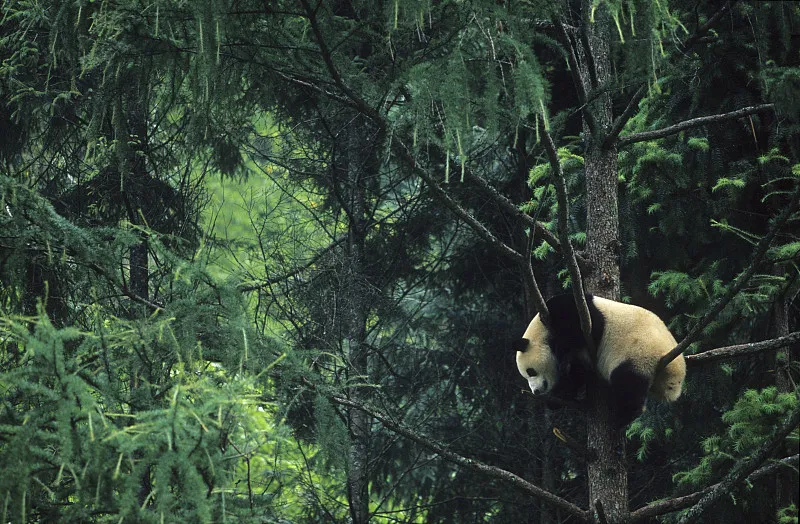
Walk into a bamboo forest in the Minshan Mountains and the first thing you notice is what you cannot see. The bamboo grows in dense, shoulder-high thickets. The canopy overhead, a mix of fir and spruce, blocks most of the sky. Even at midday, the forest floor is dim — the kind of green-gray twilight where shapes blur and distances deceive. You can see perhaps 10 meters in any direction before the bamboo closes in.
Now imagine navigating this world without language, without maps, without the ability to call out and expect an answer. This is the sensory challenge the giant panda has solved: how to find food, avoid danger, locate mates, and recognize neighbors in an environment designed to defeat vision.
The Nose That Reads the Forest
A panda enters a forest clearing and pauses. It lifts its head, nostrils flaring, sampling the air in short, deliberate inhalations. On the trunk of a weathered fir tree at the edge of the clearing, there is a dark stain — a scent mark left by another panda, perhaps days ago. The panda approaches the tree, presses its nose against the stain, and inhales deeply through an olfactory epithelium — the scent-detecting tissue inside the nasal cavity — that, relative to brain size, is significantly larger than a human’s.
What the panda detects in that single inhalation is a chemical dossier. The scent contains volatile organic compounds — fatty acids, steroids, and proteins — that encode a remarkable amount of information about the panda that left the mark. Sex. Age. Reproductive status. Individual identity. How recently the mark was deposited. Whether the marking panda was stressed, healthy, or ill.
This is olfactory communication at a level of sophistication that humans, dependent on vision and language, struggle to appreciate. Where we see a stain on a tree, a panda reads a social media feed — who was here, when, and what they wanted.
The scent-marking ritual itself is a carefully choreographed behavior. A panda seeking to leave its own chemical signature follows a specific sequence: approach a vertical surface (tree trunk, rock face, bamboo stalk), turn around, position the anogenital gland — a specialized scent-producing organ located near the base of the tail — against the surface, and perform a characteristic rubbing motion that deposits a mixture of volatile compounds. The panda may also urinate on the same spot, adding water-soluble compounds that carry different chemical information. Some pandas perform a handstand during marking — lifting their hind legs higher than their shoulders — to deposit the scent as high on the tree as possible, a behavior that likely advertises the marker’s size and physical condition.
The marks are not permanent. Rain degrades water-soluble compounds. UV radiation from sunlight breaks down volatile organics. A scent mark is a time-limited message — “I was here within the last 72 hours” or “I am currently in estrus” — that must be refreshed regularly to remain current. Pandas patrol their home ranges on circuits designed to encounter and refresh scent marks, creating an olfactory map of their neighbors’ movements that is continuously updated.
As explored in our article on panda vocalizations and sound communication, the olfactory system does not operate in isolation. Scent and sound work together: a panda might smell a neighbor’s mark, recognize the individual, and respond with a vocalization — a bark if the neighbor is unwelcome, a bleat if the neighbor is familiar.
Ears Tuned to the Bamboo Forest
If the panda’s nose reads the past — scent marks that persist for days — its ears read the present. Panda hearing is exceptionally acute across a wide frequency range, extending into ultrasonic frequencies that humans cannot detect. This auditory sensitivity is not a luxury; it is a necessity in an environment where vision fails.
Consider the acoustic challenges of the bamboo forest. The dense understory absorbs high-frequency sounds, while the canopy and terrain reflect and scatter them. A panda calling from 50 meters away may be acoustically invisible if the listener cannot distinguish the call from forest background noise. Panda hearing has evolved to solve this problem through several adaptations. The same acute senses that serve pandas also serve the humans who protect them — panda forest rangers rely on sight and sound during patrols through these dense habitats.
Broad frequency sensitivity. Pandas can hear across a range that extends from low-frequency rumbles (around 100 Hz, the frequency of a panda growl) to ultrasonic frequencies above 20 kHz. This broad range allows them to detect the full spectrum of panda vocalizations, from the deep growl of an aggressive male to the high-frequency chirp of an estrus female.
Directional localization. Panda ears are mobile and can swivel independently to pinpoint sound sources. The outer ear (pinna) is large relative to head size and cup-shaped, efficiently collecting and focusing sound waves. A panda can determine the direction of a sound source with enough precision to orient its gaze toward it — critical for locating another panda in dense understory before visual contact is possible.
Filtering background noise. Behavioral experiments suggest that pandas can selectively attend to specific sound types — the bleat of a cub, the chirp of a female in estrus — while filtering out irrelevant background noise. This auditory attention mechanism is analogous to the human “cocktail party effect,” where we can follow a single conversation in a noisy room.
Did You Know? The loudest natural sound a wild panda might hear is not another panda — it is a bamboo stalk snapping. Bamboo under stress produces a sharp, percussive crack that carries surprisingly far in the forest. Researchers suspect that pandas use these sounds to detect the presence of other pandas feeding at a distance — the auditory equivalent of seeing a dinner companion across a restaurant.
The Sensory Trade-Off: Why Vision Lost
The panda’s investment in smell and hearing came at the expense of vision. Compared to most mammals of similar size, pandas have relatively poor visual acuity, limited color discrimination, and a narrow field of view. Their eyes are small and forward-facing, providing binocular overlap that helps with depth perception at close range — useful for manipulating bamboo stalks with the pseudo-thumb discussed in our article on panda pseudo-thumb evolution — but offering little ability to spot distant predators or navigate by sight.
This sensory trade-off makes evolutionary sense. In the panda’s bamboo forest habitat, the visual environment is fundamentally limited. Vegetation density constrains visibility to approximately 10 meters under the best conditions and often less than 3 meters. Investing neural resources in high-acuity distance vision would be wasteful — the information simply isn’t available to be gathered. Natural selection allocated the panda’s limited sensory budget to the modalities that work: smell for tracking the past and hearing for monitoring the present.
The same trade-off appears in other forest-dwelling mammals with limited visibility. Wild boars, tapirs, and forest-dwelling deer all emphasize olfaction over vision to varying degrees. The panda is simply an extreme case — a bear that lives in one of the most visually constraining habitats on Earth and has correspondingly invested in its nose and ears.
Frequently Asked Questions
Can pandas smell food from far away?
Pandas can detect bamboo from moderate distances by scent, but the mechanism is more complex than simple long-distance food detection. Bamboo is always present in a panda’s habitat — the challenge is not finding bamboo but finding the right species and the right parts (shoots, leaves, stalks) at the right time. Pandas likely use scent to locate high-quality bamboo patches — young shoots emit different volatile compounds than mature stalks — rather than to detect bamboo from kilometers away.
Do panda cubs have the same sensory abilities as adults?
Cubs are born with functional smell and hearing but not vision. Their eyes remain sealed for 6-8 weeks, during which they navigate entirely by scent (locating the mother’s nipple) and sound (responding to the mother’s vocalizations). The sensory transition from a smell-and-hearing-dependent newborn to a visually-capable juvenile parallels the evolutionary sensory hierarchy in pandas.
Can pandas be sensory-overwhelmed in captivity?
Yes — this is one reason environmental enrichment is so important, as explored in our article on the science of panda environmental enrichment. The sensory environment of a captive enclosure — constant human presence, novel sounds, unfamiliar scents — is profoundly different from the bamboo forest a wild panda navigates. Thoughtful enclosure design considers panda sensory biology: providing quiet retreat spaces, scent-based enrichment (cinnamon, peppermint), and auditory environments that minimize human-generated noise.
Key Takeaways
-
Smell is the panda’s primary sense. The olfactory system dominates the panda brain, processing chemical messages left by other pandas on trees, rocks, and bamboo — a social network written in scent that persists for days.
-
Hearing is the panda’s real-time alert system. Acute auditory sensitivity across a wide frequency range allows pandas to detect the subtle sounds of approaching animals, feeding conspecifics, and potential threats in a habitat where vision is nearly useless beyond 10 meters.
-
Vision is sacrificed for the sensory modalities that matter. The panda’s comparatively poor eyesight is not a defect — it is an adaptive trade-off, reallocating neural resources from a sense that doesn’t work in dense bamboo to two senses that do.
Next time you’re in a quiet forest, close your eyes for 30 seconds and try to navigate by sound and smell alone. What can you detect that you missed with your eyes? That’s a glimpse into the panda’s sensory world — where the nose reads the past, the ears track the present, and the eyes, gently, are allowed to rest.