Decoding 12 Panda Vocalizations: What Each Sound Really Means
Key Fact: The giant panda possesses one of the richest vocal repertoires among bears — approximately 12 distinct vocalization types, including the sheep-like bleat of friendly greeting, the dog-like bark of alarm, the bird-like chirp of courtship, and the low moan of contentment. Bioacoustic researchers at the Chengdu Research Base have spent decades recording and categorizing these sounds, building an acoustic dictionary that reveals the hidden social life of a species long assumed to be silent and solitary.
Deep in the Chengdu Research Base at dawn, before the first visitors arrive, the panda enclosures fill with sound. Not the background hum of bamboo chewing — that comes later — but a complex, layered chorus of vocalizations that most visitors never hear. A low, rumbling bleat from enclosure 7: a mother calling to her cub. A sharp, percussive bark from enclosure 12: a young male announcing his presence to a neighbor he can smell but cannot see. A series of rapid, high-pitched chirps from enclosure 4: a female in estrus, broadcasting her availability to any male within hearing range.
If you close your eyes and listen without knowing the source, you might mistake the sounds for a farmyard: sheep bleating, dogs barking, birds chirping. The panda’s acoustic range is unexpectedly broad — a hidden dimension of panda behavior that challenges the popular image of the silent, solitary bamboo-eater.
The 12 Vocalizations: A Complete Acoustic Dictionary
Bioacoustic researchers classify panda vocalizations by their acoustic structure — frequency, duration, harmonic composition — and by the behavioral context in which they occur. The result is a taxonomy of sounds, each with a distinct meaning.
| # | Vocalization | What It Sounds Like | Behavioral Context | Acoustic Signature |
|---|---|---|---|---|
| 1 | Bleat | A sheep saying “baa” | Friendly greeting, mother-cub contact | Low frequency (~200-400 Hz), short duration, harmonic |
| 2 | Bark | A small dog’s warning bark | Alarm, territorial warning, aggression | Mid-frequency, sharp attack, noisy/harsh |
| 3 | Chirp | A small bird’s rapid twitter | Courtship, female estrus advertisement | High frequency (~2-4 kHz), rapid repetition |
| 4 | Honk | A goose-like nasal sound | Mild distress, frustration | Mid-frequency, nasal resonance |
| 5 | Squeal | A high, thin cry | Pain, extreme distress, cub separation | Very high frequency, long duration |
| 6 | Growl | A low, rumbling threat | Defensive aggression | Very low frequency (~100 Hz), sustained |
| 7 | Moan | A soft, contented hum | Nursing, contentment, relaxation | Low frequency, soft amplitude |
| 8 | Huff | A sharp exhalation | Startle response, mild threat | Aperiodic, broadband noise |
| 9 | Roar | A deep, sustained bellow | Intense aggression, fear | Low frequency, high amplitude, long duration |
| 10 | Grunt | A short, guttural sound | Close-contact communication | Very brief, pulsatile |
| 11 | Whimper | A soft, plaintive cry | Cub begging for milk or attention | Variable, plaintive quality |
| 12 | Tooth-Clacking | A rapid clicking | Close-range threat display | Mechanical, non-vocal |
1. The Bleat: “Hello, I’m Here”
The bleat is the most frequently heard panda vocalization — the acoustic signature of panda sociability. It sounds remarkably like a sheep’s “baa,” a fact that has amused researchers and visitors alike since the earliest days of panda observation.
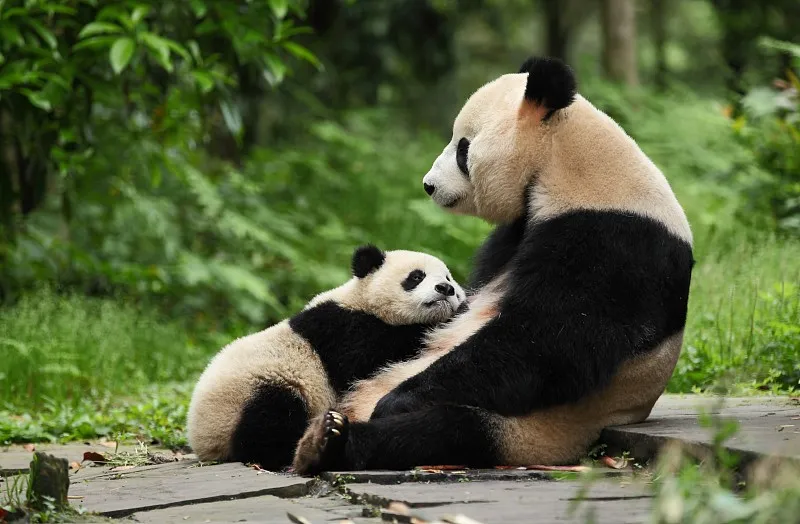
Bleats are used in friendly contexts: between mothers and cubs as a contact-maintaining signal (“I’m still here”), between potential mates during the approach phase of courtship, and occasionally between keepers and pandas who have established trust-based relationships. The sound is low-frequency (200-400 Hz), harmonic, and carries well through dense bamboo understory.
Acoustic analysis reveals that individual pandas have distinctive bleat signatures — subtle variations in frequency, duration, and harmonic structure that identify the caller. A mother panda can recognize her cub’s bleat, and vice versa, within a chorus of other vocalizing pandas. Our article on panda senses and communication explores how olfactory and auditory recognition systems work in parallel.
2. The Bark: “Stay Away”
The bark is the acoustic opposite of the bleat — harsh where the bleat is gentle, threatening where the bleat is welcoming. It sounds like a small-to-medium dog barking: sharp, percussive, with a rapid attack and a noisy, broadband frequency profile.
Barks occur in defensive or aggressive contexts. A panda encountering an unfamiliar conspecific will bark. A panda startled by a sudden movement or sound will bark. Mother pandas will bark at anything — keeper, veterinarian, male panda — that approaches their cub too closely. The bark is the universal panda warning: maintain distance.
3. The Chirp: “I Am Ready to Mate”
The chirp is the most specialized panda vocalization — produced almost exclusively by females during the brief 24-72 hour estrus window. It is the acoustic centerpiece of panda courtship, a rapid series of high-frequency (2-4 kHz) notes that sound like a small bird twittering.
The biological function is advertisement: the chirping female is broadcasting her location and reproductive status to males across a territory that, in the wild, may encompass several square kilometers. Males respond to chirps with approach behavior, following the sound through dense bamboo. Captive breeding programs routinely monitor chirping frequency and duration as indicators of optimal breeding timing — a female who chirps frequently and persistently is likely at peak estrus and most likely to conceive.
Did You Know? The 72-hour estrus window discussed in our article on panda reproductive biology means that the chirp vocalization is evolutionarily critical — the female has only three days per year to attract a mate, and failure to do so means another year without reproduction. The acoustic structure of the chirp — high-frequency, repetitive, carrying — is optimized for this urgent biological task.
4-6. Distress Sounds: Honk, Squeal, and Whimper
Three vocalizations encode forms of distress, ranging from mild to severe.
The honk is a nasal, goose-like sound associated with mild frustration or discomfort — a panda who can’t reach a preferred food item, a cub temporarily separated from its mother by a barrier, an animal mildly annoyed by an enrichment puzzle it can’t solve.
The squeal is far more serious — a high, thin, piercing cry associated with genuine pain or extreme distress. Cubs separated from their mothers for weaning produce heartrending squeals that can be heard across the entire base. Injured pandas squeal. The sound triggers immediate intervention from keepers and, in the wild, would signal life-threatening danger.
The whimper is intermediate — a soft, plaintive sound produced primarily by cubs begging for milk or attention. It is less urgent than the squeal but more insistent than the honk. Mother pandas respond to whimpers by adjusting their position to give the cub better access to nursing.
7-9. Aggression Sounds: Growl, Roar, and Huff
Three sounds mark the escalation of panda aggression, from warning to full threat.
The growl is a low, rumbling threat — the panda equivalent of “back off.” It is sustained rather than percussive, with fundamental frequencies as low as 100 Hz that you feel in your chest more than you hear with your ears. Growls occur during dominance disputes, particularly during the breeding season when multiple males may compete for access to a female.
The roar is the growl escalated to maximum intensity — deep, sustained, and terrifyingly loud. A panda roar can exceed 90 decibels and carries for hundreds of meters. Roars are rare in captivity because keepers intervene before conflicts reach that intensity, but infrared camera footage from the wild has captured roars during territorial confrontations.
The huff is the mildest aggressive signal — a sharp, explosive exhalation through the nose, often accompanied by a head-jerk. It is a startle response and a low-intensity warning: “I noticed you, and I don’t like it.” Keepers receive huffs when they approach too quickly or unexpectedly.
10-12. Close-Contact Sounds: Grunt, Moan, and Tooth-Clacking
The quietest panda vocalizations are used at close range — within a few meters, between individuals who can already see and smell each other.
The grunt is a short, guttural sound used in close-contact social interactions — between a mother and her nursing cub, between two pandas investigating each other during a breeding introduction. It is too quiet to carry far and likely serves as a proximity-maintaining signal.
The moan is the softest panda sound — a low, humming exhalation produced during nursing, relaxation, and contentment. Cubs moan while nursing. Adults moan when settling into a comfortable sleeping position. The moan is the acoustic signature of panda well-being.
Tooth-clacking is not a vocalization in the strict sense — it is a mechanical sound produced by rapidly opening and closing the jaws so that the teeth strike together. It serves as a close-range threat display, similar to the teeth-chattering of stressed chimpanzees or the bill-clacking of agitated birds. The sound is sharp, percussive, and unmistakably hostile.
The Acoustic Ecology of Solitude
The richness of panda vocalizations poses an apparent paradox: why would a solitary species evolve such a complex vocal repertoire? Social animals — primates, canids, cetaceans — need elaborate communication systems to coordinate group behavior. Solitary animals do not.
The resolution of the paradox lies in the panda’s particular form of solitude. Pandas are not asocial — they are solitary most of the time but intensely social during key life stages: mother-cub rearing, which lasts 18-24 months, and the brief, critical courtship period each spring. During these windows, communication is not optional — it is essential.
A mother panda who cannot bleat to her cub risks losing it in dense bamboo. A female in estrus who cannot chirp to attract males risks missing her single annual reproductive opportunity. A male who cannot bark to warn rivals risks injury in an unnecessary confrontation. The vocal repertoire is not a luxury — it is a collection of tools each deployed at a specific, high-stakes moment.
Frequently Asked Questions
Do pandas vocalize more in captivity or in the wild?
Captive pandas vocalize differently rather than more. Captive pandas produce more frequent low-intensity sounds (bleats, moans) because they are in closer proximity to other pandas and humans. Wild pandas produce more frequent high-intensity sounds (chirps, roars) during the breeding season when they must communicate across larger distances. The acoustic environment shapes vocal behavior as much as the social environment does.
Can panda cubs vocalize at birth?
Yes — the squeal is present from birth and is the first sound a panda cub produces. Newborn squeals are the primary mechanism by which the blind, immobile cub communicates its location and needs to its mother. The vocal repertoire expands gradually: bleats appear around 2-3 weeks, grunts around 1-2 months, and the full adult repertoire develops by approximately 6-8 months.
Do keepers use vocalizations to communicate with pandas?
Keepers use their own voices more than they imitate panda sounds. Research shows that pandas distinguish individual keeper voices and respond differently to familiar versus unfamiliar speakers — a finding explored in our profile of a day in the life of panda keepers. Some experienced keepers report that specific tone patterns (a particular pitch of Mandarin, a particular rhythm of speech) become associated with specific outcomes — feeding, training, enclosure transfer — and that pandas learn these associations as reliably as they learn vocal commands.
Key Takeaways
-
Pandas have approximately 12 distinct vocalizations spanning friendly greeting (bleat), courtship (chirp), alarm (bark), distress (squeal), aggression (growl, roar), and close-contact interaction (grunt, moan). Each sound has a specific acoustic structure and behavioral context.
-
The apparent paradox of a solitary species with a rich vocal repertoire is resolved by the panda’s particular life history: vocalizations are concentrated in the short but critical windows of mother-cub rearing and breeding-season courtship, when communication is essential for survival and reproduction.
-
Individual pandas have distinctive vocal signatures. Bleet harmonics, chirp frequency patterns, and bark timbres vary enough between individuals that both pandas and human researchers can identify specific animals by sound alone — a form of acoustic individual recognition that parallels the visual recognition provided by unique eye patch patterns.
Next time you watch a panda video or visit a zoo, close your eyes for a moment and just listen. Count how many different sounds you can identify — and see if you can tell a bleat from a chirp, a bark from a growl. Panda language is hiding in plain sound. For a playful introduction, explore what panda sounds mean for kids.