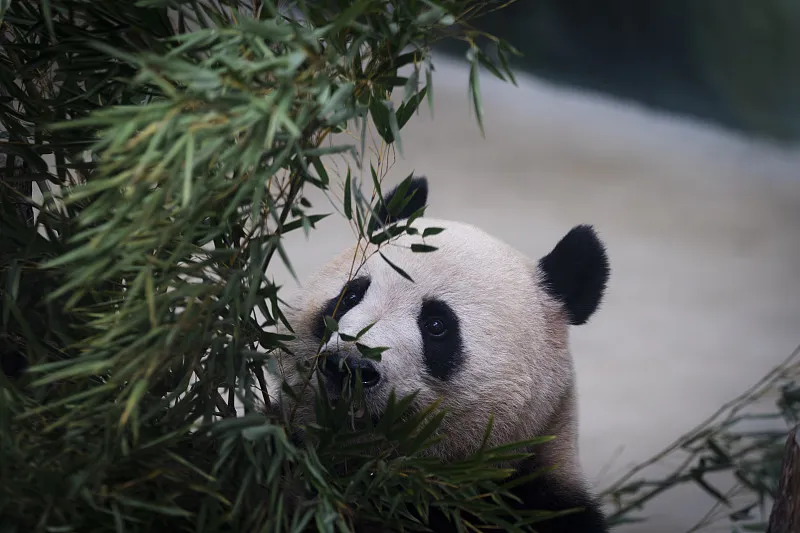
Why Pandas Don’t Hibernate: Winter Survival at High Altitude
Key Fact: The giant panda is unique among bears — the only member of Ursidae that does not hibernate. Unable to accumulate sufficient fat reserves on a low-calorie bamboo diet, pandas instead survive winter through vertical migration: descending from high-elevation summer ranges above 3,000 meters to lower-elevation winter forests between 1,800-2,200 meters, where bamboo stalks contain elevated sugar concentrations, snow cover is thinner, and temperatures are less extreme. This seasonal movement, documented through GPS collar data and infrared camera records, is one of the least visible but most critical survival strategies in panda ecology.
January in the Minshan Mountains. The temperature at 2,800 meters has dropped to -14°C overnight. A thick crust of frozen snow covers the bamboo, each stalk encased in a glassy sheath of ice that shatters audibly when disturbed. At this elevation, the arrow bamboo has stopped growing entirely — the shoots that provided rich nutrition through spring and summer are gone, and the remaining stalks are woody, fibrous, and nutritionally marginal.
The brown bears that share this mountain range are underground, curled in dens, their heart rates slowed to 8-10 beats per minute, their body temperatures hovering near 10°C. They last ate in October. They will not eat again until April.
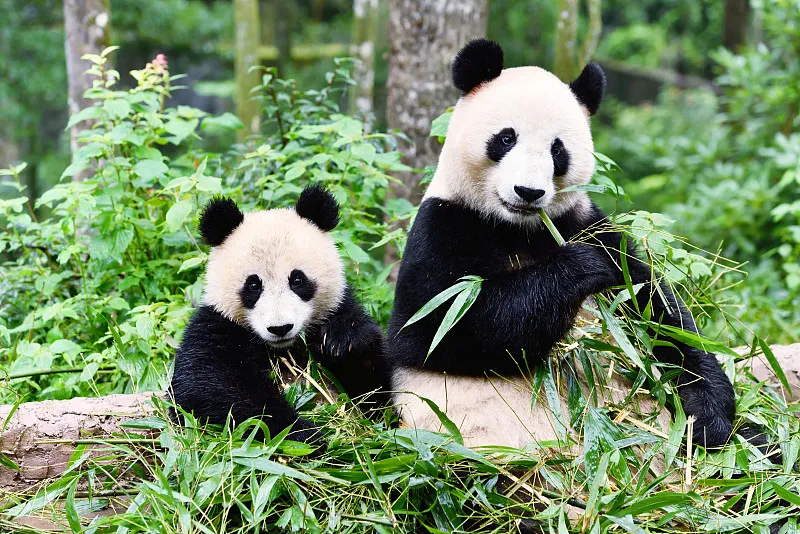
The giant pandas are awake. They are eating.
The Energy Arithmetic of Hibernation
Hibernation is an energy conservation strategy, not a lifestyle choice. A brown bear that enters its den in October weighing 300 kilograms will emerge in April weighing approximately 200 kilograms — having burned 100 kilograms of stored fat to sustain its metabolism through five months without food. The arithmetic is straightforward: to hibernate, you must first eat enough to build the fat reserves that hibernation will consume.
This is where the panda’s dietary arithmetic fails. A brown bear in Alaska can consume 40 kilograms of salmon per day during the autumn hyperphagia period, adding 2-3 kilograms of body fat daily. The salmon are rich in protein and lipids — energy-dense food that converts efficiently to stored fat.
A panda eating bamboo faces a fundamentally different equation. Bamboo is approximately 90% water and fiber, with a caloric density roughly one-tenth that of salmon. A panda eating 20 kilograms of bamboo per day absorbs approximately 4,000-5,000 kilocalories — barely enough to meet its daily energy expenditure, let alone build a hibernation-reserve fat surplus.
To accumulate 100 kilograms of body fat — the estimated requirement for a five-month hibernation — a panda would need to increase its daily caloric surplus by approximately 2,000 kilocalories for 250 consecutive days. Given bamboo’s caloric density, this would require eating approximately 60 kilograms of bamboo per day — more than double a panda’s maximum documented intake. The arithmetic simply does not work.
As explored in our article on the panda gut microbiome and digestion, pandas extract only 17-20% of the energy available in bamboo. The remaining 80% passes through undigested. A hibernation-capable panda would need either a much more efficient digestive system or a much more energy-dense food source — neither of which evolution has provided.
Did You Know? The panda’s inability to hibernate is sometimes framed as an evolutionary failure — a bear that “should” hibernate but can’t. But the framing is backwards. Evolution did not deprive pandas of the ability to hibernate; it freed them from the need to. By specializing in an abundant, year-round food source (bamboo), pandas traded the hibernation strategy for a reliable winter food supply — though bamboo flowering events can shatter that reliability. Hibernation is not a superior strategy — it is a different strategy, adapted to a different ecological niche.
The Winter Migration Strategy
If pandas cannot hibernate, they must eat through winter. And if they must eat through winter, they must find bamboo that is accessible, nutritious, and unfrozen. The solution is a seasonal vertical migration that is one of the most elegant adaptations in panda ecology.
GPS collar data from the Wanglang National Nature Reserve in the Minshan range reveals a clear seasonal pattern. In summer (June-August), pandas occupy elevations between 2,500 and 3,500 meters, following the emergence of tender new bamboo shoots as snow melts at progressively higher elevations. In autumn (September-November), they begin a gradual descent. By January, most pandas are concentrated between 1,800 and 2,200 meters — roughly 500-800 meters below their summer ranges.
The winter range offers three advantages:
Warmer temperatures. The lapse rate — the rate at which temperature decreases with altitude — averages approximately 6.5°C per 1,000 meters in the Minshan range. A panda at 2,000 meters experiences winter temperatures 3-5°C warmer than a panda at 2,800 meters. That difference may not sound dramatic, but it is the difference between bamboo stalks that are frozen solid and bamboo stalks that, while cold, remain pliable and chewable.
Thinner snow cover. Snow depth decreases significantly with decreasing elevation. At 2,800 meters, winter snow can accumulate to over 100 centimeters, completely burying the bamboo understory. At 2,000 meters, snow depth averages 20-40 centimeters — enough to cover the ground but not enough to bury the taller bamboo stalks. Pandas can access standing bamboo even in snow, brushing accumulated powder off the stalks with their paws before eating.
Higher sugar content. As temperatures drop in autumn, bamboo plants translocate soluble carbohydrates from their leaves to their stalks and rhizomes — a physiological response that protects the plant’s living tissues from freeze damage. The stalks that pandas eat in winter contain significantly higher concentrations of simple sugars than summer stalks — a seasonal nutritional bonus that helps pandas meet the elevated energy demands of cold-weather living.
The Winter Coat: Insulation Without Hibernation
A panda that remains active through winter needs a coat that can handle the cold. The panda winter coat is a masterpiece of biological insulation — and a critical reason pandas can survive without hibernation.
The summer coat consists primarily of long, coarse guard hairs — the outer layer that repels water and provides structural protection. The winter coat adds a dense, wooly underfur — a layer of fine, crimped hairs that trap a stationary layer of air against the skin. Air is an extraordinarily effective insulator — still air conducts heat approximately 25 times less efficiently than water — and the panda’s underfur creates a precisely engineered thermal barrier.
Thermal imaging studies of pandas in winter show remarkable heat retention. The surface temperature of a panda’s back fur in -10°C ambient air measures approximately 0-5°C — meaning the body heat generated by the panda’s metabolism is almost entirely retained beneath the fur, with minimal thermal leakage to the environment. By comparison, a human in winter clothing typically shows surface temperatures of 15-20°C under similar conditions, reflecting significantly greater heat loss.
The coat also has hydrophobic properties. Panda fur contains a thin film of sebaceous oil — the same oil that gives the fur its slightly rough, waxy texture to the touch. Water beads on the surface rather than soaking through, preventing the insulation-compromising effect of wet fur in snow conditions.
The Behavioral Thermostat
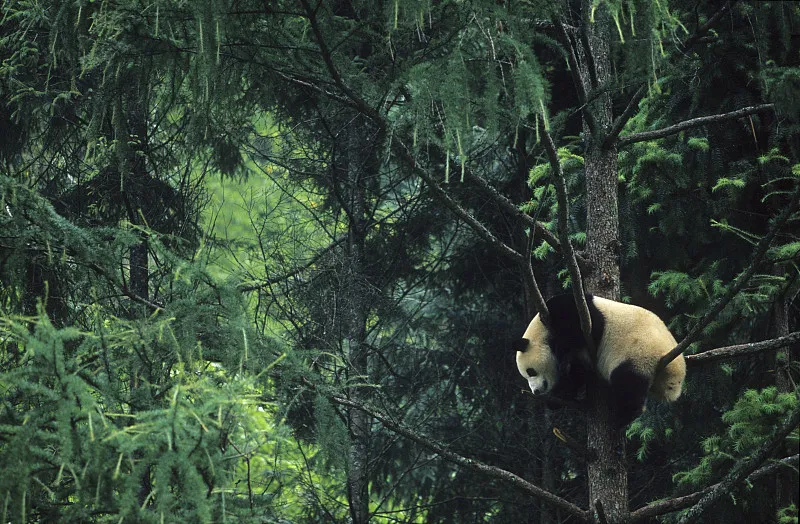
Beyond migration and insulation, pandas employ simpler behavioral strategies to manage winter cold. They seek south-facing slopes that receive maximum solar exposure during the short winter days. They rest in natural windbreaks — the lee side of large boulders, dense bamboo thickets, and the bases of large conifers — where wind chill is minimized. They remain inactive during the coldest hours (typically 2-6 AM), feeding primarily during the warmer daylight window.
The cumulative effect of these behaviors — migration, insulation, microclimate selection — is a winter survival strategy that, while less dramatic than hibernation, is equally effective. Pandas do not need to hibernate because they have evolved an alternative winter toolkit that keeps them fed, warm, and functional through conditions that would kill an unprepared mammal.
| Strategy | Hibernating Bears (Brown Bear) | Non-Hibernating Panda |
|---|---|---|
| Winter food intake | Zero | 12-38 kg bamboo/day |
| Body temperature | Drops to ~10°C | Maintained at ~37°C |
| Heart rate | 8-10 bpm | Normal (60-80 bpm resting) |
| Fat storage | 100+ kg pre-hibernation | Minimal seasonal fat |
| Elevation change | Den at moderate elevation | Descends 500-800m |
| Winter activity | None (torpor) | Active year-round |
| Primary winter challenge | Energy conservation | Accessing unfrozen bamboo |
Frequently Asked Questions
Do panda cubs survive winter as well as adults?
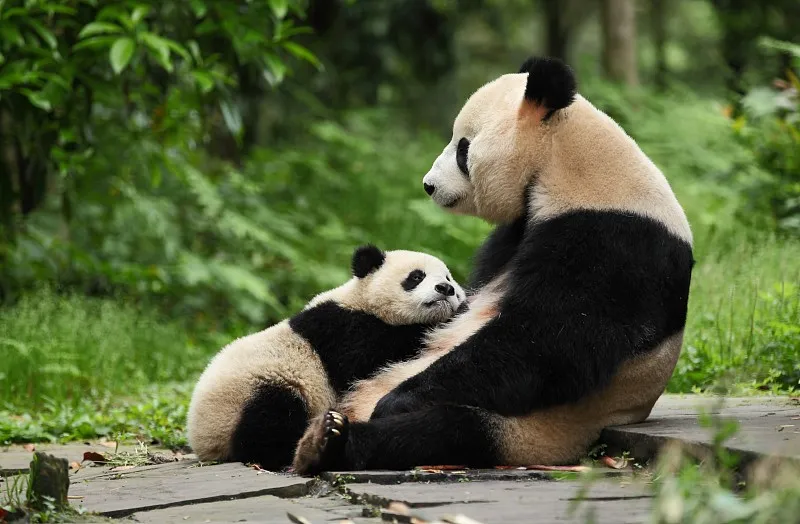
Cubs face additional winter challenges because their smaller body size loses heat more rapidly (higher surface-area-to-volume ratio). Mother pandas compensate by keeping cubs in close physical contact — the cub often sleeps pressed against the mother’s belly, where her body heat provides supplemental warmth. For a kid-friendly telling of this seasonal journey, see the panda winter migration adventure. Cubs also grow their winter underfur more rapidly than adults, achieving full insulation by approximately 4-5 months of age. At the other end of the lifespan, senior pandas need specialized geriatric care to weather cold seasons.
Could pandas ever evolve the ability to hibernate?
Evolutionary acquisition of hibernation would require significant changes to panda metabolism, fat storage, and digestive efficiency — changes that would likely require millions of years and a fundamental shift in diet. Given that the current non-hibernation strategy works adequately for the existing panda population, there is no immediate selective pressure favoring the evolution of hibernation.
How does climate change affect panda winter survival?
Climate change poses a complex threat to the winter migration strategy. Warmer winters may reduce snow cover, making bamboo more accessible — a potential short-term benefit. But warmer temperatures may also alter bamboo sugar-storage physiology, potentially reducing the winter nutritional bonus that pandas depend on. And as lower-elevation habitat is lost to agriculture and development, the vertical range available for seasonal migration shrinks — a threat explored in our article on climate change impacts on panda habitats.
Key Takeaways
-
Pandas are the only bear that does not hibernate. The reason is dietary: bamboo is too low in energy to build the fat reserves needed for months of dormancy, and pandas cannot increase their bamboo intake enough to overcome this limitation.
-
Vertical migration replaces hibernation. Pandas descend 500-800 meters in winter to find warmer temperatures, thinner snow cover, and bamboo stalks with elevated sugar content — a behavioral adaptation that keeps them fed and functional through conditions that would be unsurvivable at their summer elevations.
-
Winter survival is a coordinated strategy. Migration, a dense insulating underfur, hydrophobic guard hairs, microclimate selection, and behavioral timing combine to create a winter toolkit that is less dramatic than hibernation but equally effective — and perfectly adapted to the panda’s bamboo-based ecology.
This article draws on GPS collar tracking data from Wanglang National Nature Reserve, thermal imaging studies conducted by the Chengdu Research Base, and bamboo nutritional analysis published in the Journal of Mammalogy.