Table of contents (13 sections)
Why Pandas Live Alone: The Ecology of Solitary Bears
Key Fact: The giant panda is one of the most solitary large mammals on Earth — individuals maintain separate home ranges, interact primarily through scent marks left on trees rather than through direct contact, and come together only during the brief breeding season. This is not antisocial behavior. It is an evolutionary adaptation driven by the economics of bamboo: a food source so low in energy that a single patch can support only one panda at a time. Solitude is not a personality trait of pandas. It is a survival strategy written into their ecology by the food they eat.
Key Takeaways
-
Bamboo economics drive panda solitude — a single bamboo patch provides barely enough energy for one panda; sharing would mean starvation for all.
-
Scent marks are the panda’s social network — chemical messages deposited on trees function as a distributed communication system that allows pandas to avoid each other while still knowing who is nearby.
-
Pandas are not asocial — they are spaced apart by ecological necessity, and when they do meet (as documented by camera traps), interactions can be peaceful and even friendly.
Quick Answer: Why Do Pandas Live Alone?
Pandas live alone because bamboo gives them just enough energy to support one large bear in a patch, not a group of bears sharing the same space. Their solitude is therefore ecological before it is behavioral. They are not emotionally “anti-social” animals in the human sense. They are animals solving an energy problem with distance, scent, and timing.
That is why the more precise description is not that pandas avoid society altogether. It is that pandas avoid costly overlap. They still communicate, track neighbors, find mates, raise cubs, and negotiate boundaries. They simply do most of that work without staying physically together for long.
How Solitary Are Pandas, Really?
On May 18, 2026, the Chengdu Panda Base announced that He Hua (和花) and He Ye (和叶) — the famous 5-year-old twin sisters — were being separated into neighboring enclosures. After years of sharing a playground, the adult pandas would now live as neighbors, each in their own space. For panda fans around the world, it was an emotional milestone. For the base’s veterinary team, it was a routine transition: captive pandas, like their wild counterparts, reach an age where solitary living becomes biologically necessary.
The sisters still live in Panda Villa No. 6, just in separate activity areas. They can see and smell each other. They simply no longer share territory. This is the panda way: not isolation, but respectful distance.
Deep in the Minshan Mountains, a female panda moves through bamboo at dawn. She pauses at a weathered fir tree, sniffs the trunk, and registers the scent mark left three days ago by a male whose territory overlaps with hers. The chemical message tells her: male, approximately 12 years old, not in breeding condition, last here 72 hours ago.
She does not seek him out. She adjusts her route — angling slightly south, away from the direction his scent trail suggests he is moving. She will eat bamboo in a different patch this morning. They will not meet. They will both get enough to eat.
This is the daily reality of panda social life: not isolation, but deliberate, scent-mediated spacing. Pandas are not lonely. They are distributed across the landscape at the density that bamboo can sustain. Any closer, and they would compete for the same stalks. Any further, and they would waste energy traveling between patches. The spacing is, in ecological terms, optimal.
Home Range and Population Density
How much space does a panda really need? The answer varies by sex, age, mountain range, and bamboo productivity.
| Category | Home Range (km²) | Population Density (pandas/km²) | Key Variable |
|---|---|---|---|
| Adult male, Minshan | 10-30 | 0.04-0.08 | High bamboo productivity allows smaller ranges |
| Adult female, Minshan | 4-15 | 0.06-0.10 | Females need less energy; cub-rearing space |
| Adult male, Qinling | 20-40 | 0.02-0.05 | Lower bamboo productivity requires larger ranges |
| Adult female, Qinling | 8-20 | 0.03-0.06 | Same productivity constraint |
| Juvenile (dispersing) | 50-100 (temporary) | N/A | Moving between territories to find own space |
| Subadult (male) | 5-15 | N/A | Establishing territory near mother’s range |
The population density data reveals a striking pattern: even in the most productive panda habitat — the Minshan range, where Bashania fargesii dominates — you would need to search 10-25 square kilometers of bamboo forest to find a single panda. In the Qinling range, the density is half that.
This is not because pandas are rare. It is because the bamboo they eat is so marginally nutritious that the landscape can only support one panda per several square kilometers.
The Bamboo Arithmetic
The fundamental reason pandas live alone is numerical, not temperamental. Consider the energy budget of a single panda:
- Daily bamboo consumption: 12-38 kilograms
- Energy extracted per kilogram: ~1,000-1,500 kilocalories (only ~20% of gross energy)
- Daily energy requirement: ~4,000-5,000 kilocalories
- Surplus available for sharing: near zero
A panda eats essentially all day to meet its own energy needs. There is no surplus to support a group. If two pandas shared a territory, each would get half the bamboo — and each would slowly starve.
This contrasts sharply with social carnivores — wolves, lions, wild dogs — whose high-energy meat diets can support group living because a single kill provides surplus calories. It also contrasts with herbivores like deer and bison, whose food is so abundant that individuals do not compete directly. Pandas occupy an unusual middle ground: bamboo is everywhere but each stalk provides so little energy that sharing it is impossible.
Our articles on why pandas eat bamboo and the panda digestive system explore how this dietary limitation shapes every aspect of panda biology.
Radio Tracking Studies: GPS Evidence of Solitude
The quantitative understanding of panda social spacing comes primarily from radio tracking studies — GPS collars fitted to wild pandas that record location data at regular intervals over months or years.
A landmark study published in the Journal of Mammalogy in 2020 analyzed GPS collar data from 13 wild pandas (6 male, 7 female) in the Minshan range over a 3-year period. The findings:
-
Overlap rates. Male home ranges overlapped with adjacent male ranges by an average of 12% (range 4-28%). Female ranges overlapped with adjacent female ranges by 6% (range 0-18%). Male and female ranges overlapped by 20-35%.
-
Direct encounters. GPS data confirmed only 4 direct encounters (individuals within 100 meters of each other) over 957 panda-months of tracking data. Three of the 4 encounters occurred during the breeding season (March-April). The fourth was a mother-cub pair.
-
Movement adjustments. When tracked pandas approached within 500 meters of a neighbor’s scent-marked territory boundary, they changed direction 67% of the time — confirming that scent marks actively shape movement.
-
Dispersal distances. Juvenile males dispersed an average of 38 kilometers from their mother’s home range; juvenile females dispersed only 12 kilometers, typically settling adjacent to the mother’s territory.
These data confirm what the scent-marking behavior suggests: pandas maintain a social network mediated entirely through chemical communication, with direct encounters so rare that each one is a significant event.
The Scent-Based Social Network
If pandas live apart, they must still communicate — to find mates, to avoid conflicts, to know who is nearby. The solution is scent: a chemical communication system so sophisticated that it functions as a distributed social network.
Each panda maintains a network of scent-marking sites — prominent trees, rock faces, bamboo stands — within its home range. The marks are deposited through a specific behavioral sequence: the panda approaches the marking site, turns around, positions its anogenital gland against the surface, and performs a rubbing motion that deposits a mixture of volatile organic compounds — fatty acids, steroids, proteins — that encode the marker’s identity, sex, age, and reproductive condition.
The marks persist for days to weeks, depending on weather. Rain degrades water-soluble compounds. UV radiation breaks down volatiles. A scent mark is a time-limited message — “I was here within the last 72 hours” or “I am currently in estrus” — that decays and must be refreshed.
Pandas patrol their home ranges on circuits designed to encounter and refresh these scent marks. A panda walking through its territory is simultaneously reading the scent-messages of its neighbors and updating its own. The result is an olfactory map of the social landscape — who is where, when, and in what condition — maintained without any direct contact.
The famous “handstand” scent-marking behavior — where a panda lifts its hind legs and deposits scent as high on a tree as possible — is believed to advertise the marker’s size. A higher mark suggests a larger panda, and larger pandas are more likely to be dominant in potential encounters.
Did You Know? Pandas can determine the sex, age, and individual identity of a scent-marker from chemical cues alone. Laboratory analysis has shown that panda scent marks contain unique chemical signatures — the olfactory equivalent of fingerprints — that allow pandas to recognize specific individuals without ever seeing them. This is the same principle by which fecal DNA analysis identifies individual pandas: each panda has a unique chemical signature that persists in its biological deposits.
Seasonal Encounters: When Solitary Pandas Meet
Pandas do not live in complete isolation. Camera trap data and direct observation have documented encounters between individual pandas — and the encounters are not always aggressive.
Breeding season encounters. Males and females seek each other out during the brief March-May mating season. The female’s estrus chirp — the bird-like call described in our article on panda vocalizations — attracts males from considerable distances. Multiple males may converge on a single female, leading to dominance interactions (growling, posturing, occasionally fighting) that determine which male gains mating access.
Friendly neighbor encounters. Camera traps have documented what appear to be peaceful encounters between pandas who share territory boundaries — nose-to-nose greetings, brief mutual investigation, and then separation without aggression. These encounters suggest that pandas recognize familiar neighbors and may have individualized relationships, even if those relationships consist primarily of mutual tolerance.
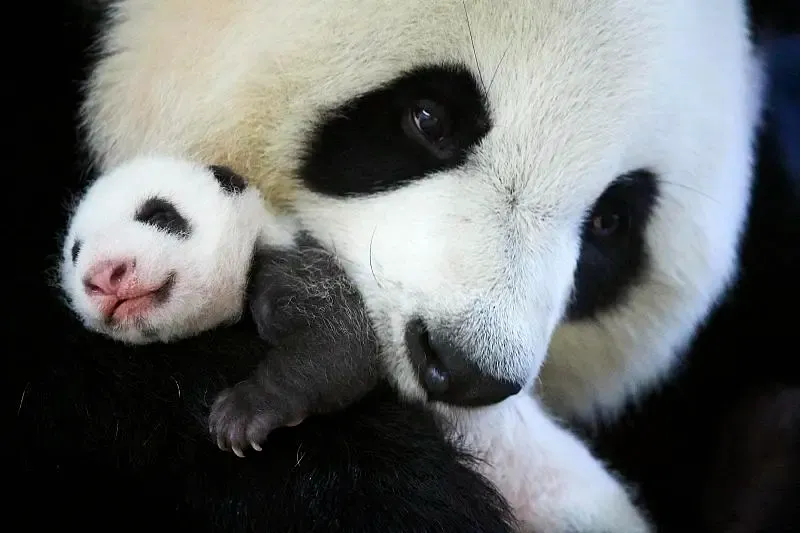
Mother-cub bonds. The longest and most intense panda social bond is between mother and cub, lasting 18-24 months — one of the longest maternal investment periods of any bear species. The mother teaches the cub to climb, to select bamboo, to recognize danger. This extended bond, explored in our article on a panda cub’s first year, contradicts the simple characterization of pandas as asocial.
Social Network Without Social Living
The panda’s social system presents a paradox: it is a social network maintained almost entirely without social contact. Pandas know their neighbors — their identity, their sex, their age, their reproductive status — without ever seeing them. The scent marks are Facebook profiles. The patrol circuits are news feeds. The occasional encounter is an in-person meeting.
This is not a primitive communication system. It is a sophisticated adaptation to an ecological constraint: bamboo is too poor a food source to support social living, but scent-mediated communication allows pandas to maintain the benefits of social information — mate location, conflict avoidance, neighbor recognition — without the costs of physical proximity.
Entity Hub: The Real Systems Behind Panda Solitude
Minshan and Qinling
These mountain systems matter because productivity changes the shape of solitude. In better bamboo habitat, pandas can maintain smaller ranges. In poorer habitat, they need more land and tolerate less overlap.
Chengdu Base and He Hua / He Ye
The 2026 separation of He Hua and He Ye is useful because it shows how captivity still bends toward the species’ ecological logic. Even beloved, highly visible pandas eventually move toward neighboring-but-separate adult life.
GPS Collar Research
Radio tracking turned panda solitude from anecdote into measurement. Once overlap rates, dispersal distances, and encounter frequency could be quantified, the “lonely panda” myth became easier to replace with a real spacing model.
Scent Marks and Estrus Calls
Panda social structure works because chemical and acoustic information substitute for constant physical company. Scent marks manage boundary knowledge; estrus calls and courtship signals briefly override distance when reproduction requires it.
Panda vs Other Solitary Mammals
| Species | Social Structure | Home Range (male) | Communication Method | Encounter Frequency |
|---|---|---|---|---|
| Giant Panda | Solitary, scent-mediated | 10-30 km² | Anogenital scent marks, vocalizations | Very rare (4 encounters/957 months) |
| Snow Leopard | Solitary, territory-based | 30-100 km² | Scent marks, scrapes, vocalizations | Rare (breeding season) |
| Tiger (Amur) | Solitary, territorial | 200-600 km² | Scent marks, claw rakes, vocalizations | Rare (breeding season) |
| Brown Bear | Solitary, overlapping ranges | 100-1,000 km² | Scent marks, tree rubbing | Moderate (salmon runs, berry patches) |
| Polar Bear | Solitary, wide-ranging | 200-600 km² | Scent marks | Very rare (sea ice) |
Pandas stand out among solitary mammals not for being more solitary — all these species are solitary — but for the sophistication of their scent-mediated spacing system. A panda’s chemical communication network allows it to maintain awareness of multiple neighbors simultaneously across a densely overlapping territory matrix, something that the larger-ranging solitary carnivores do not achieve.
Frequently Asked Questions
Could pandas ever evolve to be social?
Unlikely without a fundamental dietary shift. As long as pandas depend on bamboo — which provides subsistence-level energy with no surplus — the ecological pressure will favor solitary living. Sociality in mammals is almost always associated with diets that support food sharing (carnivores with large kills, primates with abundant fruit). Bamboo supports neither.
How does panda social structure compare to other bears?
Most bears are solitary for similar ecological reasons — dispersed food resources that cannot support groups. The panda is not unusual among bears for being solitary — it is simply the most extreme case, driven by the most energetically marginal diet. The scent-mediated spacing system may be more developed in pandas than in other bears because their lower mobility limits their ability to avoid encounters through spatial avoidance alone.
Do captive pandas need social enrichment?
Yes — and this has become a focus of modern captive management. While adult pandas should not be housed together permanently, they benefit from structured social contact: visual access to neighboring pandas, scent-exchange programs (rotating enrichment items between enclosures), carefully supervised introductions, and, in some facilities, temporary pairing of compatible individuals. The enrichment programs described in our article on environmental enrichment for pandas include social components that are essential to captive welfare.
How do pandas find mates if they are so solitary?
Through a combination of scent and sound. During the breeding season, females produce an estrus chirp — a bird-like call that carries through the forest — and deposit scent marks with chemical signals indicating their reproductive status. Males detect these signals and travel across multiple territories to reach the female. The female’s estrus period is the only time she actively seeks male attention.
What happens if two pandas encounter each other outside the breeding season?
Encounters between non-breeding adults are typically peaceful avoidance. The pandas may pause, sniff each other, and then move apart. Aggressive encounters are rare but can occur when resources are concentrated — for example, at an especially productive bamboo patch — or when a mother perceives a threat to her cub. Most of the time, their scent-based spacing system prevents encounters before they occur.
Your Turn
The female panda finishes eating and lies down against a tree trunk — the same tree where she read the male’s scent mark hours earlier. She does not think about him. She does not wish he were here. She simply rests, alone, as evolution shaped her to be — spaced across the bamboo landscape at exactly the distance that allows every panda to eat enough. Solitude is not a flaw in the panda’s nature. It is the shape of its survival. Read our article on panda environmental enrichment to see how captive facilities manage the social and cognitive needs of this solitary species, and our guide to panda vocalizations to understand what pandas say when they rarely do meet.

Dr. James Thornton
Wildlife Ecology Editor
Wildlife ecologist specializing in forest ecology, protected area effectiveness, mammal community conservation, and human-wildlife coexistence in panda habitats.
View full profile →Tags in this article
Questions readers often ask
Why are pandas solitary?
Pandas are solitary primarily because of their bamboo diet. Bamboo is abundant but nutritionally poor — a single bamboo patch can support one panda eating continuously, but not a group. If pandas lived in groups, they would quickly deplete local bamboo and starve. Solitary living is an energy-maximizing strategy: each panda claims enough territory to sustain itself without competing with others for the same bamboo.
Do pandas ever interact with each other?
Yes — but rarely and in specific contexts. Males and females interact during the brief breeding season (March-May). Mothers and cubs stay together for 18-24 months in one of the longest mother-cub bonds among bears. Occasionally, non-breeding adults encounter each other along territory boundaries. Camera trap data has documented friendly nose-to-nose greetings between neighbors, suggesting pandas are not asocial — they simply maintain distance most of the time.
How do pandas avoid running into each other?
Pandas use scent as their primary spacing mechanism. Each panda regularly deposits scent marks — from anogenital glands and urine — on trees, rocks, and bamboo along the boundaries of its home range. These chemical messages encode the marker's identity, sex, age, and reproductive status. Other pandas detect these marks and adjust their movements to avoid encounters, creating an olfactory map of who is where without ever needing visual contact.
How large is a panda's home range?
Home range size varies by sex, age, and mountain range. Adult males typically maintain home ranges of 10-30 square kilometers, while females occupy smaller ranges of 4-15 square kilometers. Home ranges in the Minshan range (higher bamboo productivity) tend to be smaller than in the Qinling range (lower productivity). Juveniles dispersing from their mothers may travel 50-100 kilometers before establishing their own territory.
How does panda social structure compare to other bears?
Most bears are solitary for similar ecological reasons — dispersed food resources that cannot support groups. Polar bears, brown bears, and black bears all maintain individual territories and interact primarily during breeding season. The panda is not unusual among bears for being solitary — it is simply the most extreme case, driven by the most energetically marginal diet. The level of scent-mediated spacing in pandas may be more sophisticated than in other bears.
Do pandas get lonely in captivity?
There is no evidence that pandas experience loneliness in the human sense. Captive pandas can be housed adjacent to each other with visual and olfactory contact, which provides social stimulation without the stress of physical proximity. However, solitary housing without any conspecific contact may contribute to the stereotypic behaviors described in our article on environmental enrichment for pandas.
Can captive pandas learn social behaviors?
Yes — and this has become a focus of captive management. Young pandas raised without exposure to other pandas may lack the behavioral repertoire for appropriate social interaction, including mating. Facilities now practice structured social introductions: allowing juveniles to interact in monitored settings, pairing compatible individuals for shared enclosure time, and using scent-swapping techniques before physical introductions.
How do mother pandas teach their cubs independence?
The mother-cub bond lasts 18-24 months, during which the mother teaches the cub to climb, select bamboo, recognize danger, and navigate the forest. In the final months before separation, the mother becomes gradually less tolerant of the cub's proximity, pushing it toward independence. This is the panda's most intense social relationship — and its most important educational period.