A Bao
阿宝
19 years old
qinling_park
A Bao (阿宝, studbook #703) is a wild-born Qinling male giant panda rescued in 2008 from Taibai County. He is a pure Qinli...
View profile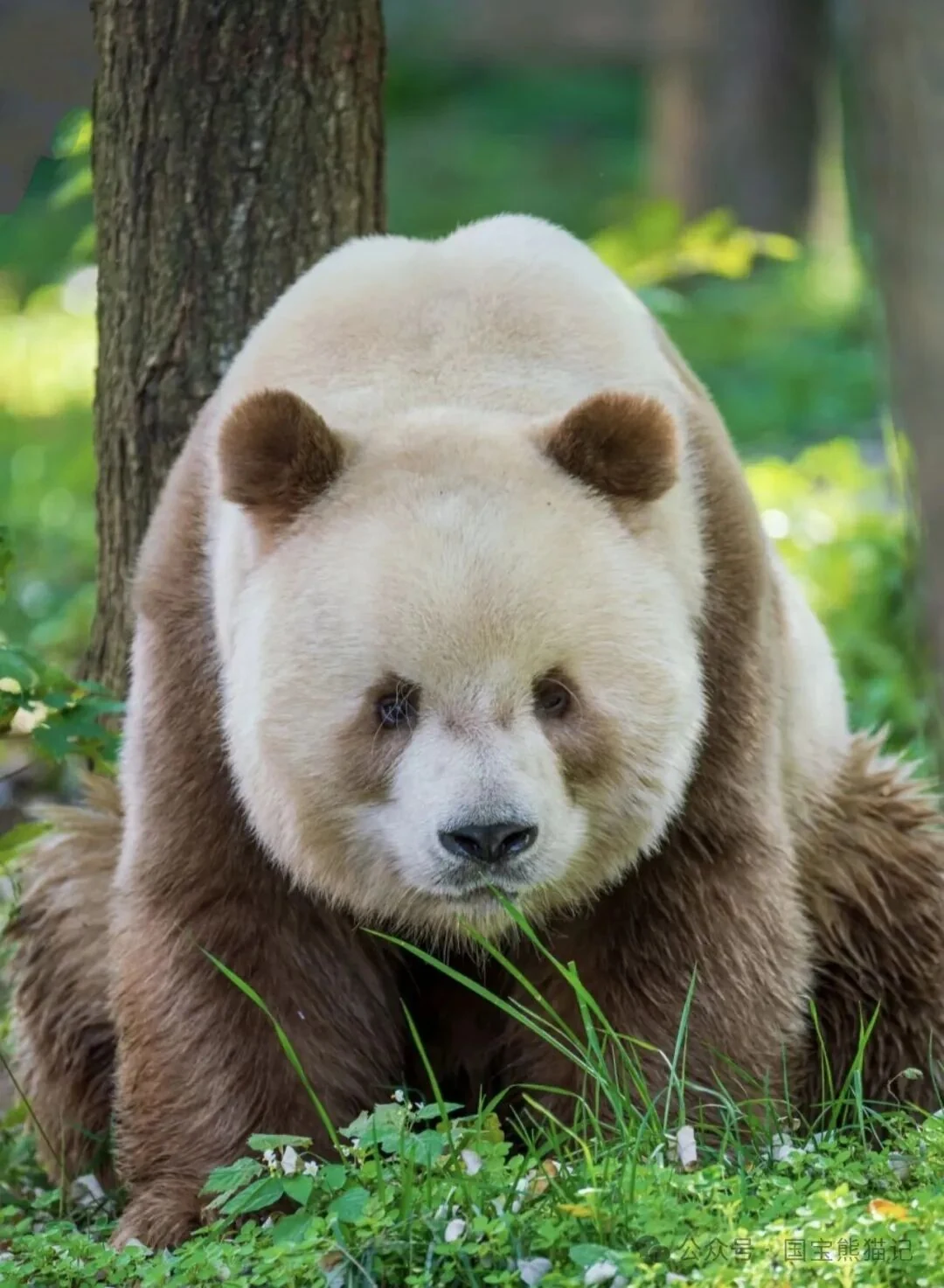
Panda archive
七仔
Qi Zai (七仔), nicknamed the "Chocolate Bear," is the world's only known captive brown-and-white Giant Panda and the fifth brown panda documented in the Qinling Mountains since 1985. Rescued in November 2009 as a dehydrated cub, he was named after the alien creature in Stephen Chow's film CJ7 (长江七号). His rare caramel coat results from a homozygous 25-bp deletion in the Bace2 gene, published in PNAS in 2024. Now weighing ~110 kg at Qinling Sibao Science Park, he eats 40+ kg of bamboo daily. He has sired four reported offspring—Qin Hua (秦华), Ba Zai (八仔), Quan Yun (全运), and Rong Rong (荣荣)—all born black-and-white.
How to use this page
This page brings together the core facts, timeline, family graph, media, place journey, and related reading for Qi Zai.
Profile snapshot
Birth date
January 1, 2009
Birth place
Fuping Wild Panda Habitat (Qinling)
Current location
Qinling Four Rare Animals Science Park
Status
Alive
Studbook
#802Archive activity
13 updates · 60 media
Narrative
Start with a concise summary, then continue into the full narrative record for Qi Zai.
Short version
Qi Zai (七仔), nicknamed the "Chocolate Bear," is the world's only known captive brown-and-white Giant Panda and the fifth brown panda documented in the Qinling Mountains since 1985. Rescued in November 2009 as a dehydrated cub, he was named after the alien creature in Stephen Chow's film CJ7 (长江七号). His rare caramel coat results from a homozygous 25-bp deletion in the Bace2 gene, published in PNAS in 2024. Now weighing ~110 kg at Qinling Sibao Science Park, he eats 40+ kg of bamboo daily. He has sired four reported offspring—Qin Hua (秦华), Ba Zai (八仔), Quan Yun (全运), and Rong Rong (荣荣)—all born black-and-white.
Qi Zai (七仔), known internationally as Qizai, is a male Giant Panda born in 2009 in the Qinling Mountains of Shaanxi Province, China. He holds the global studbook number 802 and currently resides at the Qinling Sibao Science Park (秦岭四宝科学公园) in Zhouzhi County, Xi’an, Shaanxi Province. As the only known captive brown-and-white Giant Panda in the world, Qizai represents one of the rarest genetic variations documented in the species, earning him the affectionate nicknames “Chocolate Bear” (巧克力熊) and “Treasure Among Treasures” (宝中之宝).
He is also the fifth brown-and-white Giant Panda documented in the Qinling Mountains since 1985, when the region’s panda conservation program was established. Brown-and-white pandas have only ever been found in the Qinling Mountains, making Qizai a flagship representative of the older, genetically distinct Qinling subspecies.
On the evening of November 1, 2009, staff at the Shaanxi Rare Wildlife Rescue and Breeding Research Center received an urgent call from the Fuping County Forestry Bureau. Local villagers had discovered an abandoned pale brown animal cub in the Sanguanmiao Paifanggou (三官庙牌坊沟) area of the Foping National Nature Reserve. Severely weakened after hours without food, the cub was estimated to be just one to two months old, suffering from intestinal blockage and dangerous dehydration.
Recognizing the urgency, the rescue team deployed immediately, dispatching a rescue vehicle while the forestry bureau arranged transport to meet them halfway. After more than ten days of intensive veterinary care, the fragile cub recovered and began his journey toward becoming the world’s most distinctive resident panda.
As a wild-born panda rescued from the Qinling Mountains, the identity of Qizai’s mother is not publicly documented. Unlike captive-born pandas with recorded parentage, Qizai’s maternal lineage remains unknown—typical for rescued wild cubs often found abandoned before their identities could be recorded.
The Bace2 gene mutation causing his brown-and-white coat follows an autosomal recessive inheritance pattern, and none of his known offspring have inherited the rare coloration.
Qizai participated in natural breeding for the first time in 2018 after reaching sexual maturity. Despite his remarkable genetics, his distinctive coat color has not been passed to his offspring:
| Name | Birth Date | Gender | Mother | Coat Color | Status |
|---|---|---|---|---|---|
| Qin Hua (秦华, aka Pan Pan/盼盼) | October 11, 2020 | Male | Zhu Zhu (珠珠) | Black & White | Officially confirmed |
| Ba Zai (八仔) | July 16, 2021 | Male | Zheng Zheng (正正, #834) | Black & White | Officially confirmed |
| Quan Yun (全运) | September 15, 2021 | Female | Ming Ming (明明) | Black & White | Reported, pending confirmation |
| Rong Rong (荣荣) | July 27, 2022 | Male | Jin Xin (锦心, #672) | Black & White | Reported, pending confirmation |
In May 2023, the Shaanxi Provincial Forestry Bureau officially confirmed Qin Hua and Ba Zai as Qizai’s offspring. Quan Yun—named for her birth on the opening day of the 14th National Games (全运会) in Xi’an—and Rong Rong are widely reported as his cubs but remain pending DNA confirmation. All four were born with the typical black-and-white coloring.
Researchers continue to study whether Qizai carries any dormant genetic factors that might produce brown offspring in future generations.
During his early years at the rescue center, Qizai lived together with another young male panda, Er Lang (二郎, studbook #809). The two were inseparable childhood companions (发小)—sharing food and lodging side by side. Giant panda fans gave the pair matching English nicknames: Er Lang became “Two Baby” and Qizai became “Seven Baby.”
While Qizai remains at the Qinling Sibao Science Park, Er Lang moved to the Chengdu Research Base of Giant Panda Breeding in 2024, where he now lives at the Moon Delivery Room (月亮产房).
Qizai’s most distinguishing feature is his rare brown-and-white coat, a phenotypic trait documented only a handful of times in wild Qinling Giant Pandas. Unlike the stark black-and-white pattern typical of the species, Qizai displays:
This coloration results from a genetic mutation affecting pigment production, making Qizai a living scientific specimen of significant conservation interest.
Before scientists identified the genetic mechanism, several competing theories tried to explain the brown-and-white coat:
The recessive homozygote theory proved closest to the truth.
In March 2024, a research team led by Academician Wei Fuwen of the Chinese Academy of Sciences published groundbreaking findings in PNAS (Proceedings of the National Academy of Sciences). Their study, titled “Taking a Color Photo: A Homozygous 25-bp Deletion in Bace2 May Cause Brown-and-White Coat Color in Giant Pandas,” revealed the genetic mechanism behind Qizai’s distinctive appearance.
The study utilized ecological and genetic data collected over decades at the Fuping Nature Reserve, combined with captive breeding records from the rescue center. Because brown-and-white pandas have only ever been documented in the Qinling Mountains, Qizai is regarded as a living representative of the older, rarer Qinling subspecies (Ailuropoda melanoleuca qinlingica). This research provides crucial insights for future captive breeding programs aiming to preserve and potentially study the brown-coat phenotype.
Qizai has developed into a robust adult male:
His transformation from a frail, dehydrated cub to a healthy adult demonstrates the success of dedicated rehabilitation efforts at the Shaanxi Rare Wildlife Rescue and Breeding Research Center.
| Date | Event |
|---|---|
| November 1, 2009 | Rescued from Foping County, Foping National Nature Reserve |
| November 2, 2009 | Transferred to Shaanxi Rare Wildlife Rescue and Breeding Research Center at Louguantai |
| December 2014 | Moved to Foping Panda Wild-training Base for wild training preparation |
| November 2017 | Returned to Louguantai Qinling Giant Panda Research Center |
| May 2021 | Qinling Sibao Science Park opened; Qizai settled in Giant Panda Hall 1 |
Qizai is a foodie through and through, eating around 40 kilograms of bamboo every day—a classic “lying-flat” (躺平式) eater who prefers to munch while reclining. Beyond bamboo, his favorite treats are carrots and apples. When eating carrots, he favors leaning his back against a tree, clutching the carrot in his chubby paws and savoring it bite by bite. After finishing, he will search for dropped crumbs on his chest and lick his paws clean—wasting nothing.
Despite his perpetually lazy appearance, Qizai is a capable athlete in disguise. When attracted by food, he can burst upright in an instant and even scramble up a tree to reach a treat. He also enjoys running circles along the enclosure wall until he tires himself out.
Beyond his famous coat, Qizai is best known as the comedy reliever of the panda world. His defining moment came when he bit the ear of his neighbor A Bao (阿宝), bending it into a “wrench” (扳手) shape—an incident that made him internet-famous.
Since then, Qizai has grown noticeably sneaky and guilty. At the slightest sound, his dark eyes roll around (眼珠滴溜溜地转), his head tilts, and his ears perk up as he carefully listens to his surroundings. He sometimes buries his head in his milk basin (盆盆奶), leaving just one eye visible, rolling it warily as he scans the scene. Even mid-bite on a stalk of bamboo, he will suddenly freeze, eyes darting left and right—as though checking whether the other pandas are gossiping about him behind his back. Netizens joke that he has “800 tricks up his sleeve” (八百个心眼). His temperament overall is calm and steady: besides eating and sleeping, he enjoys making friends with neighboring pandas.
Qi Zai adores carrots but is famously lazy—when he can stay put, he will not move an inch, and only a carrot can coax him into walking. To keep him healthy, keepers run a memorable daily exercise session nicknamed “hanging the bear” (吊熊): they tie a carrot to a long bamboo pole and dangle it above Qizai’s head while calling his name. The lazy-looking panda hesitates—should he move or not?—before appetite wins out. He stands up, walks along the enclosure wall, and snatches the carrot with both paws at the right moment. These sessions last about 30 minutes and help strengthen his hind legs and coordination, which keepers say is vital for his health and breeding readiness.
After his rescue, the rescue center’s keepers arranged for Zhu Zhu (珠珠)—who had only one cub and plenty of milk—to act as Qizai’s foster mother. To help Zhu Zhu accept the strange-looking cub, keepers smeared Zhu Zhu’s urine on Qizai’s fur. The trick worked: Zhu Zhu sniffed the brown cub, recognized the scent, and raised him as her own for nearly a year until he joined his peers. In 2017, Qizai appeared in the CCTV documentary Aerial China: Shaanxi (航拍中国·陕西).
In 2019, the international conservation organization Pandas International, headquartered in Denver, USA, announced its lifetime sponsorship of Qizai, providing ongoing support for his care and the conservation programs he represents. This recognition highlights Qizai’s role as an ambassador for the Qinling subspecies and rare genetic diversity conservation.
Qizai draws significant public interest to Giant Panda conservation:
In April 2026, Qizai participated in International Rare Species Day activities at the science park, engaging with visitors and highlighting conservation efforts for endangered species. That same year, online observers documented magpies collecting fur from Qizai and other pandas for nest building—a behavior wildlife experts attributed to the birds seeking high-quality nesting materials.
Qizai lives at the Qinling Sibao Science Park (秦岭四宝科学公园) in Louguantai Town (楼观台镇), Zhouzhi County, Xi’an—about 70 km from downtown Xi’an. The park opened on May 28, 2021, built around the existing Qinling Giant Panda Research Center facilities.
Qizai represents the genetically distinct Qinling Mountains subpopulation of Giant Pandas (Ailuropoda melanoleuca qinlingica). This population diverged from other Giant Panda groups approximately 300,000 years ago, developing distinct genetic characteristics including, in rare cases, the brown-and-white coat color. Brown-and-white pandas have only ever been documented in the Qinling Mountains, and Qizai is one of just a handful of individuals recorded there since 1985.
The discovery of Qizai’s genetic mutation has accelerated research into:
Shaanxi Province has launched dedicated scientific research programs focusing on Qinling brown-coated Giant Pandas, building on the foundation provided by Qizai’s unique genetics.
Evidence
Key updates and milestone events tied to Qi Zai.
Showing 10 of 13 updates
Knowledge graph
See the core family graph first, then continue through related pandas and archive themes.
Theme graph
This panda is connected to 5 themes in the broader archive graph.
Gallery
Images and video connected to Qi Zai.
Connected archive
This is the next layer around the profile: place journey, current geography, reading context, and nearby panda records.
Fuping, China
2009
Zoo
Singapore, Singapore
2009
Zoo
Xi'an, China
2009 to 2014
Breeding center
Fuping, China
2014 to 2017
Zoo
Xi'an, China
2017 to 2021
Breeding center
Xi'an, China
2021 to present
Zoo
Qinling Four Rare Animals Science Park
Xi'an, China
Qi Zai is currently linked to Qinling Four Rare Animals Science Park.
culture
Some of the most consequential pandas in conservation history were not born in captivity — they were found dying in the wild. Basi, pulled from an icy river in 1984, lived to age 37 and became the model for the 1990 Asian Games mascot. Qi Zai, discovered as an abandoned brown cub in 2009, became the world's only captive brown panda. This article tells the stories of wild pandas saved by human intervention — and the rescue infrastructure that makes their survival possible.
kids
Why do pandas roll around so much? Is panda poop really not smelly? Do pandas ever get tired of bamboo? Answer the top 10 questions kids ask about pandas' weird and wonderful behaviors, with fun facts, emojis, and simple science explanations.
kids
Put on your scientist hat! We're going on a panda data treasure hunt through the PandaCommon database. Can you find a panda born in Japan? A panda with twins? The oldest panda ever recorded? Learn to search like a real panda researcher and discover the amazing stories hidden in panda data!
kids
If you were going on a real panda expedition into the mountains of China, what would you pack? Discover the essential gear that field scientists carry — and why every item matters when you're searching for pandas in the wild!
Browse nearby, regional, and fast-moving panda profiles related to this archive entry.
阿宝
A Bao (阿宝, studbook #703) is a wild-born Qinling male giant panda rescued in 2008 from Taibai County. He is a pure Qinli...
View profile安安
An An (安安, studbook #909) is a female giant panda born on September 27, 2013 at the Shaanxi Rare Wildlife Rescue Center....
View profile楼生
Lou Sheng (楼生, studbook #562) is a female giant panda born August 2, 2003 at the Qinling Panda Research Center — the fir...
View profile阿宝
A Bao is a male giant panda born on September 7, 2010 at Madrid Zoo, the first giant panda conceived through artificial ...
View profile阿宝
A Bao is a male giant panda born on 2011-09-04 at the Chengdu Research Base of Giant Panda Breeding. He is the offspring...
View profile阿宝
A Bao (also known as Bao Lan) is a female giant panda born on November 3, 2010 at Atlanta Zoo. Initially mistaken for ma...
View profile冰星
Bing Xing is a male giant panda born on September 1, 2000 at Chengdu Research Base. He lived at Hangzhou Wildlife Park (...
View profile
成和花
Cheng Hehua (Hua Hua, 花花), nicknamed "Fruit Lai" (果赖) because she responds to this Sichuan dialect call, is China's top...
Trust
Information on this page is compiled from conservation institutions, official panda records, media archives, and the wider PandaCommon research workflow.
No external reference links are attached yet.
Move from this profile into more pandas, place histories, and the wider library.
Explore over 762 panda profiles, place links, and archive journeys.